
Muzzle Energy Chart: Comparing Popular Hunting Cartridges
If you don’t want to run the math yourself, use our quick-reference bullet energy chart below. This chart displays the average muzzle energy of popular factory-loaded cartridges to help you determine ethical hunting capabilities.
| Cartridge | Bullet Weight (gr) | Muzzle Velocity (fps) | Muzzle Energy (ft-lbs) |
|---|---|---|---|
| .22 LR | 40 | 1,200 | 128 |
| 9mm Luger | 115 | 1,150 | 338 |
| .223 Remington | 55 | 3,200 | 1,250 |
| .300 Blackout | 110 | 2,350 | 1,349 |
| 6.5 Creedmoor | 140 | 2,700 | 2,266 |
| .308 Winchester | 168 | 2,650 | 2,619 |
| .300 Win Mag | 180 | 2,960 | 3,502 |
How to Calculate Bullet Kinetic Energy
The kinetic energy of a bullet dictates its stopping power and destructive capability. In the United States, bullet energy is measured in foot-pounds (ft-lbs).
To calculate muzzle energy manually without a calculator, you use the standard physics equation for kinetic energy ($KE = \frac{1}{2}mv^2$), modified for the imperial measurements of grains and feet per second.
The Formula: Kinetic Energy = (Bullet Weight in Grains × Velocity in FPS × Velocity in FPS) / 450,420
- Example: A 140-grain 6.5 Creedmoor bullet traveling at 2,700 FPS.
- (140 × 2,700 × 2,700) / 450,420 = 2,266 ft-lbs of energy.
As you can see from the math, velocity plays a much larger role in kinetic energy than bullet weight. Because velocity is squared in the equation, pushing a lighter bullet faster will often yield higher muzzle energy than shooting a heavier bullet slower.
Ethical Hunting: How Much Energy Do You Need?
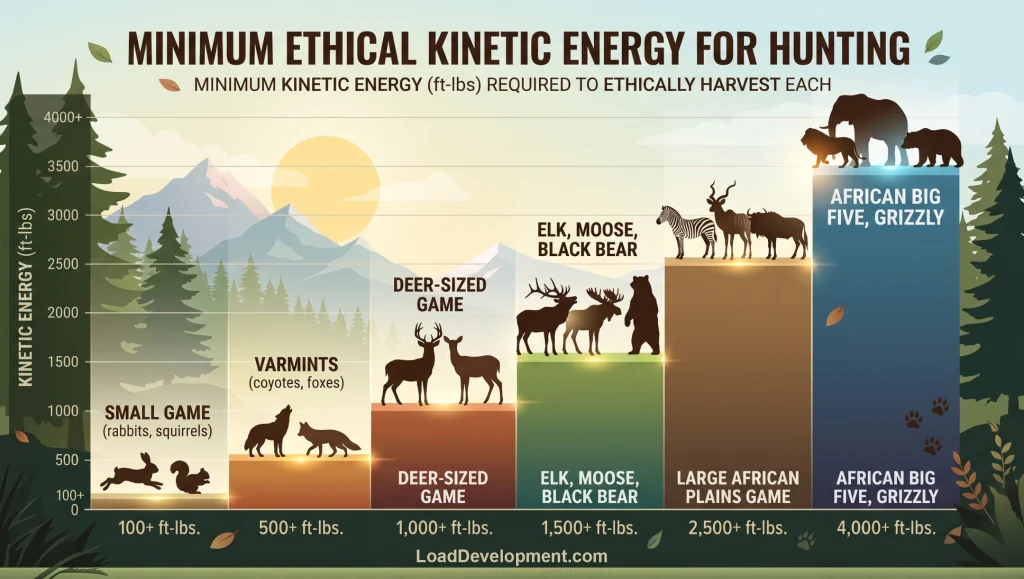
Calculating muzzle energy is critical for hunters. You must ensure your bullet carries enough kinetic energy upon impact to ethically harvest an animal. State wildlife agencies generally recommend the following minimum impact energies:
- Varmints (Coyotes, Foxes): 400 ft-lbs
- Medium Game (Whitetail Deer, Antelope): 1,000 ft-lbs
- Large Game (Elk, Moose, Black Bear): 1,500 ft-lbs
Downrange Energy and Drop Charts
Muzzle energy is only half the story. Because bullets lose velocity as they fly through the air, they also lose kinetic energy. A 6.5 Creedmoor may have 2,266 ft-lbs of energy at the muzzle, but by the time it reaches 500 yards, it may drop below the 1,000 ft-lb threshold required to ethically kill a deer.
To calculate exactly how much energy your bullet retains at specific distances, you need a ballistic solver. Plug your muzzle velocity and your bullet’s Ballistic Coefficient (BC) into Trajek to generate a full drop chart that displays your exact retained energy at every 100-yard interval.
If you find that your current load lacks the energy needed for your hunting distance, use LoadForge to calculate a new internal ballistics node and safely increase your muzzle velocity.
Frequently Asked Questions
Muzzle energy is the measurement of a bullet’s kinetic energy the exact moment it exits the barrel of a firearm. It is the primary indicator of a cartridge’s raw stopping power and is measured in foot-pounds (ft-lbs) in the United States, or Joules in the metric system.
A standard 115-grain 9mm Luger bullet traveling at 1,150 feet per second produces approximately 338 foot-pounds of kinetic energy at the muzzle.
Velocity is mathematically more important. In the kinetic energy formula, velocity is squared, while bullet weight is only a multiplier. Therefore, a small increase in velocity will increase kinetic energy much faster than an equivalent increase in bullet weight.