The 300 PRC vs 300 Win Mag debate comes up constantly in precision shooting circles, and for good reason. Both cartridges push a .30-caliber bullet to magnum velocities, both fit a standard magnum bolt face, and both have earned serious followings. The question worth asking is not which one sounds better on paper, but which one actually works better for your specific use case, whether that is long-range load development, big game hunting, or both.
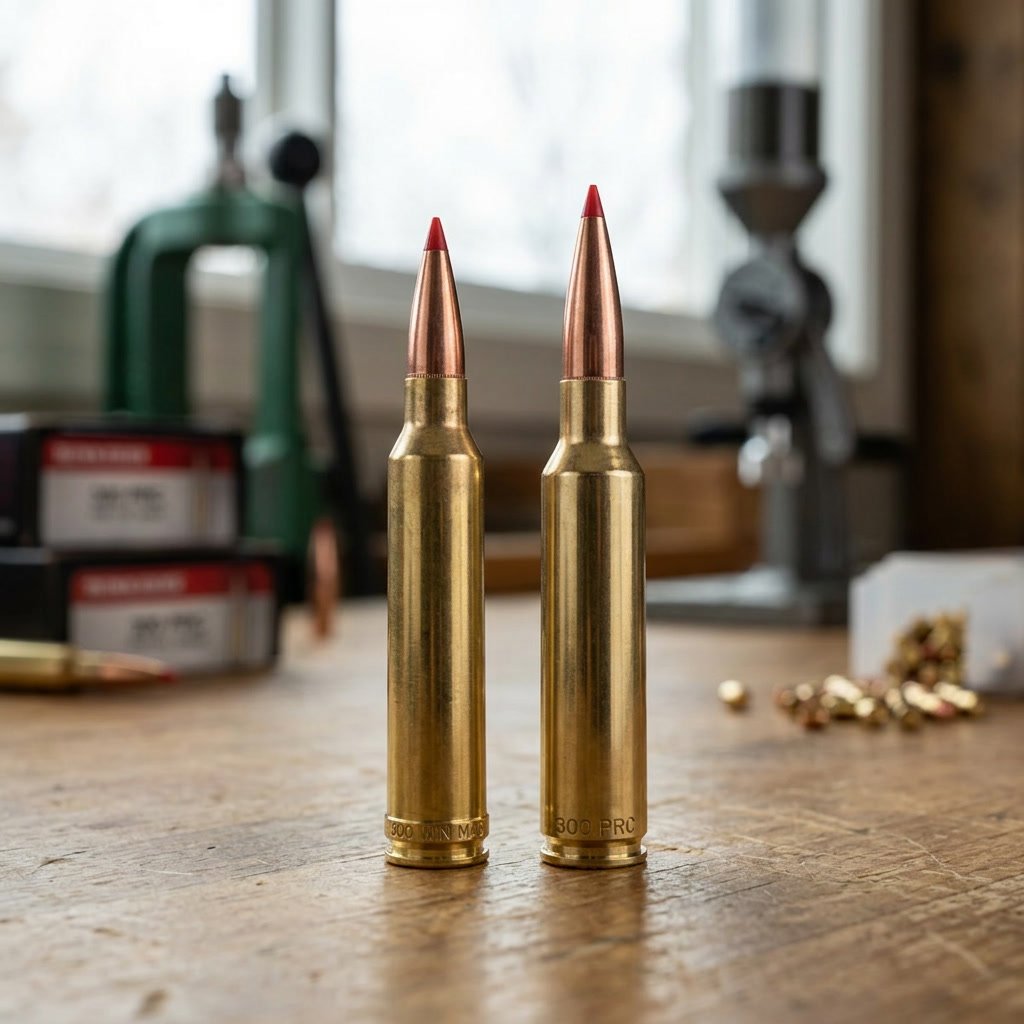
The core difference between these two cartridges is not just ballistics, it is case architecture. The .300 PRC was designed from the ground up to seat heavy, high-BC bullets without sacrificing powder capacity, a problem the .300 Winchester Magnum has always struggled with due to its short neck and belted case design. That distinction matters more to handloaders than almost any factory ammo chart will reveal.
I have worked with both cartridges through the full load development process, from case prep and seating depth testing to final node confirmation over a chronograph. The practical differences show up most clearly at the reloading bench, not just at the range.
Key Takeaways
- The 300 PRC’s beltless case and longer neck give handloaders a meaningful advantage when seating heavy, high-BC bullets without sacrificing usable powder capacity.
- The .300 Win Mag remains the more practical choice for most hunters and shooters due to its wide factory ammo availability, proven terminal performance, and lower cost per round.
- For precision long-range load development targeting 212-grain and heavier projectiles, the 300 PRC’s modern case geometry is a genuine functional improvement, not just a marketing claim.
The Short Answer
The 300 Precision Rifle Cartridge is the more modern design, with measurably better case geometry for heavy-bullet handloading, slightly more powder capacity, and a tighter freebore that supports accuracy. The .300 Winchester Magnum is the more practical, widely available, and cost-effective choice for most shooters, especially hunters. Neither cartridge is universally better; the right answer depends on what you are actually trying to do.
Which One Makes More Sense for Most Shooters
If you are a hunter who buys factory ammo and shoots inside 400 yards, the .300 Win Mag makes more sense. It is available at virtually every sporting goods retailer in the United States, factory load options are extensive, and the per-round cost is significantly lower. Ammo cost for the Win Mag typically runs $1.70 to $2.50 per round across a wide selection, while 300 PRC factory options start closer to $2.76 per round with far fewer choices.
Why Reloaders Often Favor the Newer Design
For handloaders building loads around 212-grain to 230-grain high-BC projectiles, the 300 PRC’s case architecture changes the equation. The longer neck holds heavy bullets without intruding on powder space, and the beltless design headspaces off the shoulder for more consistent sizing and better brass life. These are not minor details at the reloading bench.
When the Older Magnum Still Wins
The .300 Win Mag wins on ammunition availability, rifle selection, and total cost of ownership. It is also fully capable of handling 180-grain to 200-grain loads that perform well on big game at practical hunting distances. For a shooter who does not need to push the limits of heavy-bullet seating depth, the Win Mag’s long track record is hard to argue against.
Case Design and Headspacing
The most important difference between these two cartridges is not velocity or energy, it is how the case is built and how it headspaces. The .300 Win. Mag. carries design compromises inherited from its 1960s lineage, while the 300 PRC was engineered decades later with modern bullets and precision shooting in mind.
Belted Case vs Beltless Magnum Architecture
The .300 Win Mag uses a belted case, a feature inherited from the .375 H&H. That belt exists at the base of the case and controls headspacing, which means the shoulder plays no role in locating the case in the chamber. The 300 PRC uses a beltless design derived from the .375 Ruger, headspacing off a 30-degree shoulder instead. This is a functionally better system for handloaders because the shoulder is what actually controls case positioning during firing and sizing.
How Shoulder Angle Affects Sizing and Brass Life
A sharper shoulder angle combined with shoulder-based headspacing means the 300 PRC case is less likely to stretch excessively on firing. With the .300 Win Mag, belted cases can develop a pressure ring just ahead of the belt after repeated firing and sizing, which shortens brass life and can create inconsistency. Reloaders working the Win Mag need to pay close attention to case gauging and sizing die setup to manage this problem.
Parent Case Lineage From .375 H&H to .375 Ruger
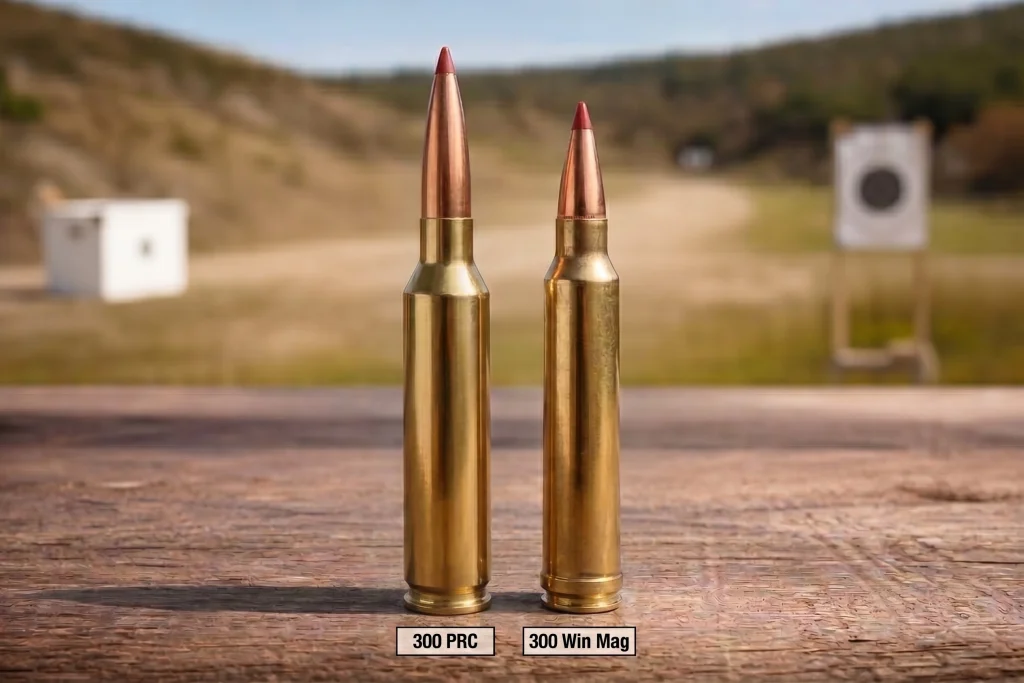
The .300 Win Mag descends from the .338 Winchester Magnum, which came from the .375 H&H. The 300 PRC was built on the .375 Ruger case, which is shorter but wider. Despite being 0.04 inches shorter in case length (2.58 vs 2.62 inches), the PRC’s fatter body gives it roughly 5 more grains of usable powder capacity, around 99 grains versus 94 grains for the Win Mag.
Magnum Bolt Face, Head Height, and Action Fit
Both cartridges use the same 0.532-inch magnum bolt face, so most magnum-length actions and bolt assemblies are compatible with both. This means a rebarreling job between the two is straightforward mechanically. The overall length of the 300 PRC runs to 3.70 inches versus 3.34 inches for the .300 Win Mag, so action length and magazine box dimensions need to be confirmed before a rifle build or conversion.
Bullet Seating, Twist Rate, and Heavy-Bullet Compatibility
Where case design differences become practically visible is in bullet seating, particularly with modern high-BC projectiles. The 300 PRC handles heavy-for-caliber bullets without the seating-depth problems that make load development harder in the .300 Win Mag. Twist rate further shapes which bullets each cartridge can stabilize effectively.
Why Overall Length Changes Bullet Seating Options
The .300 Win Mag was designed with a shorter neck and a SAAMI overall length of 3.34 inches. When you seat a long, heavy bullet like a 210-grain or 212-grain projectile in that case, the bullet shank intrudes significantly into the powder space. This reduces usable powder capacity and can push peak pressure higher for a given charge weight. The 300 PRC, with its 3.70-inch overall length and longer neck, keeps the bullet shank above the case shoulder, preserving more powder space.
Short Neck vs Longer Neck in Real Load Development
The neck length difference is meaningful at the bench. A short neck provides less grip on the bullet, which can affect bullet runout and neck tension consistency, both factors that influence extreme spread and standard deviation in velocity. The 300 PRC’s neck length was specifically designed to hold long, heavy bullets with adequate grip while still allowing them to be seated closer to the lands.
Factory Twist Rate and Rifling Twist Rate Differences
Most factory .300 Win Mag barrels ship with a 1:10 twist rate, which stabilizes bullets up to roughly 200 to 210 grains in most conditions. The 300 PRC is typically chambered with a 1:8 or 1:9 twist, designed to stabilize heavier, longer projectiles including the 212-grain ELD-M and ELD-X from Hornady, as well as 225-grain and heavier options.
Heavy-for-Caliber Bullets and High-BC Projectile Choices
If you want to run a 212-grain Hornady ELD-X or ELD-M out of the .300 Win Mag, you need to confirm your barrel’s twist rate will stabilize that bullet. You also need to accept a compressed or near-maximum load just to reach useful velocities, with the bullet seated deeper than ideal. The 300 PRC was built for exactly this bullet weight class, making load development with high-BC projectiles more straightforward and with more margin.
Ballistic Performance From Muzzle to 1,000 Yards
Raw ballistic numbers tell only part of the story, but they are worth examining carefully when comparing the muzzle velocity, trajectory, and long-range energy retention of these two cartridges. The 300 PRC’s advantage grows with distance, particularly when pairing heavy, high-BC bullets against comparable .300 Win Mag loads.
Muzzle Velocity and Velocity Comparison
A 180-grain .300 Win Mag load typically exits the muzzle at around 3,000 fps, producing approximately 3,600 ft-lbs of energy. A 212-grain 300 PRC load like the Hornady ELD-X runs closer to 2,860 fps at the muzzle, but generates around 3,850 ft-lbs of energy due to the heavier bullet. When comparing equal bullet weights, the PRC generally runs 80 to 120 fps faster than the Win Mag for bullets in the 180 to 200-grain range.
Trajectory, Bullet Drop, and Wind Drift
At 500 yards with a 100-yard zero, the difference in bullet drop between these two cartridges is narrow in comparable configurations. A 180-grain .300 Win Mag load drops around 37 to 45 inches depending on the specific load, while a 212-grain 300 PRC load drops approximately 38 to 46 inches. Wind drift, though, favors the PRC noticeably. With a 10 mph crosswind, the high-BC 212-grain PRC bullet drifts roughly 4 inches less at 500 yards than a 180-grain .300 Win Mag bullet.
Energy Retention and Energy at 1000 Yards
Energy retention past 500 yards is where the PRC’s higher-BC bullets pull ahead clearly. At 500 yards, the 300 PRC retains around 60 percent of its muzzle energy, while the .300 Win Mag retains closer to 50 percent. At 1,000 yards, the gap widens further, with the PRC’s high-BC projectiles carrying more energy and maintaining supersonic velocity more reliably.
| Load | Muzzle Velocity | Muzzle Energy | Drop at 500 yds | Energy at 500 yds |
|---|---|---|---|---|
| .300 Win Mag 180gr | 3,000 fps | ~3,597 ft-lbs | ~37 in | ~1,800 ft-lbs |
| .300 Win Mag 200gr | 2,810 fps | ~3,506 ft-lbs | ~41 in | ~1,950 ft-lbs |
| 300 PRC 212gr ELD-X | 2,860 fps | ~3,850 ft-lbs | ~38 in | ~2,285 ft-lbs |
| 300 PRC 225gr ELD-M | 2,810 fps | ~2,945 ft-lbs | ~39 in | ~2,100 ft-lbs |
Where Flatter Trajectory Actually Matters
For shots inside 400 yards, trajectory differences between these two cartridges are small enough that bullet selection and hold consistency matter far more. The PRC’s real advantage appears at 600 yards and beyond, where its flatter trajectory, lower wind drift, and higher energy retention compound into a meaningful edge. For extreme long range and precision long-range shooting past 800 yards, the 300 PRC’s design delivers a measurable advantage.
The Twist Rate Factor (Why the PRC Wins at 1,000 Yards)
The biggest difference between these two rifles isn’t the brass case; it is the barrel they are attached to.
- 300 Win Mag Standard Twist (1:10): For decades, the industry standard twist rate for a .300 Win Mag has been 1 twist in 10 inches. This perfectly stabilizes 180-grain to 200-grain bullets. However, it struggles to stabilize modern, ultra-long 225-grain+ bullets.
- 300 PRC Standard Twist (1:8 or 1:8.5): Hornady designed the 300 PRC specifically to spin heavy, ultra-high BC bullets. The faster twist rate ensures perfect gyroscopic stability for massive 212gr ELD-X and 225gr ELD-M bullets.
(Before you build a custom magnum, always run your bullet data through our Twist Rate Stability Calculator to ensure your barrel will stabilize your chosen projectile).
300 PRC vs 300 Win Mag Ballistics Chart
To see why the 300 PRC’s ability to shoot heavier bullets matters, we must look at the external ballistics.
Below is a comparison using a standard 200-grain load for the 300 Win Mag versus a 225-grain load for the 300 PRC, both fired from 24-inch barrels with a 100-yard zero and a 10 mph crosswind.
| Metric | 300 Win Mag (200gr ELD-X) | 300 PRC (225gr ELD-M) |
|---|---|---|
| Muzzle Velocity | 2,850 FPS | 2,810 FPS |
| Drop at 500 Yards | -42.8 inches | -43.1 inches |
| Drop at 1,000 Yards | -245.1 inches | -238.5 inches |
| Wind Drift at 1,000 Yds | 68.2 inches | 59.4 inches |
| Energy at 1,000 Yards | 1,350 ft-lbs | 1,620 ft-lbs |
The Takeaway: While the 300 Win Mag starts slightly faster (due to the lighter bullet), the massive 225-grain bullet of the 300 PRC cuts through the wind significantly better (almost 10 inches less drift at 1,000 yards) and retains nearly 300 ft-lbs more energy at a grand. Calculate your exact bullet energy on our free Muzzle Energy Calculator.
(To run custom drop charts for your specific environment, download one of our recommended Ballistic Solvers).
Powder Choice, Barrel Length, and Real-World Load Development
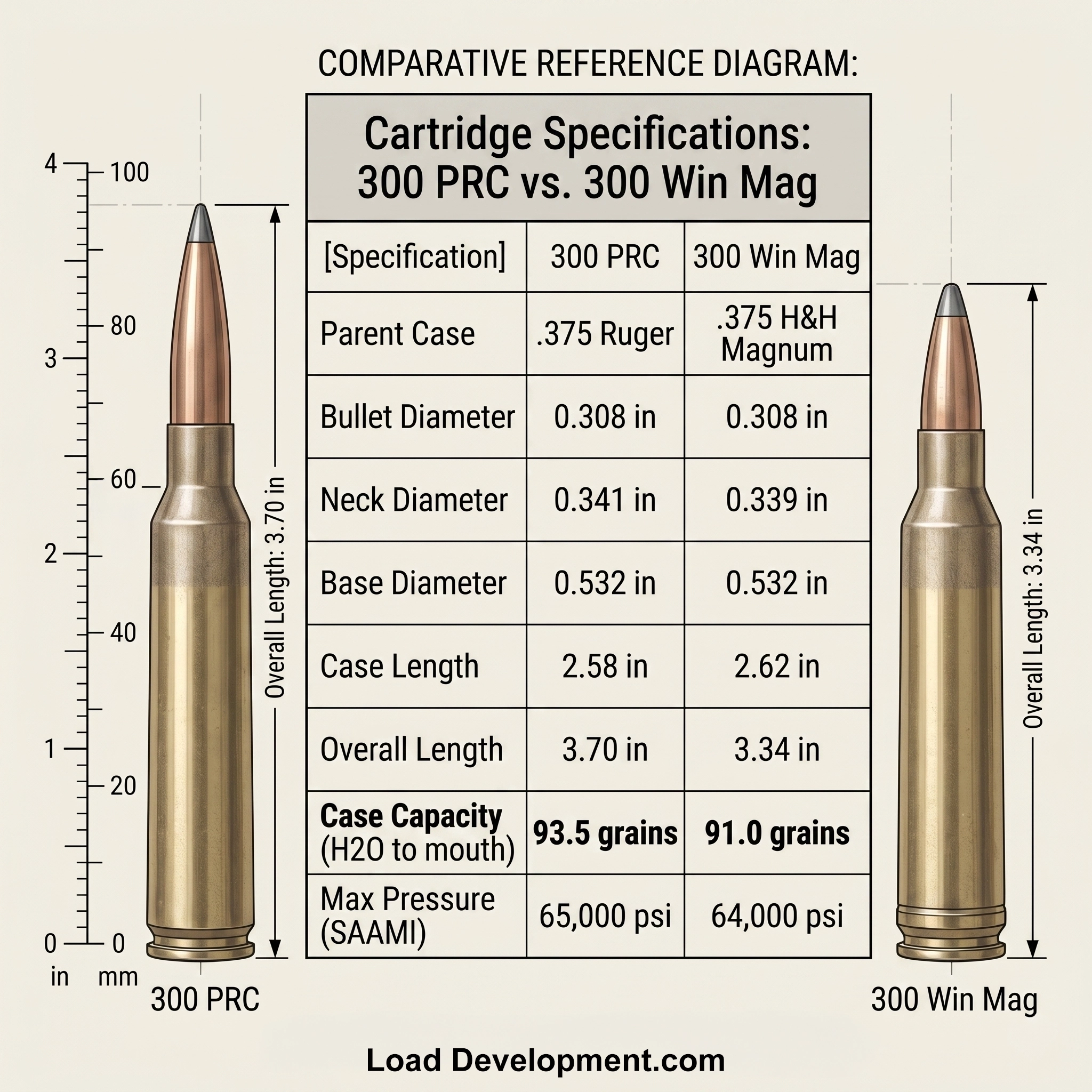
Both cartridges demand slow-burning magnum powders and longer barrels to reach their potential. Understanding how case capacity, seating depth, and barrel length interact is central to effective load development with either cartridge.
Slow Magnum Powders and Case Fill Considerations
Both the .300 Win Mag and the 300 PRC perform best with slow-burning powders in the H1000, Retumbo, and IMR-7977 range. These powders allow a full or near-full case fill, which supports consistent ignition and lower extreme spread. The 300 PRC’s approximately 5-grain capacity advantage means you can run slightly heavier charges of the same powder for more velocity, or reach a similar velocity with less pressure in some load scenarios.
How Seating Depth Affects Usable Powder Space
This is where the Win Mag’s short neck creates a practical problem during handloading. Seating a long, heavy bullet deep enough to meet SAAMI overall length specifications pushes the bullet shank into the powder column, reducing the effective case volume. I have seen this cost 2 to 4 grains of usable powder capacity compared to a properly seated load in the 300 PRC with the same bullet weight. That directly affects your pressure curve and velocity ceiling.
Barrel Length, Pressure, and Velocity Tradeoffs
A 26-inch barrel is the practical standard for both cartridges in precision configurations. Dropping to 24 inches typically costs 40 to 60 fps depending on the powder and bullet combination. The 300 PRC’s larger case volume means it loses slightly more velocity per inch of barrel loss than the Win Mag. Barrel life for both cartridges runs in the 1,500 to 2,000-round range under normal use conditions, with heavier loads accelerating throat erosion.
Consistency, Extreme Spread, and Barrel Life
In my own load development work, the 300 PRC tends to reach single-digit standard deviations more easily when the load is positioned at or near the right node. Part of this is the more consistent headspacing and the ability to seat bullets with adequate neck tension without the belt-related sizing issues that can creep into Win Mag brass after several firings. Consistent neck tension and repeatable sizing are foundational to low extreme spread, and the PRC’s architecture supports both.
Hunting, Recoil, and Practical Buying Considerations
Both cartridges are effective on big game, but they differ in ways that matter for hunting applications, particularly in factory ammo access, recoil management, and how they compare against the broader .30-caliber magnum field. The 300 PRC leads on long-range terminal performance potential, while the .300 Win Mag leads on cost and accessibility.
Terminal Performance on Big Game
At typical hunting distances inside 400 yards, both cartridges deliver more than enough energy and sectional density to cleanly take elk, moose, and similar large North American game. The 300 PRC’s higher energy retention gives it a meaningful edge for shots beyond 500 yards, carrying over 2,200 ft-lbs at that distance compared to around 1,800 ft-lbs for the .300 Win Mag with a 180-grain load. For long-range hunting specifically, the PRC’s terminal performance advantage is real and consistent.
Recoil, Muzzle Brake, and Shooter Comfort
Both cartridges produce substantial recoil, typically in the 25 to 30 ft-lbs range in similar rifle weights. The 300 PRC, with its larger powder charge and heavier bullets, tends to run at the higher end of that range. A muzzle brake reduces felt recoil significantly for either cartridge and is worth considering for extended range sessions or shooters sensitive to recoil. Without a brake, both cartridges demand consistent shooting form to maintain accuracy under fatigue.
Factory Ammo Selection and Ammunition Availability
The .300 Win Mag has a significant and practical advantage here. Factory loads are available at most sporting goods retailers nationwide, with options spanning budget hunting rounds to premium match-grade ammunition. The 300 PRC selection has grown since its 2018 introduction, but it remains limited compared to the Win Mag. Fewer factory options and higher per-round cost make the PRC more dependent on handloading for cost-effective use.
How They Compare With Other Popular .30-Caliber Magnums
| Cartridge | Case Type | Powder Capacity | Heavy Bullet Capability | Ammo Availability |
|---|---|---|---|---|
| .300 Win Mag | Belted | ~94 gr | Moderate | Excellent |
| 300 PRC | Beltless | ~99 gr | High | Limited |
| 300 WSM | Beltless | ~88 gr | Moderate | Good |
| 30 Nosler | Beltless | ~100 gr | High | Limited |
| 300 Norma Magnum | Beltless | ~108 gr | Very High | Very Limited |
| 300 Weatherby | Belted | ~103 gr | High | Limited |
| 300 Remington Ultra Magnum | Beltless | ~110 gr | Very High | Very Limited |
The 300 PRC sits in a practical middle ground, outperforming the .300 Win Mag on heavy-bullet capability while remaining more accessible than the 300 Norma Magnum or 300 Remington Ultra Magnum. The 338 Lapua Magnum is a different class entirely, moving to a heavier caliber with substantially more recoil and cost.
300 PRC Problems
The “bolt click” issue common in 300 PRC (and other PRC-family) rifles is a primary extraction hang-up caused by a mismatch between the chamber’s dimensions and standard resizing dies. Because the 300 PRC is a high-performance, non-belted magnum, the brass at the case web (the thick area just above the extractor groove) undergoes significant expansion under pressure. Standard full-length resizing dies often fail to address this because they feature a chamfered mouth and are physically stopped by the shell holder before they can reach the very bottom of the brass. This leaves a small “ring” of unsized material at the base. Over multiple firings, this web area work-hardens and expands until it “wedges” into the rear of the chamber, requiring significant force to break the bolt free—resulting in that distinct, tactile “click” during bolt lift.
Recommended Equipment to Fix the Issue
To resolve this, you typically need tools that size closer to the base or a chamber adjustment to allow more clearance:
- Short Action Customs (SAC) Modular Sizing Die: Specifically designed with tighter tolerances at the base to size further down the web than standard dies.
- Redding Small Base Body Die: A dedicated die used solely to squeeze the lower body and web area back to a smaller-than-standard diameter.
- Whidden Gunworks Custom Dies: Often recommended for PRC shooters to ensure the die is perfectly matched to their specific chamber’s dimensions.
- Alex Wheeler (AW2) Reamer: For a permanent fix on the rifle side, many gunsmiths use an “AW” (Alex Wheeler) spec reamer or a polishing hone to slightly open the base of the chamber, providing the necessary clearance for fired brass to spring back without binding.
This video demonstrates a hands-on method for addressing the “clicker” issue through chamber honing, providing a visual guide to the physical binding problem discussed.
Frequently Asked Questions

AJ Deysel is a competitive rifle shooter in the PRS and NRL Hunter series, a lifelong hunter, and a recognized ballistics specialist whose load development expertise has been featured by industry leaders like Hornady. He is the founder and lead editor of LoadDevelopment.com. Read more about AJ or view our Editorial & Testing Guidelines.