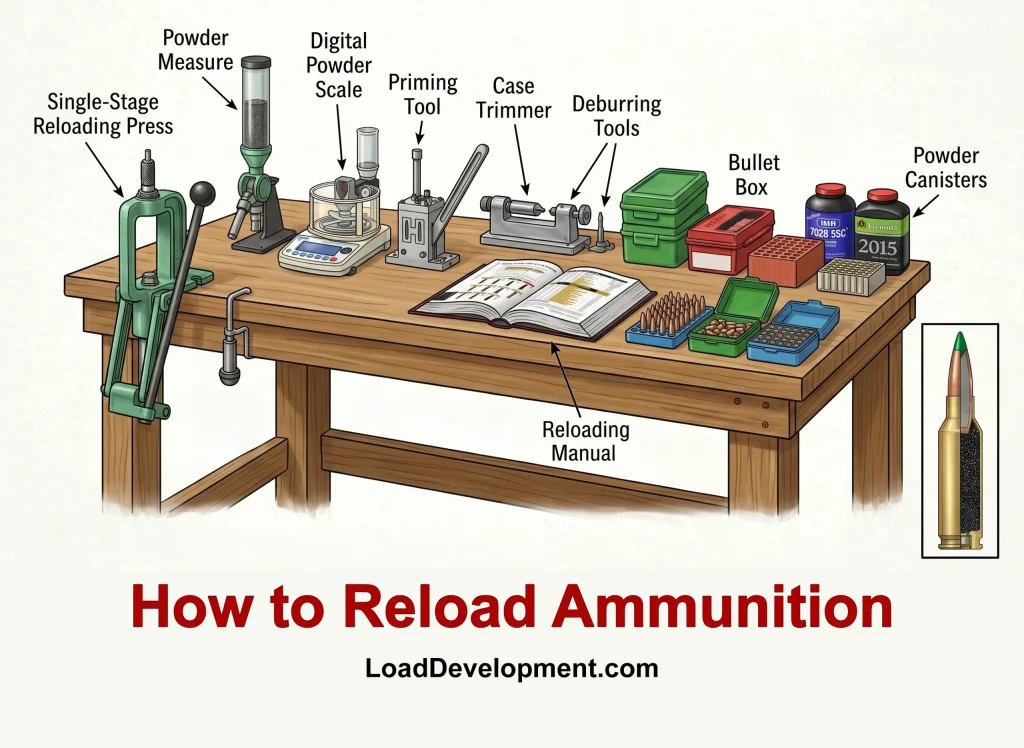
Whether you are buying your first box of 9mm or starting to explore reloading, knowing what are the basic parts of ammunition gives you a foundation for every decision that follows. A standard cartridge contains four components: the case, the primer, the propellant (powder), and the projectile (bullet). Shotshells add a fifth part, the wad. Each piece has a specific job during firing, and none of them work without the others.

If you can identify these basic parts of ammunition and explain what each one does, you will make smarter choices at the ammo counter, communicate more clearly at the range, and set yourself up to understand reloading when the time comes. This guide walks through every component in detail, from the cartridge case to the primer to the powder charge to the projectile itself, then gives shotgun shells their own dedicated section so nothing gets lost in translation.
Along the way, you will encounter terms like headstamp, primer pocket, flash hole, Boxer primer, burn rate, and terminal performance. None of them are complicated once you see where they fit. The goal is to build your vocabulary one layer at a time, starting with the parts you can see and touch, then moving into the mechanics that happen in the fraction of a second after you press the trigger.
Handloading is simply the process of pressing a primer into the case, pouring the powder into the case and then seating the bullet into the case, thus forming the complete ready to fire cartridge. For the details and specifications of each step of that process, ready our Beginner’s Guide to Reloading.
Bullet vs. Cartridge: The Terms That Matter
The single most common terminology mistake in the shooting world is calling the entire round a “bullet.” The bullet is only the projectile that leaves the barrel; the complete assembly you load into a firearm is a cartridge or round. Getting this distinction right from the start will save you confusion every time you read a product label, a reloading manual, or a ballistics chart.
What Counts as a Complete Round
A complete round of ammunition, also called a cartridge, includes four parts: the cartridge case (casing), the primer, the propellant charge, and the projectile. When all four are assembled and ready to chamber, you have a live round. Remove any one of those components and the round cannot function. You will often hear people say “ammo,” “rounds,” or “loads,” and in most contexts they all refer to this same assembled unit.
Why the Bullet Is Only One Component
The bullet is the metal projectile seated into the mouth of the cartridge case. It is the only part that travels downrange. Everything else, the case, primer, and powder, stays behind in or near the firearm. When someone asks you to “hand me a bullet,” they almost certainly mean a cartridge. Correcting this in your own vocabulary is a small step that signals you know what you are talking about.
Where Shotshells Fit Into Ammo Terminology
Shotgun ammunition uses its own naming conventions. A shotgun shell, properly called a shotshell, functions on the same principles as a rifle or handgun cartridge but adds a fifth component: the wad. Shotshells are also sometimes called “shells” or “rounds.” You will rarely hear anyone call a shotshell a “cartridge” in casual conversation, though technically the term applies. The key takeaway is that whether you are handling a 9mm cartridge or a 12 gauge shotshell, the same basic logic applies: a case holds a primer, a powder charge, and one or more projectiles.
The Cartridge Case: Structure, Seal, and Case Features
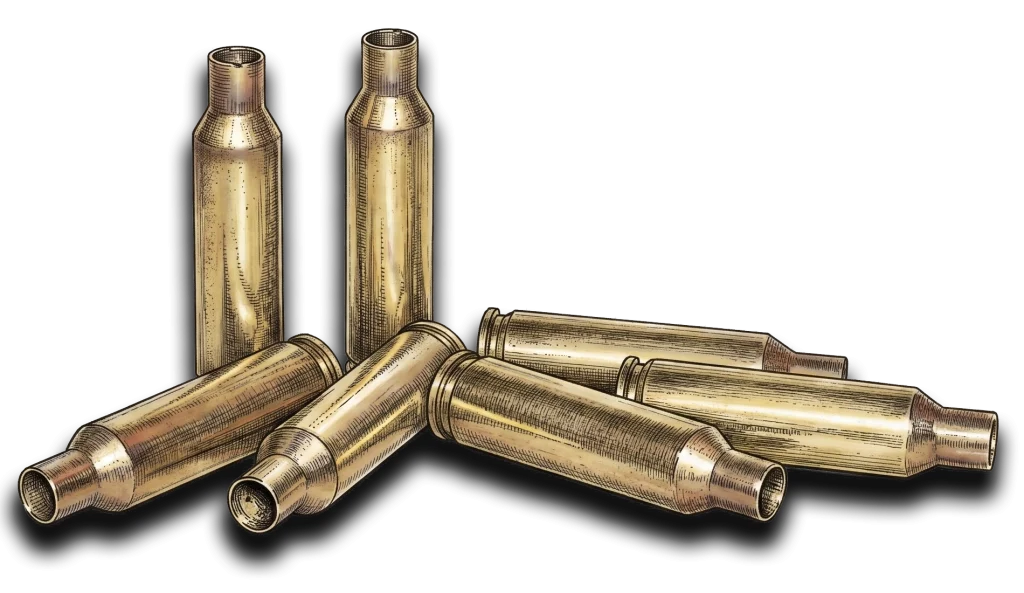
The cartridge case is the container that holds every other component together. It positions the primer at the base, contains the powder charge inside its walls, and grips the projectile at its mouth. Beyond simple containment, the case also seals the chamber during firing to prevent gas from escaping rearward, a function that directly affects both safety and performance.
How the Case Holds the Assembly Together
When you chamber a round, the case centers everything in the correct position. The base sits against the bolt face, the primer pocket aligns with the firing pin channel, and the case neck grips the bullet with enough tension to stay put until pressure forces it out. Upon ignition, the brass (or steel) walls expand against the chamber walls, creating a gas-tight seal. That seal directs all expanding gas forward, behind the projectile, where it does useful work.
Brass vs. Steel vs. Other Case Materials
Most centerfire rifle and handgun ammunition uses brass cases. Brass is easy to form, resists corrosion, and springs back slightly after firing, which makes extraction reliable. It is also the preferred material for reloading because it can be resized and reloaded multiple times.
Steel-cased ammo is cheaper to manufacture and common in imported military-surplus rounds. Steel does not resize as cleanly, so most reloaders avoid it. You will also encounter aluminum cases (typically in budget handgun ammo) and nickel-plated brass, which offers corrosion resistance and smoother feeding. If reloading is in your future, stick with brass.
There is now also newer alloy steel cases being developed by manufacturers like Federal allowing higher chamber pressures in standard rifle chambers and faster velocities from the same cartridges than with brass cases. Originally designed and developed for military use, civilian ammunition is starting to become available in it too.
Rim, Shoulder, and Headstamp Basics
The rim is the flange at the base of the case. It gives the extractor something to grab when pulling a spent case from the chamber. Cases are classified by rim type: rimmed, semi-rimmed, rimless, rebated, and belted. Most modern rifle and handgun cartridges, like .223 Remington and .308 Winchester, are technically “rimless,” meaning the rim is the same diameter as the case body.
The shoulder is the angled section where a bottleneck case tapers down to the neck. It helps position the cartridge at the correct depth in the chamber. Straight-walled cases, like many handgun rounds, lack a shoulder entirely.
The headstamp is the text and symbols stamped into the base. It typically shows the manufacturer and the caliber designation. Always check the headstamp to confirm you are loading the correct ammo for your firearm.
Primer Pocket and Flash Hole Explained
At the center of the case base sits the primer pocket, a small cup-shaped recess that holds the primer. Directly behind the primer pocket, inside the case, you will find the flash hole, a small passage that allows the primer’s flame to reach the powder charge.
Boxer-primed cases (standard in U.S.-made ammo) have a single, centered flash hole, which makes them straightforward to deprime and reload. Berdan-primed cases have two smaller flash holes and an integral anvil, making reloading impractical for most people. When you inspect a spent case for reloading potential, the primer pocket and flash hole design tell you immediately whether that brass is worth saving.
The Primer: Ignition and Primer Types
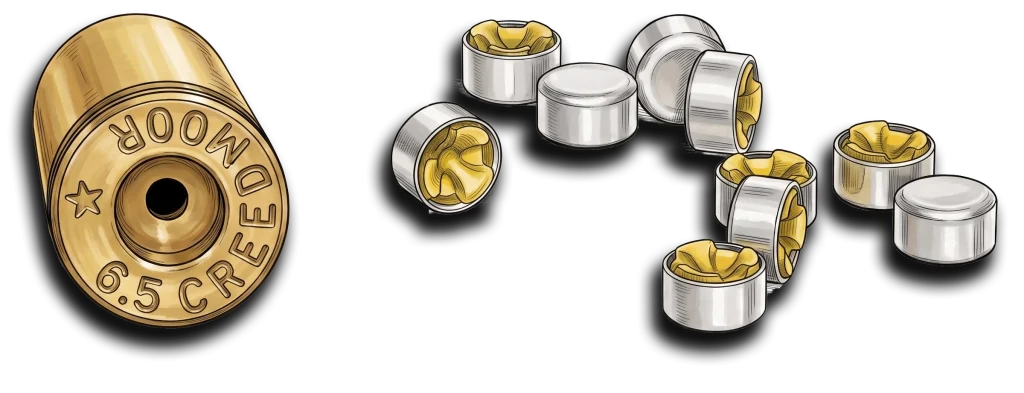
The primer is a small but critical component seated in the base of the cartridge. It contains a pressure-sensitive chemical compound that detonates when struck by the firing pin, producing a hot flash of flame that ignites the powder charge. Without a functioning primer, nothing else happens.
What the Primer Does During Firing
When you pull the trigger, the firing pin strikes the primer. That impact crushes the priming compound against a tiny anvil, causing a small, controlled detonation. The resulting flame passes through the flash hole and into the case body, where it lights the propellant. This entire sequence takes only a few milliseconds. A reliable primer means consistent ignition; a weak or contaminated primer can cause a misfire or a hangfire, both of which are safety concerns you should take seriously.
Centerfire vs. Rimfire Ammunition
The two broad categories of ammunition are defined by where the primer sits.
In centerfire ammunition, the primer is a separate, replaceable cup pressed into the center of the case base. Examples include 9mm, .223 Remington, .308 Winchester, and virtually every modern rifle and handgun cartridge above .22 caliber. Centerfire primers are available in small and large sizes for both pistol and rifle applications.
In rimfire ammunition, the priming compound is spun into the inside rim of the case base. The firing pin strikes the rim itself, crushing the compound to create ignition. The .22 Long Rifle is the most common rimfire cartridge in the world. Rimfire cases cannot be reloaded because the rim is permanently deformed after firing. Rimfire rounds are generally limited to smaller, lower-pressure calibers.
Boxer and Berdan Primer Differences
Within centerfire ammunition, there are two primer designs you should know.
Boxer primers (standard in American-made ammo) contain their own built-in anvil and sit over a single central flash hole. This design makes spent primers easy to punch out with a simple decapping pin, which is why reloaders prefer Boxer-primed brass.
Berdan primers use an anvil that is part of the case itself, with two smaller flash holes positioned off-center. Berdan priming is common in European and military-surplus ammunition. While technically reloadable, the process is tedious enough that most handloaders skip Berdan brass entirely.
If you pick up range brass and want to know which type it is, look down into the case mouth with a light. One central flash hole means Boxer. Two offset holes mean Berdan.
The Propellant: Powder, Burn Rate, and Pressure
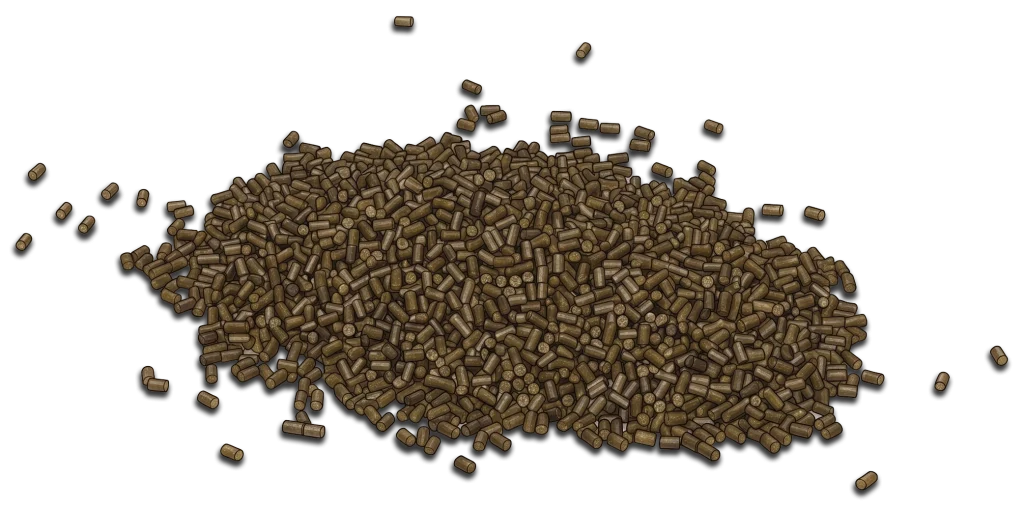
Propellant is the chemical engine of the cartridge. Once the primer’s flame reaches the powder charge, the propellant burns rapidly, producing a large volume of expanding gas that accelerates the projectile down the barrel. The type, amount, and shape of the powder you use directly influence velocity, pressure, and accuracy.
How Powder Drives the Projectile
When the propellant ignites, it does not explode; it deflagrates, meaning it burns extremely fast in a controlled, progressive manner. The expanding gas builds pressure behind the projectile’s base, pushing it forward through the barrel. Peak chamber pressure in a typical rifle cartridge like .308 Winchester can exceed 60,000 psi. All of that force is generated and spent in just a few inches of barrel travel.
Smokeless Powder vs. Black Powder
Modern ammunition uses smokeless powder, a nitrocellulose-based propellant that burns cleaner, produces higher velocities, and generates more consistent pressures than the alternative. It leaves far less fouling in the bore.
Black powder is the original firearm propellant, a mixture of potassium nitrate, charcoal, and sulfur. It burns at lower pressures, produces heavy white smoke, and leaves corrosive residue. You will encounter black powder in muzzleloaders and historical replicas, but it has no role in modern cartridge ammunition. Never substitute one for the other; smokeless powder in a black powder firearm can cause catastrophic failure.
Burn Rate, Velocity, and Ballistics
Burn rate describes how quickly a given powder converts to gas. Fast-burning powders reach peak pressure quickly and are suited for short-barreled handguns and small-capacity cases. Slow-burning powders sustain pressure over a longer barrel length, making them ideal for magnum rifles and long-range cartridges.
Matching the right burn rate to your cartridge and barrel length is fundamental to safe, accurate loading. A powder that burns too fast can spike pressure dangerously. A powder that burns too slow may not fully combust, wasting energy and fouling the barrel. Published load data from powder manufacturers exists precisely to keep you in the safe zone.
Powder Shapes and Load Performance
Smokeless powder comes in distinct grain shapes, each engineered for specific performance characteristics.
- Ball (spherical) powder meters easily through volumetric powder measures, making it popular for progressive reloading.
- Extruded (stick) powder offers precise burn rate control and is favored in many rifle cartridges for accuracy.
- Flake powder burns quickly and is commonly used in shotshells and handgun loads.
The surface area of each grain shape affects how uniformly the charge ignites and how pressure builds. When you start reloading, you will learn that even small differences in powder charge weight, measured in grains (1 grain = 1/7000 of a pound), can shift velocity and pressure meaningfully. Precision matters.
The Projectile: Bullet Construction and Performance
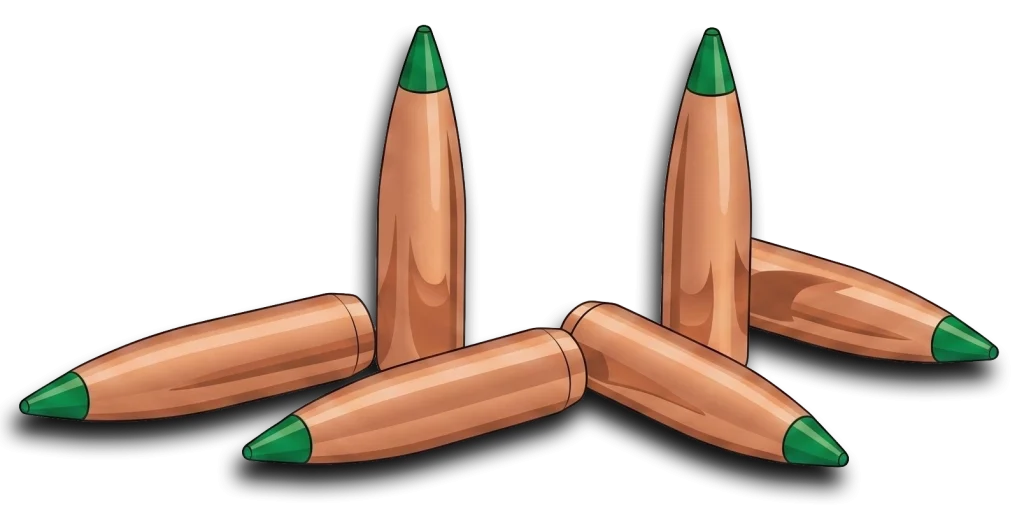
The projectile is the only part of the cartridge that reaches the target. Its design, weight, and construction determine how it behaves in flight and what it does upon impact. Choosing the right bullet for your application, whether target shooting, hunting, or self-defense, is one of the most consequential decisions you will make when selecting ammunition.
Basic Bullet Anatomy for New Shooters
A typical bullet has three visible zones. The tip (or nose) is the front, shaped to manage aerodynamic drag. The bearing surface is the cylindrical midsection that contacts the rifling in the barrel, imparting spin for stability. The base is the rear, which receives the full force of propellant gas.

Inside, most bullets consist of a lead core surrounded by a copper jacket. Some designs use bonded cores, solid copper construction, or segmented internal structures, but the core-and-jacket arrangement remains the most common starting point. When someone says “bullet,” this is the specific component they should mean.
Full Metal Jacket, Hollow Point, and Soft Point
These are the three bullet types you will encounter most often.
- Full Metal Jacket (FMJ): A lead core completely enclosed by a copper jacket. FMJ bullets are inexpensive, feed reliably, and are the standard choice for target shooting and training. They do not expand on impact.
- Hollow Point (HP): Features a cavity in the tip designed to initiate expansion upon hitting soft tissue. Hollow point bullets are the go-to for self-defense handgun ammunition and many hunting applications.
- Soft Point (SP): Has an exposed lead tip with a partial copper jacket. Soft points expand more gradually than hollow points, offering a balance of penetration and expansion. They are popular for hunting medium-sized game.
Other specialized types include ballistic tip, bonded, partition, and armor-piercing ammunition, each engineered for a specific task.
Bullet Weight, Caliber, and Intended Use
Bullet weight is measured in grains. Heavier bullets generally retain energy better at distance but may start at lower velocities. Lighter bullets achieve higher speeds and flatter trajectories but can shed energy faster.
Caliber refers to the projectile’s diameter. A 9mm bullet is approximately 9 millimeters across. A .308 Winchester fires a bullet roughly .308 inches in diameter. Caliber and bullet weight together define the cartridge’s character.
For target shooting, you typically want an accurate, affordable bullet, often an FMJ. For hunting, you want controlled expansion matched to the size of your game. Selecting the right weight and type for the job is more important than chasing the newest marketing trend.
Penetration, Expansion, and Terminal Performance
Terminal performance describes what the bullet does after it hits the target. Three factors matter most:
- Penetration is the depth the bullet reaches. Insufficient penetration means the bullet stops before reaching vital structures. Excessive penetration means wasted energy and potential collateral risk.
- Expansion is the degree to which the bullet’s frontal diameter increases. Expansion creates a larger wound channel and transfers more energy to the target.
- Weight retention is how much of the original bullet mass stays intact. Bullets that fragment aggressively may not penetrate deeply enough; bullets that hold together too rigidly may not expand adequately.
Balancing these three variables is the central challenge of bullet design. For self-defense, the FBI standard calls for 12 to 18 inches of penetration in calibrated ballistic gelatin. For hunting, you want enough expansion to create a humane, quick harvest while retaining enough mass to reach vital organs.
Common Rifle Cartridge Sizes
| Cartridge Name | Action Size | Bullet Diameter | Case Length | Typical Use |
|---|---|---|---|---|
| .223 Remington | Mini Action | 0.224″ | 1.760″ | Varmint / Target |
| 6.5 Creedmoor | Short Action | 0.264″ | 1.920″ | Target / Medium Game |
| .308 Winchester | Short Action | 0.308″ | 2.015″ | Target / Medium Game |
| .270 Winchester | Long Action | 0.277″ | 2.540″ | Medium / Large Game |
| .30-06 Springfield | Long Action | 0.308″ | 2.494″ | Medium / Large Game |
| .300 Win Mag | Magnum Action | 0.308″ | 2.620″ | Large Game / Long Range |
Shotgun Shell Anatomy and Choosing the Right Load
Shotgun ammunition operates on the same ignition principle as rifle and handgun cartridges but adds complexity with a fifth component and a wider variety of projectile options. Knowing the five main parts of a shotshell, plus how to match loads to your purpose, puts you ahead of most casual shotgun owners.
The Five Main Parts of a Shotshell
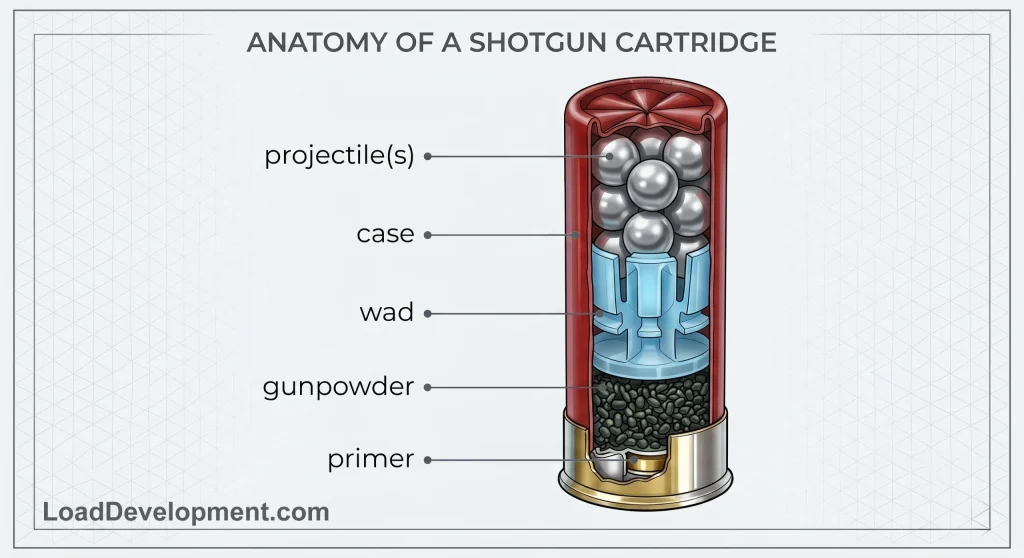
A complete shotshell contains five components:
- Hull (case): Usually plastic with a brass or steel base. It holds everything together, similar to a cartridge case.
- Primer: Seated in the base, identical in function to a centerfire primer.
- Powder: A fast-burning propellant charge, typically flake or ball powder.
- Wad: A plastic or fiber cup that sits between the powder and the shot charge.
- Projectile(s): Either multiple pellets (shot) or a single solid projectile (slug).
A standard 12 gauge shell illustrates all five clearly. The hull is roughly 2¾ inches long, the primer is visible in the brass base, and a star crimp at the mouth seals the shot and wad inside.
Why the Wad Matters
The wad is the component that separates shotshells from metallic cartridges. It serves three roles: it seals propellant gas behind the shot column, cushions the pellets from the initial acceleration spike, and keeps the pellets organized as they travel down the barrel. Without the wad, gas would blow through the shot charge unevenly, producing erratic patterns and lower velocity. A quality wad is the single biggest contributor to a consistent shot pattern at the target.
Shot, Slug, and Wadding Differences
Shot refers to multiple small pellets, ranging from tiny #9 birdshot to large 00 buckshot. The number and size of pellets determine effective range and application. Birdshot works for clays and small game; buckshot is used for close-range defense and large game.
A slug is a single, large projectile, essentially turning your shotgun into a short-range rifle. Slugs are common for deer hunting in regions where rifle use is restricted.
Wadding is sometimes used to describe fiber or felt components in older-style shells, but in modern loads the plastic wad cup handles all the functions previously spread across multiple fiber wads.
Common Examples for Handgun, Rifle, and Shotgun Loads
Putting everything together with real-world examples helps connect these concepts:
| Type | Example | Key Components |
|---|---|---|
| Handgun | 9mm Luger FMJ | Brass case, small pistol primer, fast-burn powder, 115-gr FMJ bullet |
| Rifle | .223 Remington | Brass case, small rifle primer, medium-burn powder, 55-gr FMJ or SP bullet |
| Rifle | .308 Winchester | Brass case, large rifle primer, slow-burn powder, 168-gr match bullet |
| Rimfire | .22 Long Rifle | Brass rimfire case, priming compound in rim, fast powder, 40-gr lead bullet |
| Shotgun | 12 Gauge, 2¾” | Plastic hull, 209 primer, fast-burn powder, plastic wad, #8 birdshot |
Notice how the principles are identical across all types. Only the specifics of case geometry, primer size, powder charge, and projectile design change.
Storage and Selection Basics for Everyday Use
Choosing the right ammunition starts with your firearm’s manual. Match the caliber or gauge stamped on the barrel exactly. Never guess.
For storage, keep your ammo in a cool, dry location away from solvents and extreme heat. A sealed ammo can or a quality plastic storage box works well. Properly stored modern ammunition can remain reliable for decades.
When selecting loads, think about your purpose first:
- Target shooting and training: prioritize affordability and reliability (FMJ for handguns and rifles, light birdshot for shotguns).
- Self-defense: choose quality hollow point handgun ammo or buckshot for shotguns.
- Hunting: match bullet or shot type to the game species and local regulations.
- Precision and long-range shooting: invest in match-grade ammo with consistent bullet weight and powder charges.
Starting with these guidelines keeps you safe, legal, and effective with every trip to the range or field.
Frequently Asked Questions
A standard rifle or handgun cartridge contains four basic components: the cartridge case, the primer, the propellant (powder), and the projectile (bullet). The case holds everything together, the primer provides ignition, the powder generates gas pressure, and the bullet is the part that travels downrange toward the target.
When you press the trigger, the firing pin strikes the primer, which detonates and sends a flame through the flash hole into the case. That flame ignites the propellant, producing rapidly expanding gas that pushes the bullet out of the case neck, through the barrel, and toward the target. The entire sequence takes only a few milliseconds.
In centerfire cartridges, a separate primer is seated in a pocket at the center of the case base and can be replaced during reloading. In rimfire cartridges like the .22 Long Rifle, the priming compound is built into the rim of the case itself, so the firing pin strikes the rim instead of the center. Rimfire cases cannot be reloaded.
Bullet construction, weight, velocity, and shape all influence terminal performance. A hollow point bullet is designed to expand and transfer energy into a target, while a full metal jacket maintains its shape and penetrates deeply. Matching the right bullet type to your intended purpose, whether self-defense, hunting, or target practice, is critical for safe, effective results.
Always verify the caliber or gauge designation stamped on your firearm’s barrel and match it exactly to the ammunition you purchase. Beyond caliber, consider your intended use: FMJ for affordable range training, hollow points for personal defense, and soft points or specialty bullets for hunting. Check your firearm’s owner manual for any additional pressure or load restrictions.
A shotgun shell, or shotshell, has five main components: the hull (case), the primer, the powder charge, the wad, and the projectile or projectiles. The wad is the additional part not found in rifle or handgun cartridges; it seals gas behind the shot, cushions the pellets during acceleration, and helps produce a consistent shot pattern at the target.

AJ Deysel is a competitive rifle shooter in the PRS and NRL Hunter series, a lifelong hunter, and a recognized ballistics specialist whose load development expertise has been featured by industry leaders like Hornady. He is the founder and lead editor of LoadDevelopment.com. Read more about AJ or view our Editorial & Testing Guidelines.