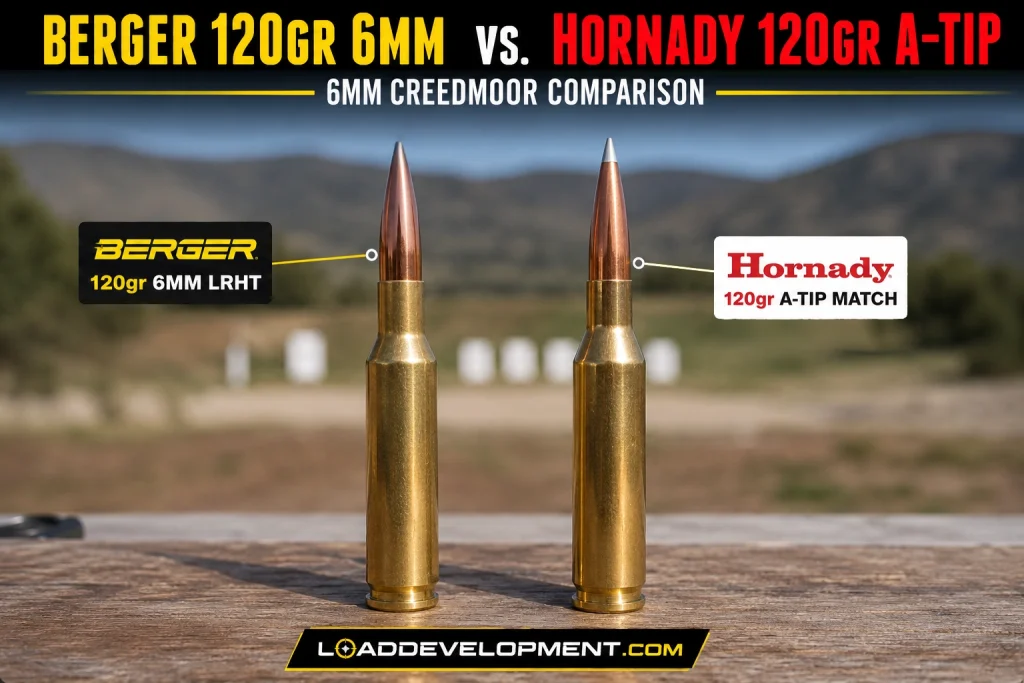
Two heavyweight .243-caliber match bullets now sit on the same shelf, and both want the same job: pushing a 6mm cartridge into wind-drift territory that used to belong to 6.5mm. Berger’s 6mm 120 grain Long Range Hybrid Target carries a published 0.328 G7 BC and a 0.657 G1, figures the company calls the highest in class for a .243 projectile. Hornady’s 120-grain 6mm A-Tip Match arrives with the same weight target and a very different design philosophy.
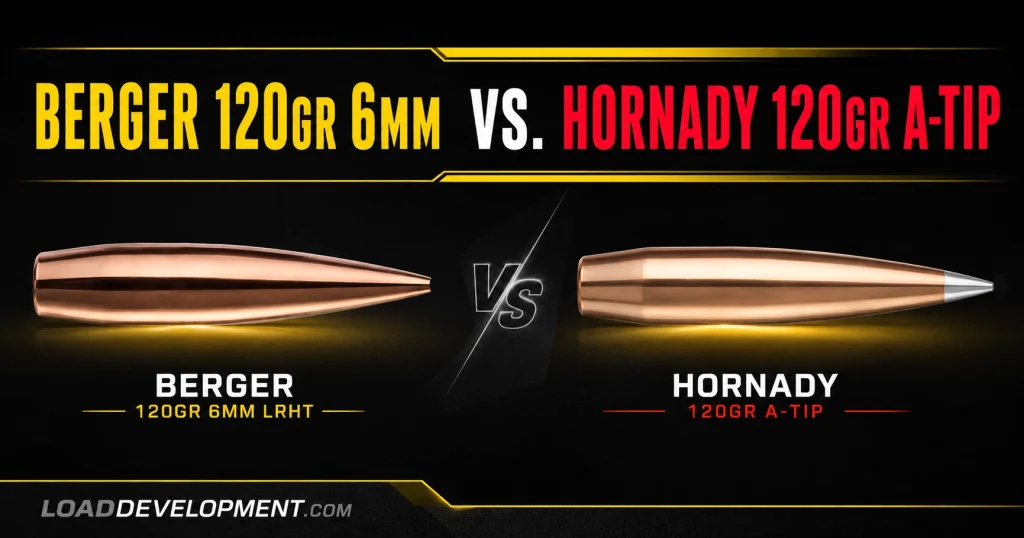
If you shoot PRS, F-Class, or benchrest, the practical question isn’t which spec sheet reads better. It’s whether your chamber, twist, magazine, and case capacity can run a 120-grain 6mm at a velocity that makes the BC advantage real.
A heavier 6mm only pays off when your rifle can stabilize it, chamber it at a workable seating depth, and still reach a velocity node that beats what your current bullet already does. That’s the framework used here, and it’s the same framework behind the tools at LoadDevelopment.com, where AJ has been helping shooters cut through marketing noise since 2016.
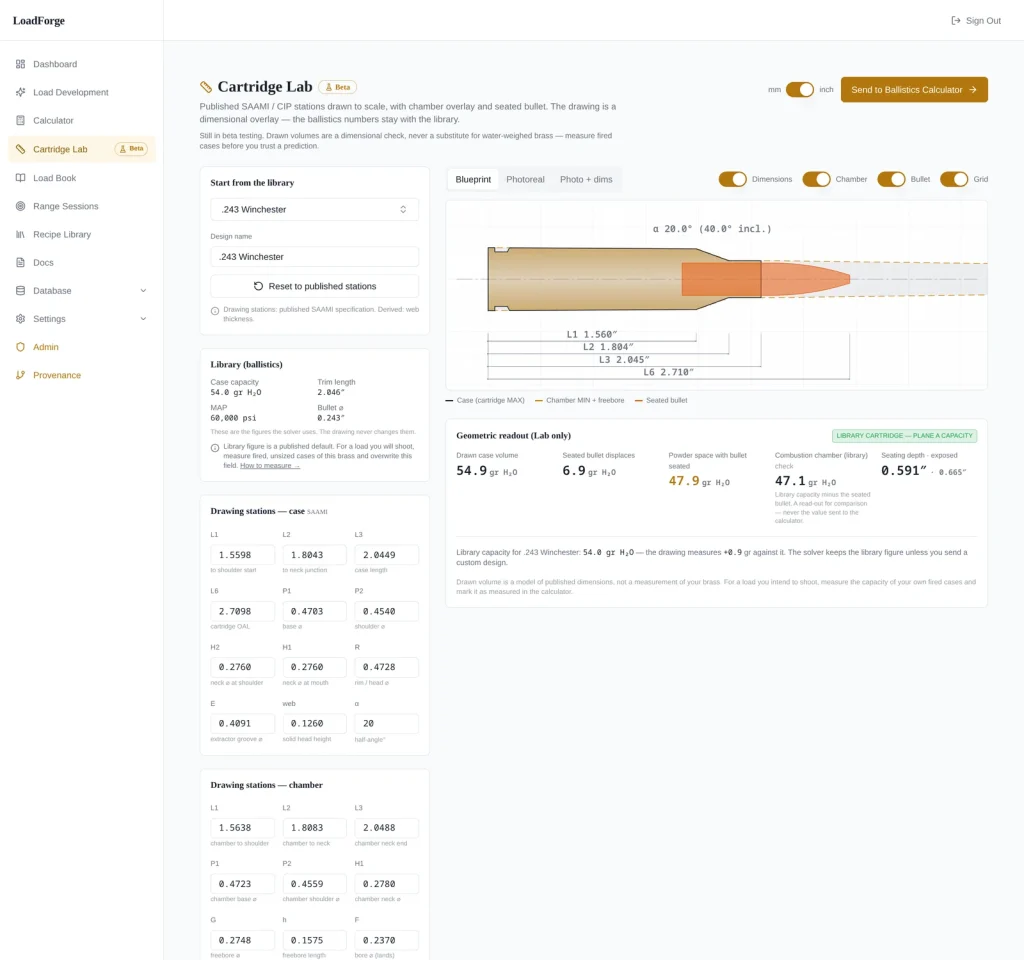
Both projectiles are already loaded into the Trajek bullet database, the Matchup comparison tool, and LoadForge for internal-ballistics work, so you can model the decision before you buy a box of anything.
What Separates the Two 120-Grain 6mm Match Bullets?
The Berger 6mm 120 grain Long Range Hybrid Target uses a hybrid ogive and Meplat Reduction Technology with a published 0.328 G7 ballistic coefficient, while Hornady’s 120-grain A-Tip Match uses their Drag Variability Reduction Technology tip design which also features a flat meplat that increases bullet drag uniformity for less dispersion and smaller groups at longer ranges. Both are long, high-BC .243 caliber bullets built for F-Class, precision rifle, and benchrest, and both are long enough to force real conversations about freebore and magazine length.
Side-by-Side Specifications and Published Ballistic Coefficients
Where these two diverge in practice:
- Seating tolerance. Berger’s hybrid ogive blends tangent and secant sections, which broadens the seating-depth window during tuning. A-Tip bullets frequently reward a narrower node and more careful jump testing.
- Bearing surface and pressure. Both bullets are long for a 6mm; expect reduced usable case capacity in short-throated chambers.
| Spec | Berger 120gr 6mm LRHT | Hornady 120gr 6mm A-Tip Match |
|---|---|---|
| Diameter | 0.243″ | 0.243″ |
| G7 BC | 0.328 | 0.340 |
| G1 BC | 0.657 | 0.675 |
| Overall length | 1.383″ | 1.424″ |
| Nose/tip design | Hybrid ogive, MRT trimmed meplat | Machined aluminum DVRT tip |
| Recommended twist | 1:7.5″ or faster | 1:7″ or faster |
How they compare to the other top 6mm bullet options:
| Spec | Berger 120 LRHT | Hornady 120 A-Tip Match | Berger 109 LRHT | Sierra 116 Tipped MatchKing |
|---|---|---|---|---|
| G7 BC | 0.328 | 0.340 | 0.292 | 0.305 |
| G1 BC | 0.657 | 0.675 | 0.568 | 0.609 |
| Overall length | 1.383″ | 1.424″ | 1.277″ | 1.375″ |
| Recommended minimum twist | 1:7.5″ | 1:7″ | 1:8″ | 1:7.5″ |
| Ogive profile | Hybrid | Secant with machined aluminum tip | Hybrid | Tangent-style with polymer tip |
| Meplat treatment | MRT applied | DVRT applied | MRT applied | Acetyl Resin tip |
Bullet Length, Bearing Surface, and Magazine Fit
At 1.383″, the Berger 120 is materially longer than a 105-class 6mm bullet, and that length is where most rifles run into trouble first. Field testing of the 120 LRHT noted that gas guns in particular may need a shortened cartridge overall length for reliable magazine feeding.
In a bolt gun, the constraint shows up as boat tail position relative to the neck-shoulder junction. Seat one of these deep enough to fit a 2.900″ AICS magazine in a short-freebore chamber and you start eating usable case capacity, which works directly against the velocity you need to justify the weight.
Measure before you order. Drop a dummy round in your magazine at your intended jump, then check where the boat tail sits inside the case.
Which Profile Best Fits PRS, F-Class, and Benchrest?
For PRS, magazine length and barrel life decide more than raw BC, so the 120 makes sense in chambers with generous freebore that keep the bullet out of the powder column. F-Class shooters, working single-feed with long throats, get the cleanest access to what these bullets offer.
Benchrest use is narrower. The hybrid ogive’s jump tolerance is a real asset in seating-depth work, and the Berger 6mm 120 grain LRHT product description specifically calls out F-Class, precision rifle, and benchrest as target disciplines.
Why BC Consistency Matters More Than a Single BC Number
Shot-to-shot BC variation produces vertical dispersion at distance in the same way muzzle velocity spread does, which is why a slightly lower but tightly held BC can outshoot a higher advertised figure. Berger’s entire “No BS BC” position is built on this, and Doppler radar verification plus meplat trimming exist to shrink that variation.
Berger Hybrid Ogive and Hornady A-Tip Design Priorities
Berger’s hybrid ogive blends a tangent nose section near the bearing surface with a secant section forward, which is why these bullets tolerate jump and simplify seating-depth testing. That tolerance saves powder and barrel life during load development.
Hornady attacks the same problem from the tip. A machined DVRT aluminum tip holds a far more repeatable nose geometry than a polymer tip or an open hollow point, which is the entire point of the A-Tip line.
Two different engineering answers to one problem: keeping the front of the bullet identical from round to round.
Meplat Reduction Technology, Doppler Verification, and BC Variation
Every Long Range Hybrid Target bullet uses Berger’s Meplat Reduction Technology, which trims the open tip to a consistent diameter without pointing the bullet. Independent testing of the new 120 found it extremely consistent in both weight and max ogive diameter, with a very consistent BC, which correlates directly with low ES and SD in finished ammunition.
Berger’s own explanation of why BC consistency wins makes the mechanism clear: small BC variations create vertical dispersion at long range that no amount of muzzle velocity tuning will remove.
Hornady on the other hand, also improved their BC consistency with they proprietary DVRT technology. Hornady DVRT (Drag Variability Reduction Technology) is a patented bullet design that uses a precise flat tip to make every shot fly with the same air resistance, incorporated not only in their A-Tip line but also their ELD-Match and some other lines too.
Wind Calls, Vertical Dispersion, and Follow-Up Shots at Distance
A high BC shrinks your wind bracket; a consistent BC shrinks your vertical group at the same distance. You need both, and the second one is invisible on a spec sheet.
Practically, the 120’s advantage is that a 0.657 G1 BC sits nearly a full tenth above a 105-grain hybrid’s 0.545, which means you can launch slower and still arrive faster at 600 and 1,000 yards. In competition, the 120 LRHT was credited with performing well in high winds at the Hornady Precision Rifle Challenge.
For your own numbers, run both bullets through a ballistic calculator at your actual muzzle velocity before assuming the heavier bullet wins.
Will Your 6mm Rifle Stabilize a 120-Grain Bullet?
Berger specifies 1:7.5″ or faster for the 120-grain LRHT and Hornady a 1:7″ or faster twist, realistically 1:7″ barrels are the safe answer in cold, dense air. Our twist calculator also verifies this. Most existing 6mm Dasher, 6mm GT, and 6mm Creedmoor rifles wear 1:7.5″ or 1:8″ twists, so a barrel change is a live possibility for anyone currently running an 8-twist.
Required Twist Rate and Stability Margin
Stability factor (Sg) is what matters, and it moves with velocity, air density, and temperature. Falling below Sg 1.5 costs you BC directly.
Berger’s own comparison shows the effect: at an Sg of 1.4, your effective G7 drops from 0.328 to roughly 0.318, about three percent per tenth below 1.5. That is a small but real penalty at 1,000 yards.
Run your specific numbers through the twist rate stability calculator using the coldest, densest conditions you expect to compete in, not a pleasant summer afternoon.
Chamber Freebore, COAL, and Seating-Depth Constraints
A 1.383″ bullet in a chamber cut for a 105-grain hybrid will seat deep, and that is where the plan usually breaks. Reamer freebore, not magazine length, is the first thing to check on an existing rifle.
If you’re specifying a new barrel and chamber, add freebore to keep the boat tail at or above the neck-shoulder junction at your target COAL. The hybrid ogive gives you a wider jump window to work in, which reduces the cost of getting freebore slightly wrong. Use the freebore calculator to order the right spec reamer or chamber the first time.
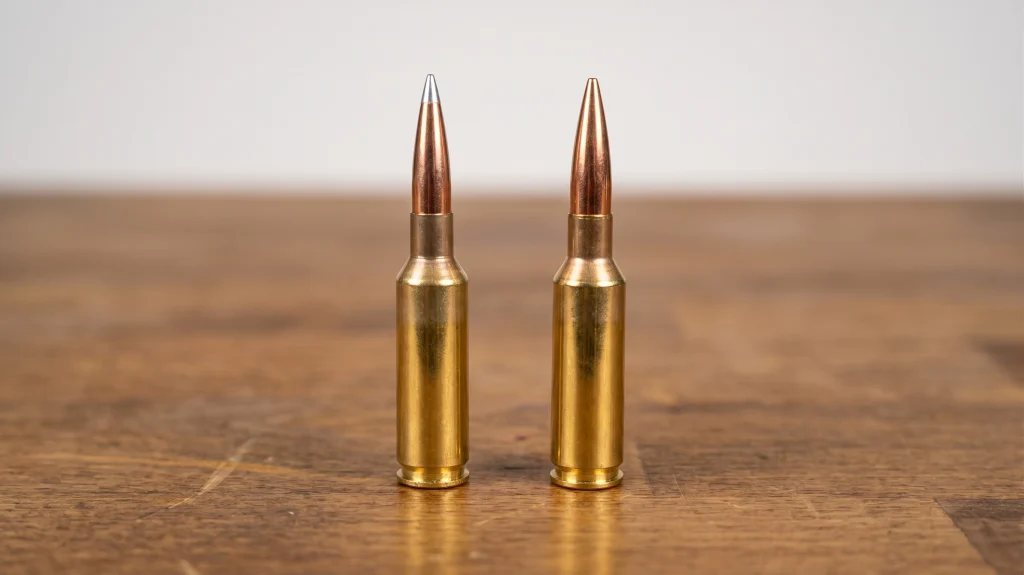
Case Capacity and Velocity Expectations in Dasher, GT, and Creedmoor
The 120 asks for case capacity. Forum consensus around launch pointed toward a 6×47 Lapua or larger to move these bullets meaningfully, and one comparison put a 120 at 2,850 fps in a 6×47 or GT as roughly wind-equivalent to a 6.5 Creedmoor pushing 153s at 2,700.
The 6mm Dasher has the least room of the three and pays the steepest capacity penalty when you seat deep. The 6mm GT sits in a comfortable middle, and 6mm Creedmoor offers the most powder space at the cost of barrel life. Slower magnum-class powders are worth testing with a bullet this long.
The Hornady load data for their 120gr A-Tip in those calibers puts it in the 2600 – 2850fps velocity bracket in a 6mm GT and 2700 – 2950fps for the 6mm Creedmoor
How the New 120s Compare With Established High-BC Options
Comparing the current top BC bullet and cartridge combinations in the PRS and Long Range shooting leagues to the 120gr 6mm Berger LRHT to see if it is worth doing a caliber change for.
| Bullet Weight | Bullet | Cartridge | G7 BC | Muzzle Velocity | Drop @900yds | 10mph Wind Drift @900yds | PRS Rifle Recoil (ft-lbs) |
|---|---|---|---|---|---|---|---|
| 120gr | Berger LRHT | 6mm GT | 0.328 | 2860 fps | 210.5 in (6.5MRAD) | 48.9 in (1.5MRAD) | 3.96 |
| 144gr | Berger LRHT | 6.5 Creedmoor | 0.336 | 2790 fps | 220.6 in (6.8MRAD) | 49.3 in (1.5MRAD) | 5.14 |
| 109gr | Berger LRHT | 6mm Dasher | 0.292 | 2840 fps | 226.49 in (7.0MRAD) | 57.3 in (1.8MRAD) | 3.02 |
| 135gr | Berger LRHT | 25 Creedmoor | 0.334 | 2830 fps | 213.9 in (6.6MRAD) | 48.2 in (1.5MRAD) | 4.70 |
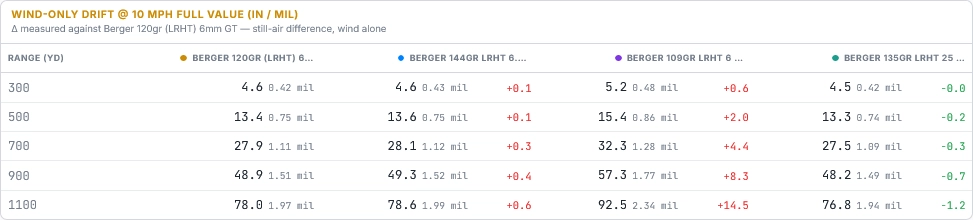
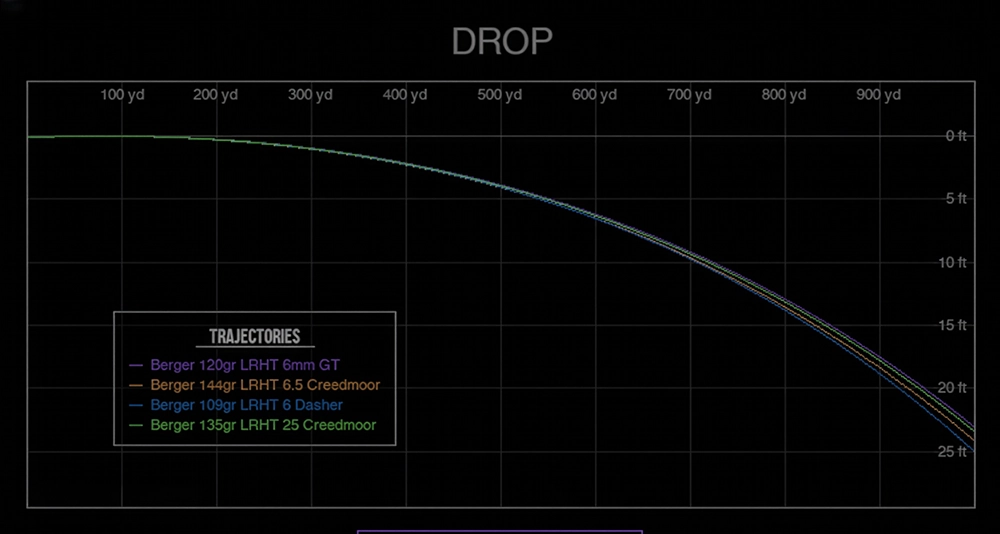
The 120-grain bullets buy roughly a tenth of G1 BC over a 105-class 6mm, but they cost you velocity, case capacity, and barrel life. Comparing them against the 109-grain LRHT and against heavier LRHTs in other calibers tells you whether that trade improves your match setup or moves it sideways.
120-Grain 6mm vs. Berger 109-Grain LRHT
The 109 LRHT remains the safer default for magazine-fed precision rifle work in a Dasher or GT. It fits standard chambers, runs in 1:8″ twists, and reaches its velocity node without deep seating.
The 120 pays off when you have the freebore and the twist to run it near 2,850 fps. Below that, the BC advantage narrows against a faster 109 or a 115 DTAC.
Why the Berger 135-Grain .25-Caliber LRHT Is a Useful BC Benchmark
The 135-grain .25-caliber LRHT is the reference point for shooters who considered a 25 Creedmoor or 25×47 to chase BC. If a 120-grain 6mm at 2,850 fps lands close to that wind performance in a cartridge you already own, the caliber change stops making sense.
That comparison drove much of the early discussion around the 120’s release, and it’s a legitimate reason to test before rebarreling.
What the Berger 144-Grain 6.5mm LRHT Reveals About Caliber Tradeoffs
The 144-grain 6.5mm LRHT shows what more frontal area and mass buy you in a larger case. It wins on absolute wind performance, and it costs recoil, which matters for spotting your own impacts in PRS.
A 120-grain 6mm closes enough of that gap to keep serious shooters in a low-recoil chambering. Use the bullet BC comparison tool to see exactly how much of the gap closes at your ranges.
Use the 120-Grain Data Before You Commit Components
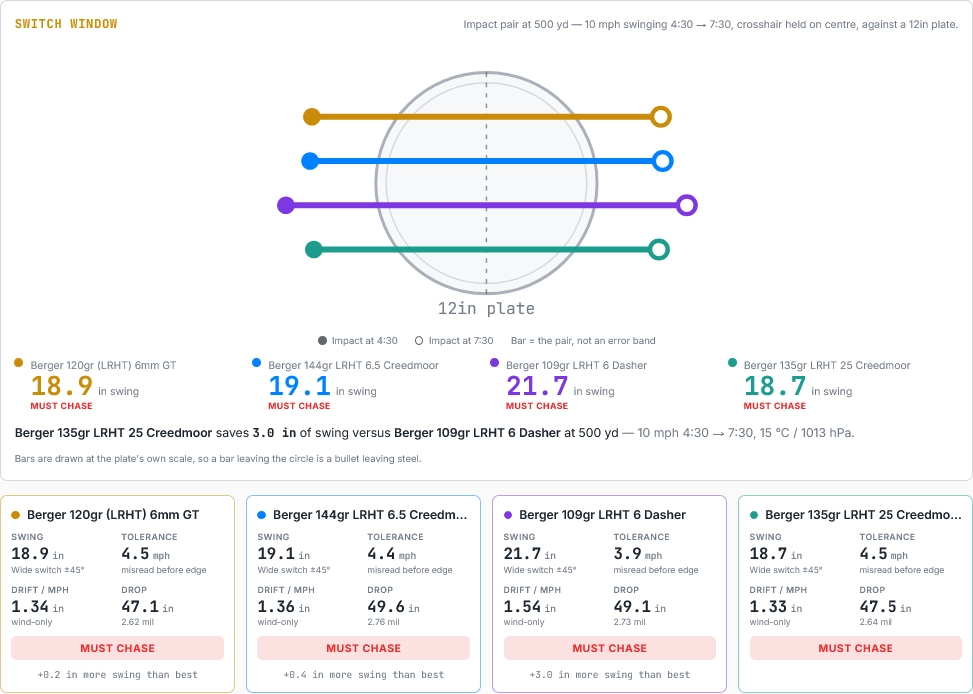
Model both bullets against your current load before you buy a box, a barrel, or a reamer. Both 120-grain profiles are live in Loadforge and Trajek, which lets you test the decision on paper first.
Comparing Drop and Wind Drift in Trajek and Matchup
The Trajek bullet database carries the Berger 120 LRHT and the Hornady 120 A-Tip with their published BCs, so drop and wind drift calculations start from real numbers. The Matchup tool puts two trajectories side by side at your muzzle velocity, atmosphere, and target distances.
Run your current bullet at its known velocity against a realistic 120-grain velocity, not an optimistic one. A 100 fps assumption error will flip the verdict at 1,000 yards.
Modeling Internal Ballistics and Load Development in LoadForge
LoadForge handles the internal side: case capacity, powder selection, and predicted velocity for a given charge in your chamber. It’s where you find out whether a 120 in a Dasher reaches a useful node before pressure signs arrive.
LoadForge outputs are predictions, not pressure-tested published data. Treat them as a starting map for component selection and workup, never as a substitute for verified load data.
A Safe Validation Plan for Your Rifle
Start below any modeled charge and work up in small increments, watching for pressure signs at every step. Confirm velocity with a properly set-up chronograph before trusting any modeled number.
A workable sequence:
- Chamber a dummy round at your intended jump and verify magazine fit and boat tail position.
- Confirm Sg above 1.5 in your coldest expected conditions.
- Work up in 0.2 to 0.3 grain steps, recording velocity and ES.
- Test seating depth once you have a node.
- Re-verify BC assumptions against measured drop at distance.
Careful correct setup and use of a chronograph removes most of the guesswork from step three.
Choosing the 120-Grain 6mm That Fits Your Rifle and Match Plan
Berger’s 6mm 120 grain Long Range Hybrid Target and Hornady’s 120-grain A-Tip both deliver .243-caliber exterior ballistics that were unavailable a year ago, and both demand a 1:7.5″ or faster twist plus enough freebore to keep the boat tail out of the powder column.
If you run a 6mm Creedmoor or a generously throated 6mm GT and can reach the high-2,800s, the heavier bullet earns its place. In a tight-chambered 6mm Dasher with a 1:8″ twist, the 109 LRHT still does more for you than a deeply seated 120.
Verify twist stability first, chamber and magazine fit second, and attainable velocity third. Then confirm the trajectory advantage in Trajek and Matchup, model your workup in LoadForge, and prove it on paper at 1,000 yards with your own chronograph data.
What Changes on the Clock in PRS and NRL Hunter?
Higher BC narrows your wind-call error window, which is the practical benefit competitors feel first. A bullet that drifts less per mph of wind error converts marginal calls into impacts, and that shows up in stage scores before it shows up in group size.
Wind Calls, Trace, and Follow-Up Shots at Distance
At 800 to 1,200 yards, a 10% wind-call error with a 0.328 G7 bullet costs measurably less lateral displacement than the same error with a 0.28 G7 projectile. Trace also reads differently: heavier, slower bullets hold visible trace longer, which helps spotters call corrections.
Higher retained velocity keeps the bullet supersonic further out, so target impact is easier to hear and see. Combine that with a solver trued from a ballistic calculator session and your follow-up shot gets faster.
Can a 120-Grain 6mm Bullet Make NRL Hunter Power Factor?
A 120gr bullet at 3,200 fps produces a power factor of 384 000, and community calculations have compared 120gr 6mm loads at roughly 384 000 to 385 000 PF against established combinations. So yes that clears the official NRL Hunter rules minimum power factory and shooters with existing 6mm Creedmoor or similar rifles are possibly able to use them in NRL Hunter matches too.
Confirm your own chronograph numbers before you assume you’re compliant. Muzzle velocity varies with barrel length, temperature, and lot, and a load that made PF in July may not in December. Correct chronograph setup is part of match prep, and so is packing the NRL Hunter match gear that keeps your data and equipment organized between stages.
Frequently Asked Questions
Berger publishes a 0.657 G1 BC and a 0.328 G7 BC for the 6mm 120 grain Long Range Hybrid Target, which the company describes as the highest G7 in .243 caliber. Those figures assume an Sg at or above 1.5; at Sg 1.4 the effective G7 falls to roughly 0.318.
Hornady publishes a 0.675 G1 BC and a 0.340 G7 BC for the 6mm 120 grain A-Tip Match bullet, which makes it the new highest G7 in .243 caliber.
Berger recommends 1:7.5″ or faster for the 120-grain LRHT, and 1:7″ is the safer choice for cold-weather or high-density-altitude matches. Both 120-grain bullets are long enough that a 1:8″ barrel will not hold adequate stability margin.
A 6mm GT with adequate freebore handles the 120 reasonably well; a standard-chamber 6mm Dasher struggles because deep seating eats the case capacity it needs. Early discussion around launch pointed toward a 6×47 Lapua or larger for getting these bullets moving at their intended speed.
The 109 LRHT remains the better PRS choice in magazine-fed rifles with standard chambers and 1:8″ twists. The 120 wins when your chamber freebore, 1:7.5″ twist, and case capacity let you reach roughly 2,850 fps without deep seating.
Both bullets are loaded in the Trajek bullet database with their published BCs, and the Matchup tool compares two trajectories side by side at your muzzle velocity and atmospheric conditions. Enter a measured velocity for your rifle rather than a catalog figure.
Pressure-tested published data for the 120-grain 6mm bullets is limited given how recently both were release, but yes our Load Database has load data for both these bullets. LoadForge models internal ballistics for component planning, but treat those outputs as a starting point for a conservative workup, never as verified load data.
A 120gr bullet at 3,200 fps yields 384 000 power factor, and shooters have run comparisons at roughly 384 000 to 385 000 PF. So yes it does satisfy the 380 000 minimum power factor rule for NRL Hunter if the muzzle velocity is higher than around 3150 fps.

AJ Deysel is a competitive rifle shooter in the PRS and NRL Hunter series, a lifelong hunter, and a recognized ballistics specialist whose load development expertise has been featured by industry leaders like Hornady. He is the founder and lead editor of LoadDevelopment.com. Read more about AJ or view our Editorial & Testing Guidelines.