
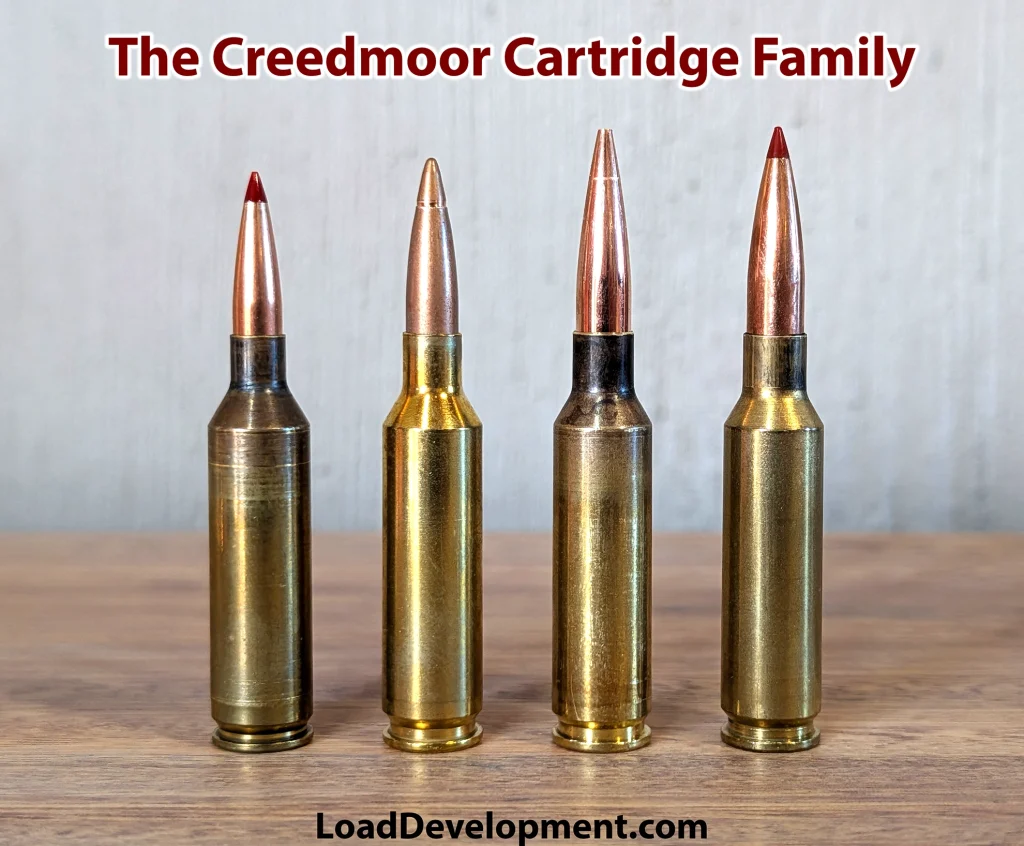
The Quick Answer: The 6mm Creedmoor is simply a 6.5 Creedmoor cartridge case necked down to accept a smaller, lighter .243 caliber bullet. Because it pushes a lighter bullet with the same powder charge, the 6mm Creedmoor shoots flatter, drifts less in the wind, and produces less recoil than the 6.5 Creedmoor.

However, this extreme “overbore” design acts like a plasma torch on the barrel. A 6mm Creedmoor will burn out a barrel in roughly half the time of a 6.5 Creedmoor. If you are deciding between these two precision cartridges, you have to weigh ballistic performance against component cost.
We ran the internal ballistics through LoadForge and generated external drop charts to show you exactly why the 6mm is so fast, and why it burns barrels so quickly.
The Birth of the 6mm Creedmoor
When Hornady introduced the 6.5 Creedmoor in 2007, it revolutionized long-range target shooting. However, competitive Precision Rifle Series (PRS) shooters are always looking for an edge. They loved the 6.5 Creedmoor’s case design—with its sharp 30-degree shoulder and minimal body taper—but they wanted even less recoil so they could spot their own impacts through the scope.
By simply running 6.5 Creedmoor brass through a sizing die to neck it down to 6mm (.243 caliber), wildcatters created a cartridge that could push heavy 105-grain to 115-grain bullets at blistering speeds (often exceeding 3,000 FPS). Hornady eventually standardized it, and the 6mm Creedmoor was born.
External Ballistics (The 1,000 Yard Chart)
To see why PRS shooters fell in love with the 6mm Creedmoor, we have to look at the external ballistics.
Below is a comparison using a 115-grain 6mm bullet (like a DTAC or Berger Hybrid) versus a 140-grain 6.5mm bullet (like the Hornady ELD-M), both fired from 24-inch barrels with a 100-yard zero and a 10 mph crosswind.
| Metric | 6.5 Creedmoor (140gr ELD-M) | 6mm Creedmoor (115gr DTAC) |
|---|---|---|
| Muzzle Velocity | 2,750 FPS | 3,000 FPS |
| Drop at 500 Yards | -44.8 inches | -36.2 inches |
| Drop at 1,000 Yards | -265.2 inches | -218.4 inches |
| Wind Drift at 1,000 Yds | 65.4 inches | 58.1 inches |
The Takeaway: The 6mm Creedmoor’s combination of high velocity and high Ballistic Coefficient (BC) allows it to cheat the wind significantly better than the 6.5 Creedmoor. At 1,000 yards, it drops 40 inches less and drifts 7 inches less in the wind.
(To run custom drop charts for your specific environment, download one of our recommended Ballistic Solvers).

Recoil: Why the 6mm Dominates PRS
The ballistic chart above is impressive, but recoil management is the real reason top competitors choose the 6mm.
- A 140-grain 6.5 Creedmoor produces roughly 12 ft-lbs of free recoil.
- A 115-grain 6mm Creedmoor produces roughly 9 ft-lbs of free recoil.
In a heavy, 15-pound competition rifle equipped with a muzzle brake, a 6mm Creedmoor barely moves when fired. This lack of recoil allows the shooter to watch the bullet’s vapor trail through the scope and see exactly where the bullet impacts the steel target (or the dirt). If they miss, they can make an immediate wind correction and send a follow-up shot without needing a spotter.
The Fatal Flaw: Barrel Life & Throat Erosion
The 6mm Creedmoor is ballistically superior, but it comes with a massive hidden cost: barrel life.
This is due to the “overbore” concept. Both cases hold roughly 52 grains of H2O capacity. However, the 6mm Creedmoor pushes that massive volume of burning powder through a tiny 6mm hole. This creates extreme heat and pressure at the throat of the chamber, eroding the rifling at an alarming rate.
- 6.5 Creedmoor Barrel Life: 2,500 to 3,000+ rounds.
- 6mm Creedmoor Barrel Life: 1,200 to 1,500 rounds.
If you shoot PRS competitively, you will burn out a 6mm Creedmoor barrel in a single season. You must factor the cost of a new barrel and chambering ($700 to $900) into your annual ammunition budget.
(Note: You can extend your barrel life by backing off maximum pressure nodes. Use the LoadForge internal ballistics calculator to model your chamber pressures and find the optimal balance between velocity and throat erosion).
Which is Better for Hunting?
- Deer & Antelope: Both are excellent. The 6mm Creedmoor is essentially a modernized .243 Winchester, making it a laser beam for deer and antelope inside 400 yards. The low recoil makes it a phenomenal choice for youth hunters.
- Elk & Large Game: The 6.5 Creedmoor wins decisively. The heavier 143-grain bullets provide the necessary sectional density and kinetic energy to penetrate heavy bone and muscle. The 6mm is generally considered too light for ethical elk hunting.
The Handloader’s Perspective
If you are handloading for these cartridges, your life is incredibly easy: they both thrive on the exact same powder.
Hodgdon H4350 is the undisputed king of the Creedmoor family. It provides optimal case fill and excellent temperature stability for both the 6.5mm and 6mm versions.
The 6mm Dasher Alternative: Because the 6mm Creedmoor burns barrels so incredibly fast, many competitive shooters have transitioned to smaller 6mm cartridges. The 6mm Dasher and the 6mm GT offer nearly identical wind-cheating ballistics to the 6mm Creedmoor, but burn significantly less powder, extending barrel life to over 2,500 rounds.
Frequently Asked Questions
No. The 6mm Creedmoor is a necked-down version of the 6.5 Creedmoor case. It utilizes the same brass body but holds a smaller, lighter .243 caliber (6mm) bullet instead of a .264 caliber (6.5mm) bullet.
The typical barrel life for a 6mm Creedmoor is 1,200 to 1,500 rounds before accuracy degrades. This short lifespan is due to its highly overbore design, which causes rapid throat erosion.
The 6mm Creedmoor is widely preferred by top PRS competitors. Its flatter trajectory and significantly lower recoil allow shooters to spot their own impacts and make rapid wind corrections, despite the penalty of shorter barrel life.

AJ Deysel is a competitive rifle shooter in the PRS and NRL Hunter series, a lifelong hunter, and a recognized ballistics specialist whose load development expertise has been featured by industry leaders like Hornady. He is the founder and lead editor of LoadDevelopment.com. Read more about AJ or view our Editorial & Testing Guidelines.


Interesting tradeoff between wind and barrel life. Do you think one performs better in specific conditions?