
Torque conversion between inch-pounds and foot-pounds runs on a single number: 12. To convert inch-pounds to foot-pounds, divide by 12; to convert foot-pounds to inch-pounds, multiply by 12. That means 240 in-lb equals 20 ft-lb, and 25 in-lb equals roughly 2.08 ft-lb.
That math matters more on a rifle than almost anywhere else. Scope rings, bases, and action screws are specified in inch-pounds precisely because the values are small, and a wrench calibrated in foot-pounds usually cannot resolve them accurately.
At LoadDevelopment.com, the focus is on precise, repeatable measurements, whether you are working up a load or setting fastener torque on a rifle you expect to shoot the same way tomorrow. Consistent torque is part of the same discipline that produces consistent groups.
Use the calculator above for quick conversions, then work through the sections below to see how the numbers apply to real scope-ring and action-screw specifications, and which tool actually belongs in your hand.
Understanding Torque Units
Torque is rotational force: a force applied at a distance from the pivot. Inch-pounds and foot-pounds describe the same physical quantity using different lever-arm lengths, which is why one foot-pound always equals twelve inch-pounds.
What Inch-Pounds Measure
An inch-pound (in-lb, sometimes written lb-in) is the torque produced by one pound of force applied one inch from the center of rotation. It is the working unit for small, low-torque fasteners.
Nearly every firearms specification you will encounter lives here: scope ring caps, base screws, rail screws, action screws, and most Torx and hex hardware on a modern rifle. Values typically fall between 15 and 65 in-lb.
What Foot-Pounds Measure
A foot-pound (ft-lb, or lb-ft) is one pound of force applied one foot from the pivot. It is twelve times larger than an inch-pound, which makes it the practical unit for automotive and structural work.
Lug nuts, suspension bolts, and cylinder heads are specified in foot-pounds because the numbers stay readable. A 25 in-lb scope ring spec converts to about 2.08 ft-lb, a value that sits below the usable range of most automotive wrenches.
Foot-pounds also appear in ballistics as a unit of energy, as in muzzle energy. The unit name is identical, but the quantity is not. When a scope manufacturer publishes a torque figure, it is describing rotational force on a fastener, not projectile energy.
The Conversion Formula
Both directions use the exact factor of 12, with no rounding built into the relationship itself. Divide when moving to the larger unit, multiply when moving to the smaller one.
Converting From Inch-Pounds
Foot-Pounds = Inch-Pounds ÷ 12
A 60 in-lb action screw specification becomes 60 ÷ 12 = 5 ft-lb. A 45 in-lb spec becomes 3.75 ft-lb. A 20 in-lb ring screw becomes about 1.67 ft-lb.
Note how quickly the numbers become awkward fractions. That is the practical signal that foot-pounds are the wrong unit for the job, not just an inconvenient one.
Converting From Foot-Pounds
Inch-Pounds = Foot-Pounds × 12
If a manual lists 15 ft-lb and your wrench reads in inch-pounds, set 15 × 12 = 180 in-lb. A 30 ft-lb spec becomes 360 in-lb.
This direction comes up most often on barrel nuts, muzzle devices, and receiver hardware where manufacturers publish larger figures. Convert once, write the converted number down, then set the wrench and verify you are reading the correct scale. Many click-type wrenches carry dual scales, and setting the secondary scale by mistake is a common error.
Where a converted value falls between graduations, set the nearest graduation rather than estimating a position between marks.
Common Gunsmithing Torque Values
Rifle hardware clusters into two clear torque bands: scope rings in the 15 to 25 in-lb range, and action screws in the 45 to 65 in-lb range. The table below covers both, with exact foot-pound equivalents.
| Inch-Pounds (in-lb) | Foot-Pounds (ft-lb) | Typical Application |
|---|---|---|
| 15 | 1.25 | Scope ring cap screws (low end) |
| 20 | 1.67 | Scope ring cap screws (common) |
| 25 | 2.08 | Scope ring cap screws (upper end) |
| 30 | 2.5 | Base and rail screws, heavier hardware |
| 45 | 3.75 | Action screws (lighter spec) |
| 65 | 5.42 | Action screws (heavier spec) |
Scope Ring Specifications
Most ring manufacturers publish cap screw torque between 15 and 25 in-lb, which is 1.25 to 2.08 ft-lb. Base and rail screws often run higher, commonly 25 to 65 in-lb depending on the mount and thread size.
Tighten ring caps in an alternating cross pattern in small increments so the gap on each side of the ring stays even. Uneven tightening loads one side of the scope tube first.
Action Screw Specifications
Action screw torque generally falls between 45 and 65 in-lb, or 3.75 to 5.42 ft-lb, depending on the stock or chassis material and the receiver design. Aluminum bedding blocks and chassis systems often tolerate the higher end; some composite stocks specify less.
Torque the front screw first, then the rear, unless the manufacturer specifies otherwise. Record the value you used. Action screw torque is a variable worth controlling when you are diagnosing group changes, and repeatability only exists if you know what you set last time.
Always confirm against the specification published for your specific action, stock, and mount.
Selecting the Right Torque Wrench
The tool determines whether your converted number means anything. A wrench is only accurate within its rated range, and firearms work sits at the very bottom of the imperial torque scale.
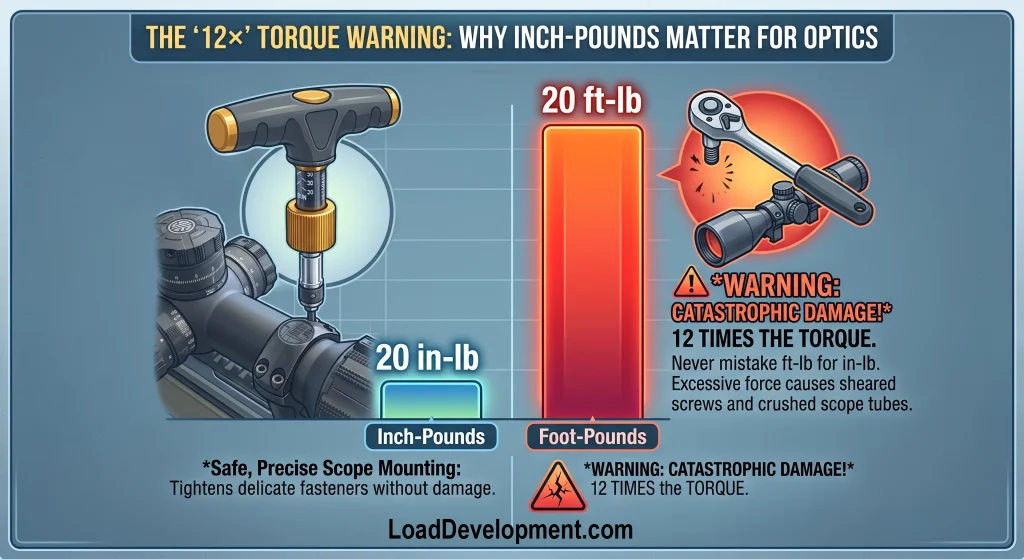
Dedicated Inch-Pound Wrenches
A gunsmithing torque wrench typically covers roughly 10 to 80 in-lb, which brackets ring, base, and action screw specifications with room on both ends. Click-type and dial-indicating models both work; the click type is easier to use one-handed on a rifle in a vise.
Look for a stated accuracy rating, usually ±4% or better, and a bit interface that accepts the Torx and hex sizes on your hardware. Store click wrenches at their lowest setting to preserve spring calibration, and have them checked periodically against a known standard.
A single properly calibrated inch-pound wrench covers nearly all optics mounting and receiver hardware work.
Limits of Automotive Torque Tools
A typical 3/8-inch automotive click wrench starts around 10 to 20 ft-lb. Convert a 20 in-lb scope ring spec and you get 1.67 ft-lb, well below the lowest graduation on that scale.
Below the rated minimum, the internal mechanism does not click reliably and the reading is not meaningful. You are effectively tightening by feel while holding a tool long enough to apply eight to ten times the intended torque before you notice.
Beam-type wrenches share the problem at low values, since a 2 ft-lb deflection is difficult to read with any precision. Foot-pound tools have their place on barrel nuts and muzzle devices; they do not belong on ring caps.
Need the right tool for the job? Check out our complete guide to the Best Torque Wrenches for Gunsmithing to ensure you never crush a scope tube again.
Preventing Damage During Installation
Most optic and receiver damage traces back to two things: the wrong tool for the torque range, and a specification that was assumed rather than checked. Both are avoidable.
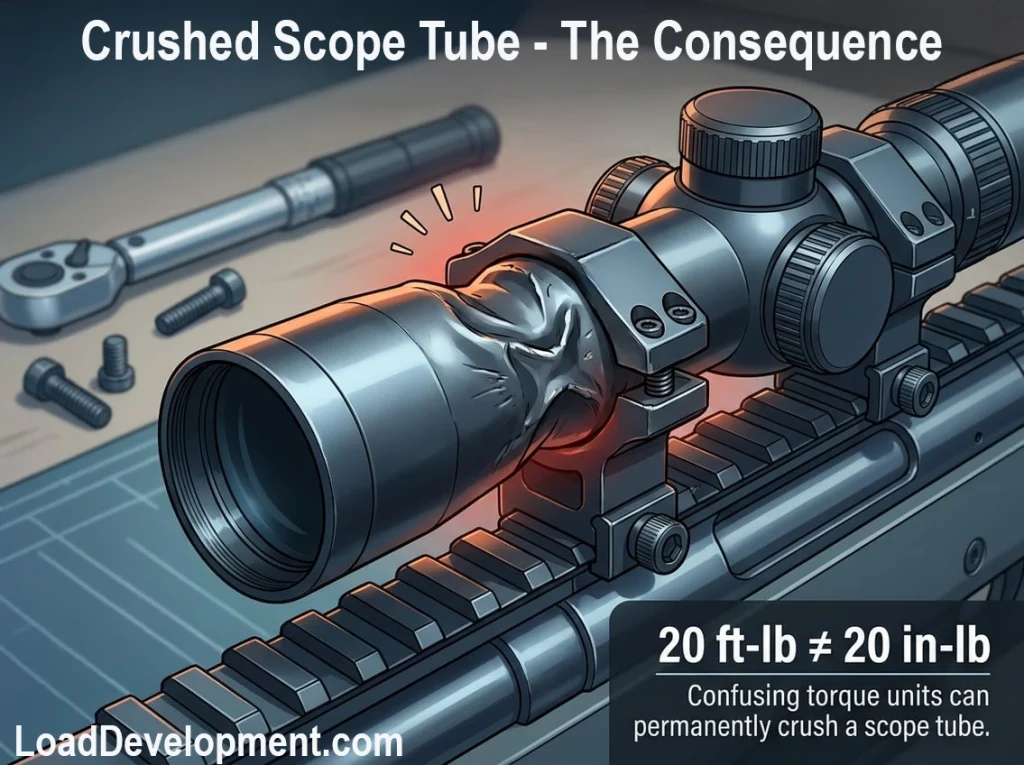
Avoiding Crushed Scope Tubes
Main tubes are thin-walled aluminum. Over-torqued rings can deform the tube, bind the erector assembly, and produce tracking errors or a point of impact that will not hold.
The damage is not always visible. A tube can be squeezed enough to affect internal adjustments while the exterior still looks correct, which makes the problem easy to misdiagnose as a mount or ammunition issue.
Practical safeguards:
- Use a wrench whose rated range brackets the specification, not one that barely reaches it
- Tighten cap screws in an alternating pattern, in two or three passes
- Stop at the specified value; a quarter turn “for insurance” is how tubes get crushed
- Check ring gaps for even spacing before the final pass
- Use the fastener manufacturer’s thread locker recommendation rather than substituting your own
Following Firearm Manufacturer Specifications
Read the most popular manufacturer torque specifications on our Rifle Torque Specs Guide.
Torque specifications belong to specific components. The ring maker publishes cap screw values, the action or stock maker publishes action screw values, and the base maker publishes base screw values. Those three numbers are often different on the same rifle.
Treat conversion charts as translation tools, not as authority. If a published spec conflicts with anything you read here, follow the published spec.
When no figure is available, contact the manufacturer rather than adopting a number from a general fastener chart. Generic bolt torque tables assume steel-on-steel structural joints, not an aluminum scope tube clamped in a ring.
Frequently Asked Questions
Divide the inch-pound value by 12. For example, 60 in-lb ÷ 12 = 5 ft-lb. To reverse the calculation, multiply foot-pounds by 12.
200 in-lb equals approximately 16.67 ft-lb (200 ÷ 12 = 16.666). This value is above the useful range of most foot-pound wrenches’ lower limits, so either unit works if your tool is rated for it.
500 in-lb equals approximately 41.67 ft-lb. Torque in this range typically applies to barrel nuts or muzzle devices rather than optics hardware, and a foot-pound wrench is the appropriate tool.
250 in-lb equals approximately 20.83 ft-lb. Values near this level exceed most dedicated gunsmithing wrenches, which usually top out around 80 in-lb, so a larger wrench is required.
150 in-lb equals 12.5 ft-lb exactly. That sits at or near the minimum graduation on many automotive click wrenches, so verify your tool’s rated range before relying on the reading.
Many wrenches carry dual scales, and some digital models switch units directly. Accuracy still depends on the tool’s rated range, so a wrench displaying inch-pounds will not measure 20 in-lb accurately if its minimum is 200 in-lb. Confirm which scale you are setting before applying torque.