If you spend enough time mounting optics or torquing action screws, you already know the Wheeler F.A.T. (Firearm Accurizing Torque) Wrench. It is the undisputed standard on most home gunsmithing benches. But the mechanical version has one fatal flaw that catches out a lot of shooters: if you forget to dial the spring back to the lowest setting after use, the tool loses its calibration. Over time, that 18 in-lbs you’re applying to your scope rings might actually be 22 in-lbs—enough to crush a thin-walled scope tube.
Enter the Wheeler Digital F.A.T. Wrench.
By replacing the mechanical spring with a digital strain gauge, Wheeler eliminated the calibration memory issue entirely. In this review, we’re looking at whether the digital upgrade justifies the higher price tag, how it performs on the bench, and why peak-hold technology matters when you are trying to achieve perfectly even torque across a scope mount.
Digital vs. Mechanical: The Real-World Difference
The primary advantage of the Digital F.A.T. Wrench isn’t just the LCD screen—it’s the consistency.
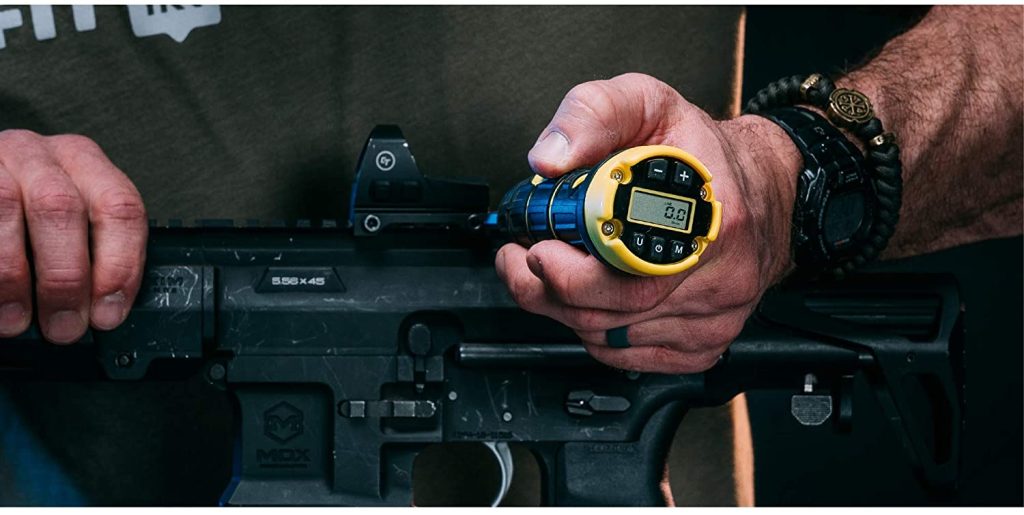
With a mechanical “click” wrench, you turn until the spring gives way. It works, but it’s a binary mechanism. The Digital F.A.T. Wrench features an active display that shows you the exact inch-pounds of pressure you are applying in real-time, along with audible indicators as you approach your target torque.
For critical applications—like tightening the base screws on a precision rifle chassis where uneven torque can induce stress into the action and ruin your harmonics—being able to watch the torque curve build ensures you are applying perfectly even pressure across all fasteners.
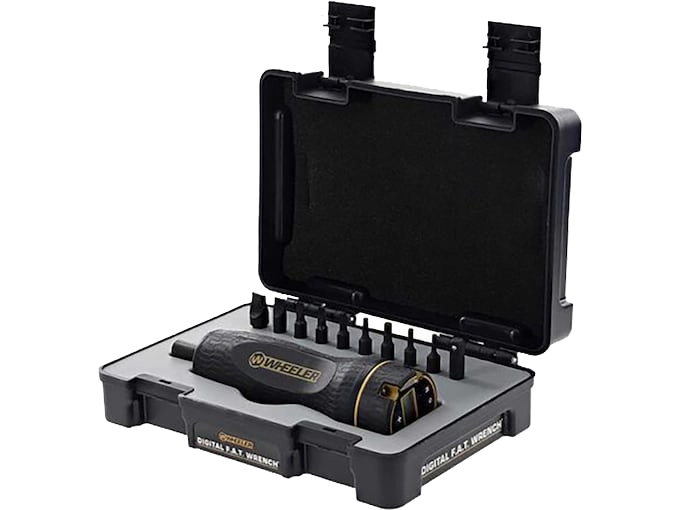
Wheeler Digital F.A.T. Wrench The ultimate precision torque driver for the gunsmithing bench. The Wheeler Digital F.A.T. Wrench eliminates the calibration errors of traditional mechanical springs. Featuring a real-time LCD display, audible alerts, and a peak-hold function, it applies perfectly even pressure from 15 to 100 in-lbs (+/- 2% accuracy). Includes 10 hollow-ground, S2 tool steel gunsmithing bits and a hard storage case. If you are tuning action screws or mounting high-end optics, this is the tool you need.
When you use the link above to shop for one of the products, we receive a small commission from the sale, at no extra cost to you. This helps us keep this site going, and does not affect the price you would pay usually in any way whatsoever.
The Bits, Build Quality, and Practical Use
The Bits: Why Gunsmithing Screwdrivers Matter
One of the biggest mistakes novice shooters make is using standard hardware store screwdriver bits on their firearms. Standard flathead bits are wedge-shaped; they only make contact at the very bottom of the screw slot, which inevitably leads to slipping and mangled screw heads.
The Wheeler Digital F.A.T. Wrench includes 10 bits made from hardened S2 tool steel (56-58 Rockwell “C”). More importantly, the flat blades are hollow-ground. This means the sides of the bit are parallel, allowing them to fill the entire slot of the screw head to distribute the torque evenly.
The included bit selection covers 95% of what you need for optics mounting and basic rifle maintenance:
- Hex Bits: 5/32″, 7/64″, 3/32″ (Covers most modern scope rings and chassis bolts)
- Torx Bits: T15, T20 (Essential for modern optics mounts like Spuhr or MDT)
- Flat Blades: #10, #11, #32
- Specialty: Leupold/Buehler windage bit (Critical for older turn-in style rings)
- Adapter: 1/4″ socket adapter
Ergonomics and Build Quality
The physical tool is substantial. It features a rubber over-molded grip that provides excellent traction, even if your hands are coated in gun oil or solvent.
The digital interface is straightforward. It operates on a standard CR2032 battery (which is included) and features a clear LCD screen. You can toggle between inch-pounds (in-lbs), foot-pounds (ft-lbs), and kilogram-centimeters (kg-cm). For firearms, you will exclusively use the inch-pound setting. The wrench has an operating range of 15 to 100 in-lbs, with an accuracy of +/- 2%.
Bench vs. Range Bag
While the Digital F.A.T. Wrench is an exceptional tool for the reloading room or gunsmithing bench, it’s not the ideal choice for a minimalist range bag. It comes in a hard plastic storage case (measuring roughly 7.5″ x 5.5″) that protects the digital components and organizes the bits.
If you need a tool to make quick adjustments in the field or at a PRS match, a compact mechanical option like the Fix It Sticks might be a better fit. But for precision mounting in a controlled environment—where you want the absolute certainty of a digital peak-hold readout—the Wheeler is superior.
If you prefer old school analog or manual torque wrench for your guns, read our full gun torque wrench comparison.
The Final Verdict: Is the Digital Upgrade Worth It?
If you only mount one scope every three years, the standard mechanical Wheeler F.A.T. Wrench is perfectly adequate.
However, if you are regularly swapping optics, tuning action screw torque to find optimal barrel harmonics, or working on expensive precision rifle chassis systems, the Wheeler Digital F.A.T. Wrench is worth the premium. The +/- 2% accuracy, the elimination of spring-memory calibration issues, and the real-time visual torque curve provide a level of precision that a mechanical “click” wrench simply cannot match.
It is, without a doubt, one of the best investments you can make for your gunsmithing bench.
Frequently Asked Questions (FAQs)
The Wheeler Digital F.A.T. Wrench is highly accurate, rated at +/- 2% across its entire operating range of 15 to 100 inch-pounds. This is more accurate than the standard mechanical FAT Wrench, which is rated at +/- 2 inch-pounds up to 40 in-lbs, and +/- 5% above 40 in-lbs.
It uses a single CR2032 coin-cell battery. Because it features an auto-shutoff function to preserve battery life, a single battery will typically last through several seasons of regular bench use.
No. You should never use a torque wrench (digital or mechanical) to break loose stuck or overtightened screws. Doing so can damage the internal strain gauge or calibration. Always use a standard driver to loosen screws, and only use the torque wrench for final tightening.
Yes, the digital display can toggle between inch-pounds, foot-pounds, and kilogram-centimeters. However, the tool is designed for small fasteners; its maximum torque is 100 inch-pounds (which is roughly 8.3 foot-pounds). It should not be used for heavy automotive applications.

AJ Deysel is a competitive rifle shooter in the PRS and NRL Hunter series, a lifelong hunter, and a recognized ballistics specialist whose load development expertise has been featured by industry leaders like Hornady. He is the founder and lead editor of LoadDevelopment.com. Read more about AJ or view our Editorial & Testing Guidelines.