A good 308 ballistics chart should tell you more than factory muzzle velocity. You need usable drop, trajectory, wind drift, velocity, and energy data in inches, MOA, and MIL so you can make real corrections at distance, whether you are shooting steel, paper, or game.

If you want practical .308 Winchester ballistics, the 175-grain class remains the most dependable reference load for 1,000-yard dope, while 150- to 165-grain hunting loads still make the most sense for most field use inside normal hunting distances.
A lot of published ballistics charts leave out the details that matter once you start dialing or holding in MOA or mil. In practice, your barrel length, actual muzzle velocity, zero distance, twist rate, atmosphere, and bullet choice can move your real data enough that a generic table becomes only a baseline.
The numbers below are built as practical reference points for a 100-yard zero and standard conditions. If you want to true your own dope, check your results with a ballistics calculator and refine your handloads with LoadForge.
Key Takeaways
- The 175-grain Sierra MatchKing is still the cleanest benchmark for long-range .308 dope.
- Lighter hunting bullets shoot flatter early, while heavier bullets usually hold velocity and wind better farther out.
- Inches alone are not enough, you need MOA and mil values to make useful sight corrections.
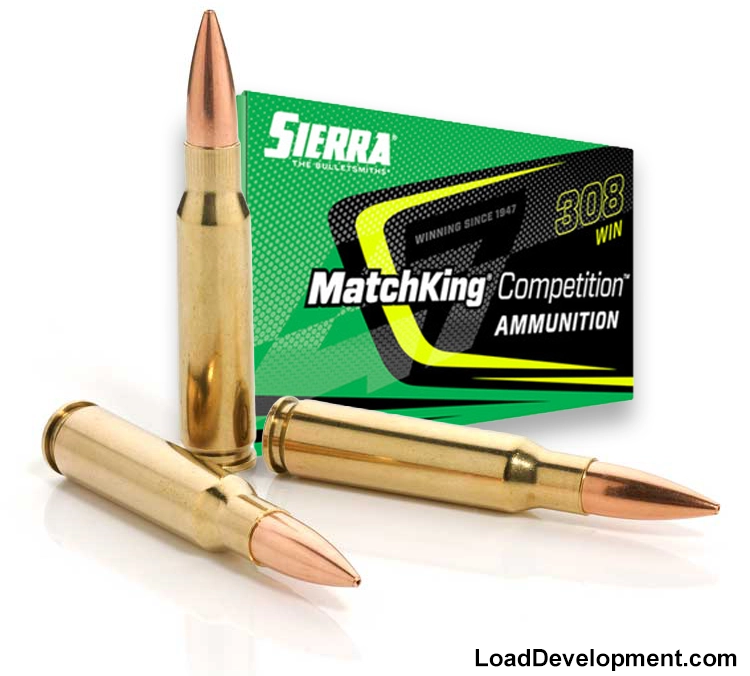
175gr Sierra MatchKing Reference Load
If you shoot match-focused .308 Winchester, the 175gr Sierra MatchKing is the reference point many shooters still come back to. It is not the fastest option, though it stays useful because it holds together better through distance than many classic 168-grain loads.
Baseline Setup and Assumptions
For a practical baseline, use these assumptions:
- Bullet: 175gr Sierra MatchKing HPBT
- Ballistic coefficient: G1 0.496 class
- Muzzle velocity: 2,600 fps
- Zero: 100 yards
- Sight height: 1.75 inches
- Atmosphere: Standard sea-level conditions
- Wind: 10 mph full-value crosswind
This is close to what many shooters see from a 24-inch barrel with quality match ammunition or a tuned handload. From a 20-inch rifle, you will often lose roughly 80 to 140 fps, which matters by the time you get past 700 yards.
Trajectory, Drop, and Wind Calls to 1,000 Yards
Below is a practical .308 ballistics chart for this reference load.
| Range | Drop (in) | Drop (MOA) | Drop (MIL) | Velocity (fps) | Energy (ft-lb) | Wind Drift 10 mph (in) | Wind (MOA) | Wind (MIL) |
|---|---|---|---|---|---|---|---|---|
| 100 | 0 | 0.0 | 0.00 | 2435 | 2304 | 0.8 | 0.8 | 0.22 |
| 200 | -3.7 | 1.8 | 0.52 | 2277 | 2015 | 3.4 | 1.6 | 0.47 |
| 300 | -13.8 | 4.4 | 1.27 | 2125 | 1754 | 7.8 | 2.5 | 0.72 |
| 400 | -31.8 | 7.6 | 2.21 | 1980 | 1523 | 14.3 | 3.4 | 0.99 |
| 500 | -59.5 | 11.4 | 3.31 | 1841 | 1316 | 23.4 | 4.5 | 1.30 |
| 600 | -99.8 | 15.9 | 4.63 | 1708 | 1134 | 35.9 | 5.7 | 1.67 |
| 700 | -156.2 | 21.3 | 6.18 | 1582 | 972 | 52.7 | 7.2 | 2.09 |
| 800 | -232.8 | 27.8 | 8.07 | 1462 | 831 | 74.8 | 8.9 | 2.65 |
| 900 | -334.6 | 35.5 | 10.31 | 1349 | 707 | 103.4 | 11.0 | 3.21 |
| 1000 | -468.0 | 44.7 | 12.99 | 1242 | 600 | 139.0 | 13.3 | 3.86 |
These are good starting numbers, not final dope. In real use, many rifles print a little lower or higher at 1,000 depending on true muzzle velocity and local density altitude.
What This Load Does Well for Match Shooting
You get predictable vertical and manageable wind drift for a .308 Win, especially from 600 to 1,000 yards. That is the main reason the 175gr Sierra MatchKing stayed relevant for match shooting and precision work for so long.
You also get a load that usually remains stable deeper into the transonic zone than older 168-grain match designs. If you have ever watched a 175 SMK track cleanly at 900 while another load starts showing erratic dispersion, that difference is easy to respect.
For practical use, many shooters end up with a rough dope ladder close to this with a 100-yard zero:
500 yd: 11.4 MOA / 3.3 mil
700 yd: 21.3 MOA / 6.2 mil
1000 yd: 44.7 MOA / 13.0 mil
168gr and Hunting-Weight Load Comparisons
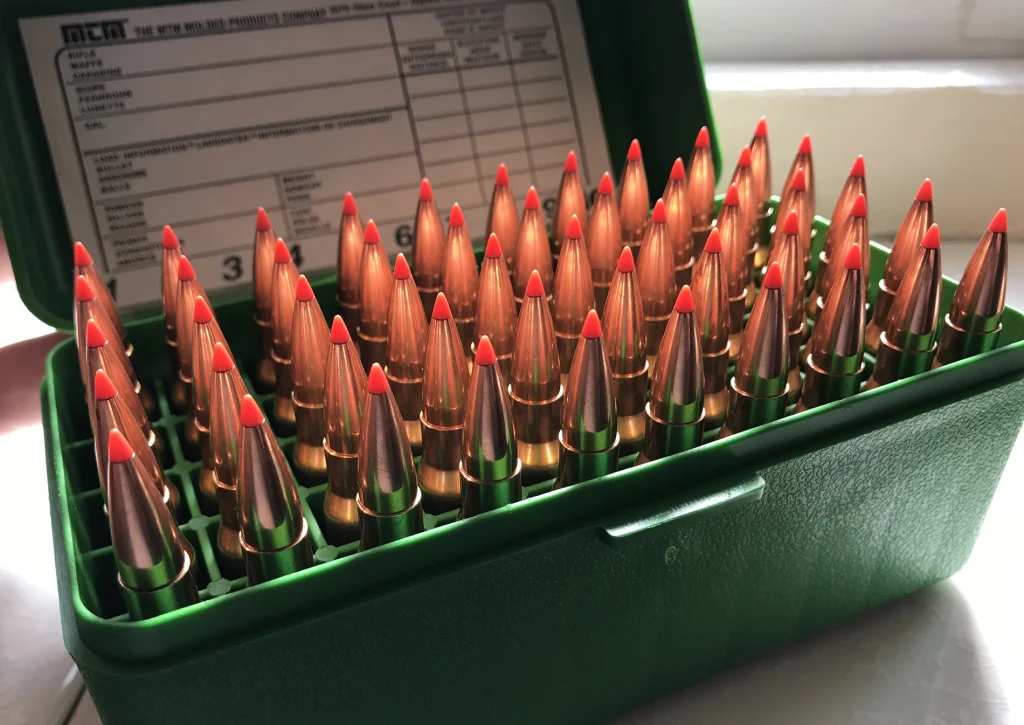
Not every .308 ammo choice needs to be built around 1,000-yard target work. If you shoot a mix of paper, steel, deer hunting, and general field use, the 150 grain, 165 grain, 168 grain, and 180 grain classes each give you a different balance of trajectory, recoil, penetration, and energy retention.
168gr Match Loads for Dual-Purpose Use
A 168-grain match load often leaves around 2,650 fps from a 24-inch barrel and gives you a slightly flatter early trajectory than a 175gr load. Inside 600 yards, many 168-grain loads are easy to run and very accurate.
For dual-purpose use, loads built around bullets like a Berger hybrid-style projectile or some modern tipped match designs can bridge target shooting and limited hunting use better than a classic open-tip match bullet. You still need to separate match accuracy from terminal performance. A match bullet is not automatically a hunting bullet.
150 Grain Deer Loads and Point-Blank Practicality
For whitetail and general deer hunting, 150 grain hunting rounds remain the practical choice for many rifles. Loads like Hornady SST, Federal Fusion, Barnes VOR-TX with Barnes TTSX, Nosler Ballistic Tip, Nosler AccuBond, and Winchester Ammunition deer loads tend to offer flatter point-blank trajectory inside 300 yards.
A typical 150-grain hunting load at 2,820 fps with a 100-yard zero often looks close to this:
| Range | Drop (in) | Velocity (fps) | Energy (ft-lb) |
|---|---|---|---|
| 100 | 0 | 2610 | 2269 |
| 200 | -3.1 | 2415 | 1942 |
| 300 | -11.8 | 2229 | 1654 |
| 500 | -52.5 | 1886 | 1184 |
| 1000 | -420.0 | 1148 | 439 |
That flatter early trajectory is useful in the field. You can hold more simply on deer-sized targets without rushing a correction.
165 Grain and 180 Grain Options for Larger Game
The 165 grain class is a strong middle ground. Bullets like the Hornady ELD-X, Federal Fusion 165, Nosler AccuBond, and similar bonded or controlled-expansion designs work well when you want better energy retention and penetration than a lighter cup-and-core deer load. Calculate your exact bullet energy on our free Muzzle Energy Calculator.
At the heavy end, 180 grain loads such as Nosler Partition, heavier Federal Fusion options, or Winchester Expedition type hunting loads make sense for larger game where penetration matters more than a flat trajectory. They hit harder up close, though they usually add more recoil and more drop.
For caribou, mixed hunting, and larger-bodied game, many shooters settle on 165s before jumping to 180s. In a .308 Winchester, that tends to be the balance point where trajectory and terminal performance still stay manageable.
How to Read the Numbers That Matter
A ballistics chart is only useful if you can turn the data into corrections at the rifle. The most important numbers are trajectory, bullet drop, velocity, energy, ballistic coefficient, and wind drift, then converting those numbers into MOA or mil so you can dial or hold accurately.
Drop in Inches vs MOA vs MIL
Inches tell you what the bullet is doing physically. MOA and mil tell you what to do with your optic.
At 500 yards, a drop value of about 60 inches sounds simple, though your turret does not speak in inches. That same correction is about 11.4 MOA or 3.3 mil. If your scope is mil-based, inches are just background information.
A practical rule is to keep your dope card in the same unit your optic uses. If you need help converting those values, a scope click tool like the MOA/MRAD calculator on LoadDevelopment.com is useful when you are building or checking data.
Velocity Loss and Energy Retention Downrange
Velocity matters because it drives both trajectory and energy. As your .308 bullet slows down, drop increases faster, wind drift grows, and terminal effect changes.
Energy retention matters more for hunting than for target shooting. A steel plate only cares if you hit it consistently. Game animals care about impact velocity, bullet construction, expansion threshold, and penetration, not just raw foot-pounds.
Why Ballistic Coefficient Changes Real-World Dope
Ballistic coefficient, or BC, is one of the biggest reasons two loads with similar muzzle velocity can produce very different downrange results. A higher-BC bullet usually drops less and drifts less once distance stretches out.
You can see this clearly with .308 ballistics when comparing older 168-grain bullets to 175-grain match bullets, or comparing a flat-base hunting bullet to a sleek ELD-X or Berger design. If you shoot enough distance, the BC difference shows up fast on the wind line.
Rifle and Load Variables That Change Trajectory
Your actual .308 Winchester loads rarely match the box perfectly. Barrel length, twist, propellant, temperature, pressure, and bullet weight all affect the dope you will use in a bolt gun, an AR-10, or another semi-automatic platform.
Barrel Length and Real Muzzle Velocity
Barrel length changes muzzle velocity more than many shooters expect. A 24-inch test barrel may print published numbers, while a 20-inch rifle may lose around 20 to 30 fps per inch with some loads.
That means your 175gr load advertised at 2,600 fps might really leave at 2,470 to 2,520 fps. By 1,000 yards, that difference can add several tenths of a mil of extra drop.
Twist Rate and Bullet Stability
Most .308 rifles use twist rates around 1:10, 1:11.25, or 1:12. The 168- to 175-grain range is usually easy to stabilize, while heavier and longer bullets can push a slower twist closer to the edge in cold, dense air.
If you are checking bullet stability across grain weights, use a twist rate calculator before assuming the issue is the load. Stability problems often look like bad groups or unpredictable vertical.
Propellant Choice, Grain Weight, and Pressure Considerations
Propellant choice affects velocity spread, temperature behavior, and pressure. In handloaded 308 Winchester loads, that shows up as different standard deviations, different usable charge windows, and different safe top-end limits.
The .308 is a short-action cartridge with a forgiving reputation, though pressure is still pressure. That matters even more when you compare commercial .308 Winchester to 7.62×51, 7.62x51mm, or 7.62×51 NATO chambers and brass. Similar external dimensions do not mean identical internal conditions.
The Transonic Zone and Practical Distance Limits
The transonic zone is where many generic .308 ballistics charts stop being helpful and real bullet behavior starts to matter. This is the speed range where bullets move down toward the sound barrier, and stability, trajectory consistency, and wind drift can change enough to widen groups.
Why Some 168gr Loads Struggle Past 800 Yards
A lot of traditional 168-grain match loads are excellent to 600 and often solid to 800 yards. Past that point, some designs begin to show less predictable ballistic performance as they approach and pass through transonic speeds.
You can see it on target as unexplained vertical or a sudden loss of consistency in wind calls. It is not that 168s cannot reach farther, it is that some specific bullet shapes are less forgiving there.
Why 175gr Loads Stay Relevant to 1,000 Yards
The 175gr Sierra MatchKing stays relevant because it generally handles the trip to 1,000 yards better in .308. It retains velocity a little better, often delays transonic issues, and gives you more dependable trajectory behavior when conditions are not ideal.
That does not make it magical. You still need solid wind calls, decent muzzle velocity, and a stable rifle. It just gives you a more forgiving baseline than many older 168gr match loads.
Effective Range for Precision vs Hunting Use
For precision target shooting, the effective range of .308 depends mostly on your standards. If your goal is first-round impacts on practical targets, 800 to 1,000 yards is realistic with a tuned rifle and good data.
For hunting, effective range is shorter because terminal performance matters as much as pure hit probability. Most hunters should think in terms of retained velocity, energy retention, bullet construction, and wind drift, not just whether the bullet can physically get there.
How .308 Winchester Stacks Up in Context
The .308 Winchester remains useful because it balances recoil, barrel life, rifle size, and practical ballistics better than many cartridges. It is not the flattest or hardest-hitting option, though it still works very well in a short-action cartridge and in semi-automatic platforms like the AR-10.
.308 Winchester vs 7.62×51 NATO
The .308 and 7.62×51 NATO are closely related, and many rifles can chamber both depending on the rifle maker’s guidance. In practice, .308 Winchester often runs a bit higher pressure and may use more performance-focused loads.
For external ballistics, they can look similar with the same bullet weight. The difference shows up more in chamber dimensions, brass capacity, and pressure behavior than in a simple drop chart.
.308 Winchester vs 30-06 Springfield
The 30-06 usually gains velocity with the same bullet weight because it has more case capacity. That gives it a modest edge in energy and trajectory, especially with heavier bullets.
The tradeoff is that .308 usually brings less recoil, shorter action length, and broad compatibility with compact rifles and semi-automatic systems. For many shooters, that efficiency is the point.
.308 Winchester vs 300 Win Mag
The 300 Win Mag clearly outruns the .308 in velocity, energy, and long-range ballistics. It carries better through wind and distance and keeps bullets supersonic much farther out.
You pay for that with more recoil, more muzzle blast, shorter barrel life, and a less forgiving practice cycle. If you actually spend time behind both, you notice quickly that the .308 is easier to train with consistently.
Frequently Asked Questions
With a typical 175gr Sierra MatchKing load zeroed at 100 yards, your drop is about 0 inches at 100, 3.7 inches at 200, 13.8 inches at 300, and 59.5 inches at 500. That converts to roughly 0, 1.8, 4.4, and 11.4 MOA.
A 200-yard zero pushes your mid-range trajectory a little higher and reduces hold at 300 yards compared with a 100-yard zero. It can simplify hunting holds inside 300 yards, though many precision shooters still prefer a 100-yard zero because it keeps dope cleaner and easier to verify.
A typical 150-grain hunting load starting near 2,820 fps may show about 52.5 inches of drop at 500 yards and around 420 inches at 1,000 with a 100-yard zero. Velocity may be about 1,886 fps at 500 and around 1,148 fps at 1,000, with energy dropping from roughly 1,184 ft-lb at 500 to about 439 ft-lb at 1,000.
A 168-grain load usually starts faster and shoots flatter at moderate range. A 180-grain load often drops more early, though some heavier bullets can hold wind better than expected if BC is strong enough. In practice, the exact bullet design matters as much as weight.
Shorter barrels usually cut muzzle velocity, often by roughly 20 to 30 fps per inch in .308 Winchester, depending on the load. That lower start speed increases drop and wind drift as distance builds, especially past 600 yards.
You can usually find it in factory ballistics tables from brands like Federal, Hornady, Barnes, Nosler, Fiocchi, Black Hills, and Winchester Ammunition. For more useful field data, verify those numbers with your rifle and run them through a ballistic calculator, then true them against actual impacts at distance.

AJ Deysel is a competitive rifle shooter in the PRS and NRL Hunter series, a lifelong hunter, and a recognized ballistics specialist whose load development expertise has been featured by industry leaders like Hornady. He is the founder and lead editor of LoadDevelopment.com. Read more about AJ or view our Editorial & Testing Guidelines.