Alpha-tier optics exist because precision rifle shooting exposes every weakness in a scope. Mediocre glass costs you wind reads. Sloppy turrets cost you first-round hits. A narrow field of view costs you time on a stage where you have 90 seconds and ten targets across three positions.
If you are shooting a precision rifle seriously, the scope is the component most worth over-investing in, because tracking errors and poor optical resolution cannot be fixed by better handloads or a better barrel.
This roundup covers seven optics that consistently show up on the firing line at high-level PRS and NRL matches: the Zero Compromise Optic ZC527, Tangent Theta 5-25×56, Leupold Mark 5HD 5-25×56, Nightforce ATACR 7-35×56 F1, Kahles K540i 5-40x56i, Vortex Razor HD Gen III 6-36×56, and Zeiss LRP S5 5-25×56. Each earns its place for a different reason, and the right pick depends on your discipline, your rifle’s balance, and how much weight you are willing to carry.
You will also find the configuration decisions that matter more than brand loyalty: focal plane, angular unit, elevation travel, reticle design, and how to verify a scope actually tracks before you trust it at 1,000 yards.
What Separates Alpha-Tier Optics From the Rest
The gap between a $1,200 scope and a $4,000 scope is not marketing. It shows up in how much detail you can resolve in mirage at 3 p.m., whether your turret returns to zero after 40 rotations, and whether the reticle stays usable when you dial 12 mils and hold another 2.
Optical Resolution, Contrast, and Field of View
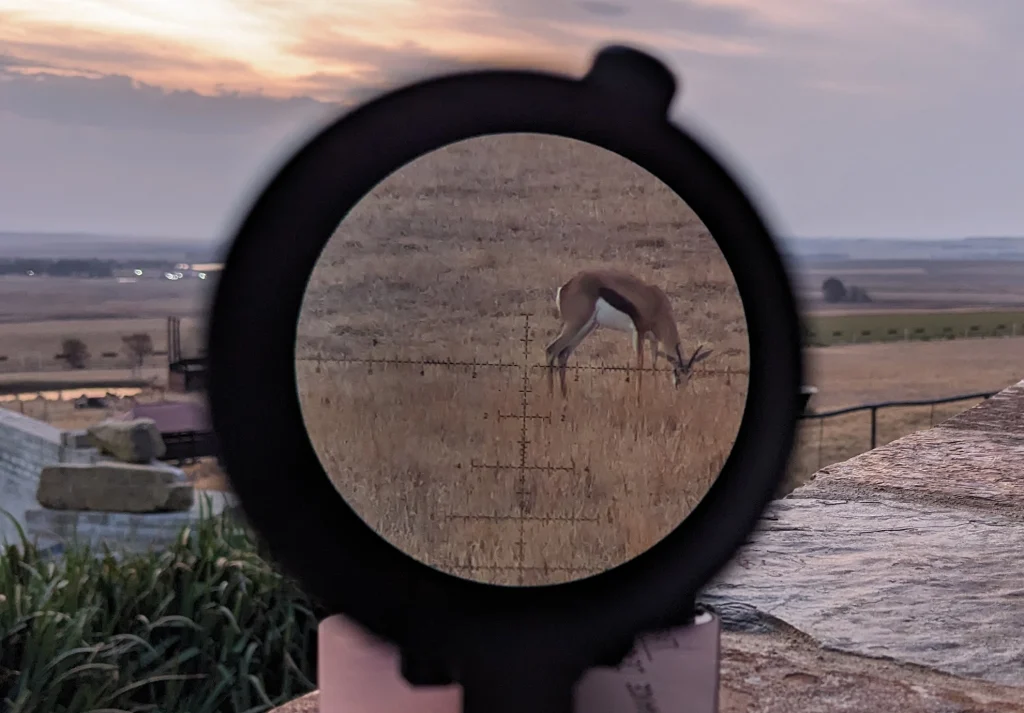
Resolution is the ability to separate two close details. Contrast is the ability to distinguish those details from the background. Alpha glass gives you both at the same time, which is what lets you call a low-contrast impact in dry grass at 800 yards.
Field of view matters more than most shooters expect. On a positional stage, a wider view at a given magnification means faster target acquisition and less time hunting for the next plate.
The practical test is simple: set up at 25x on a target board at 600 yards in mid-afternoon mirage. Better optics let you keep the magnification up. Lesser optics force you to dial back to 15x to see anything useful.
Mechanical Precision Under Match Conditions
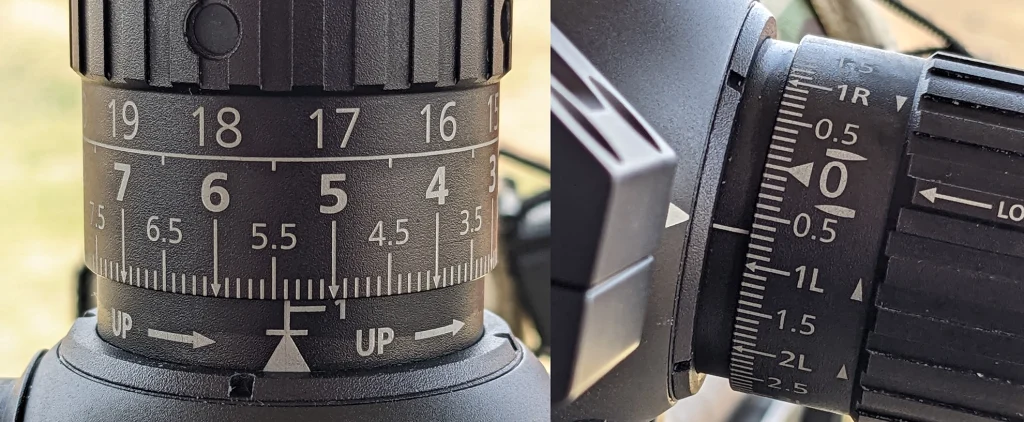
Tracking accuracy is the non-negotiable. If you dial 5 mils and the reticle moves 4.85 mils, you are off by roughly 0.5 MOA at every distance, and it compounds.
Return to zero matters just as much. A match rifle sees hundreds of turret revolutions in a season, plus impacts against barricades and vehicle transport.
Turret feel is not a luxury item. Crisp, tactile, audible clicks let you dial by count without breaking your position or taking your eye off the scope, which is worth real seconds under time.
Why Premium Scopes Dominate Precision Rifle Shooting
Serious competitors converge on a short list of brands because match conditions punish anything that drifts, fogs, or loses zero. Reliability across a full season is the currency.
There is also a resale argument. Flagship optics from established brands hold value well, which lowers the real cost of experimenting with a configuration that ends up not fitting your style.
How to Choose the Right Configuration
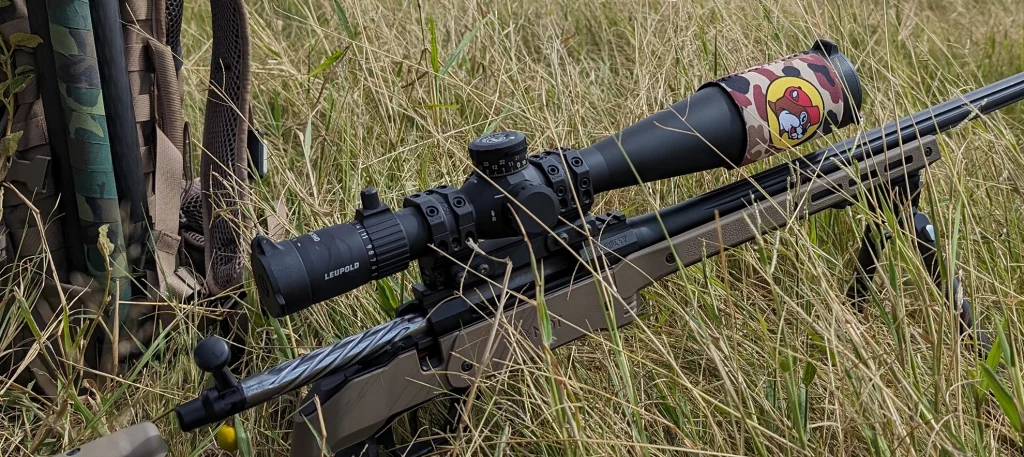
Configuration decisions affect your stage performance more than a marginal difference in glass quality between two flagship scopes. Get the focal plane, angular unit, elevation travel, and reticle right, and you will shoot better with a mid-tier optic than with a poorly configured alpha scope.
First Focal Plane Versus Second Focal Plane
In a first focal plane (FFP) scope, the reticle grows and shrinks with magnification, so your subtensions stay true at every power setting. That is the entire ballgame for precision rifle work.
Second focal plane (SFP) keeps the reticle a constant size, and your holds are only correct at one magnification, usually maximum. It has a place on lightweight hunting rifles where a fine reticle at low power helps in dim light.
For PRS, NRL, and any discipline where you hold wind and elevation off the reticle, choose FFP. Every scope in this roundup is FFP for that reason.
MRAD Versus MOA Adjustments
Both units work. MRAD (milliradian) is base-10, which makes mental math faster: 0.1 mil clicks, 1 mil equals roughly 3.6 inches at 100 yards.
MOA gives finer nominal resolution at 1/4 MOA clicks, about 0.26 inches at 100 yards, but the arithmetic is clumsier under time pressure.
The stronger argument for MRAD is community. Nearly every PRS spotter, ballistic app default, and stage correction call happens in mils. Speaking a different language on the firing line slows you down.
Match your turrets to your reticle. A mil reticle with MOA turrets is a self-inflicted wound.
Elevation Travel, Parallax, and Magnification Range
Total elevation travel determines how far you can dial before running out. For 6mm and 6.5mm cartridges out to 1,200 yards, 25 to 30 mils of usable travel is comfortable. For ELR work with heavy magnums, look for 35 mils or more, and plan on a 20 or 30 MOA canted rail.
Parallax adjustment should be a side knob with a usable range from around 25 yards to infinity. Poor parallax execution introduces aiming error that looks exactly like bad ammunition.
| Magnification Range | Best Fit | Practical Tradeoff |
|---|---|---|
| 5-25x | PRS, general precision | Best balance of FOV, eye box, weight |
| 6-36x | Mixed PRS and long-range | Slightly narrower eye box at top end |
| 7-35x | Known-distance and ELR | Higher minimum power hurts close stages |
| 5-40x | Wide-use competition | Heavier, top power rarely usable in mirage |
Higher magnification is not free. An 8x erector ratio typically means shallower depth of field and a fussier eye box, which slows you down when you are building a rushed position on a barricade.
Christmas Tree Reticles for Holds and Corrections
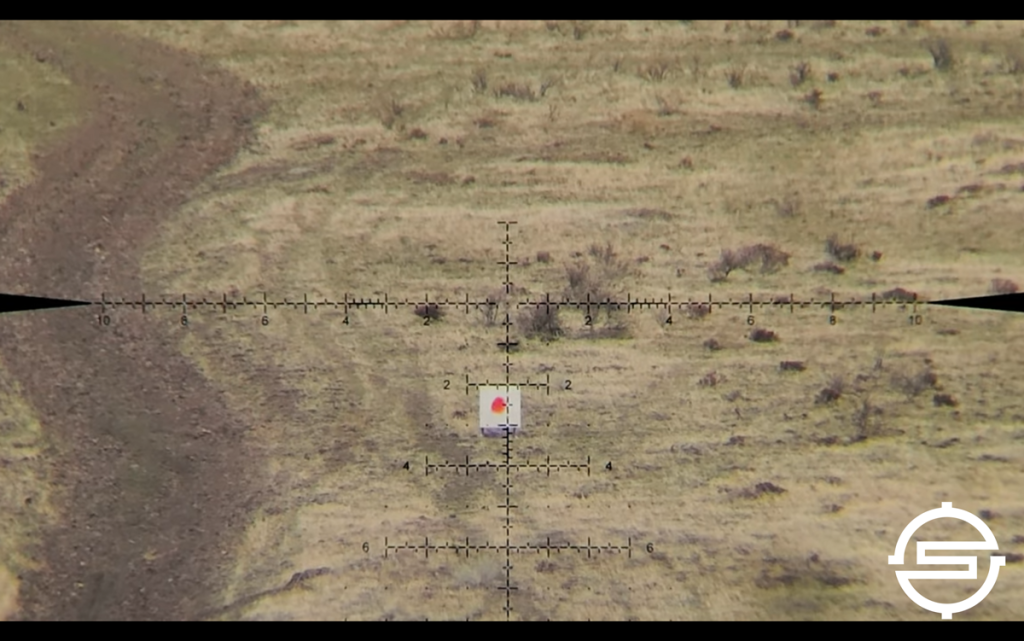
A Christmas tree reticle adds a grid of wind holds below the horizontal stadia, so you can hold both elevation and wind simultaneously instead of dialing.
That saves time on multi-target stages where distances change between shots. It also makes follow-up corrections faster because you can reference exactly where the reticle sat when you broke the shot.
The design tradeoff is clutter. Overly dense trees obscure small targets at distance, so look for reticles with fine floating dots or hash marks rather than heavy lines.
Alpha-Tier Scope Comparison
Seven flagship optics, each with a defensible reason to sit on a match rifle. Specifications matter, but the tradeoffs in weight, field of view, and turret execution are what determine which one belongs on your setup.
| Model | Magnification | Tube | Approx. Weight | Elevation Travel | Notable Strength |
|---|---|---|---|---|---|
| ZCO ZC527 | 5-27×56 | 36mm | ~38 oz | ~34 mils | Field of view and glass |
| Tangent Theta TT525P | 5-25×56 | 34mm | ~38 oz | ~26 mils | Turret feel, tool-less re-zero |
| Leupold Mark 5HD | 5-25×56 | 35mm | ~30 oz | ~30 mils | Lightweight premium |
| Nightforce ATACR F1 | 7-35×56 | 34mm | ~39 oz | ~32 mils | Durability and travel |
| Kahles K540i | 5-40×56 | 34mm | ~37 oz | ~29 mils | Magnification range |
| Vortex Razor HD Gen III | 6-36×56 | 34mm | ~45 oz | ~33 mils | Value and EBR-7D reticle |
| Zeiss LRP S5 | 5-25×56 | 34mm | ~38 oz | ~34 mils | 1-MRAD-per-click option |
Weights and travel figures vary by configuration and reticle; verify against current manufacturer specifications before purchase.
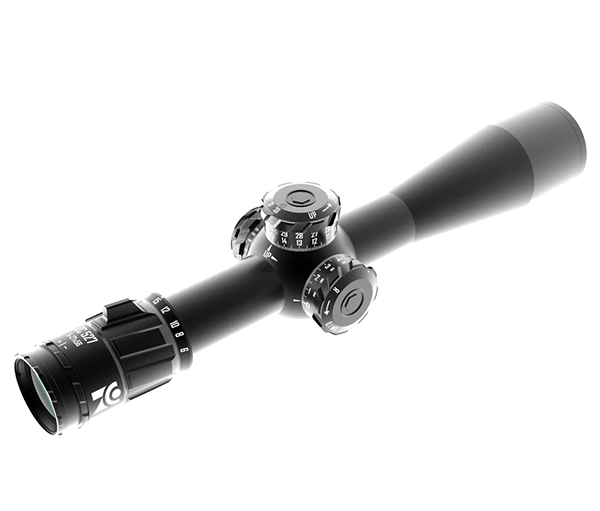
Zero Compromise Optic ZC527
The ZC527 is the current benchmark for field of view at high magnification. That wide view combined with excellent edge-to-edge resolution is what makes it feel fast on positional stages.
Turret execution is exceptional: firm, unmistakable clicks with a locking illumination control that stays out of the way. The 36mm tube supports roughly 34 mils of travel.
The cost is real, and so is the weight. If your priority is maximum optical and mechanical performance without compromise, this is the reference point everything else gets measured against.
Zero Compromise Optic (ZCO) ZC527
- Magnification: 5-27x
- Objective Lens: 56mm
- Tube Diameter: 36mm
- Focal Plane: First Focal Plane (FFP)
- Max Elevation Travel: 35 MRAD / 120 MOA
- Weight: 37.9 oz
- Length: 15.24″
When you use the link above to shop for one of the products, we receive a small commission from the sale, at no extra cost to you. This helps us keep this site going, and does not affect the price you would pay usually in any way whatsoever.
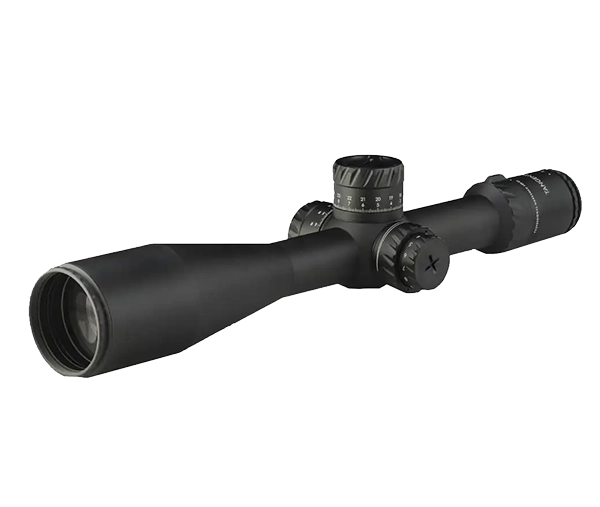
Tangent Theta 5-25×56
Tangent Theta built its reputation on turret feel and mechanical honesty. The clicks are among the most tactile available, and the tool-less re-zero lets you reset the turret in the field without a hex key.
Optically it is superb, with excellent low-light contrast and a clean, uncluttered eye box that stays forgiving as you move between positions.
Elevation travel is more modest than some competitors at roughly 26 mils, so pair it with a 20 or 30 MOA rail if you shoot past 1,200 yards.
Tangent Theta 5-25×56
- Magnification: 5-25x
- Objective Lens: 56mm
- Tube Diameter: 34mm
- Focal Plane: First Focal Plane (FFP)
- Max Elevation Travel: 28 MRAD
- Weight: 40.6 oz
- Length: 16.7″
When you use the link above to shop for one of the products, we receive a small commission from the sale, at no extra cost to you. This helps us keep this site going, and does not affect the price you would pay usually in any way whatsoever.
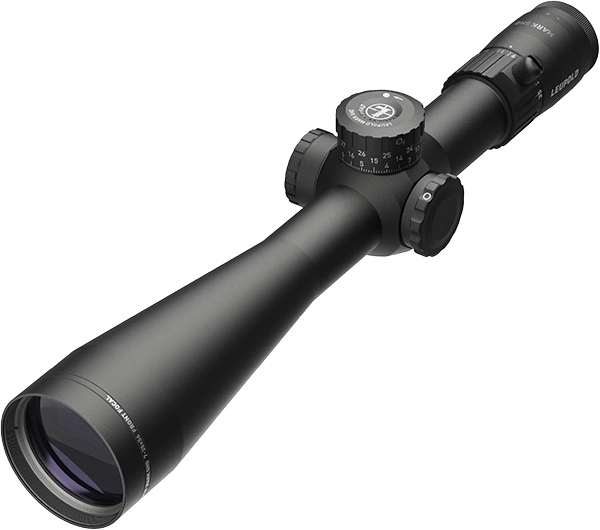
Leupold Mark 5HD 5-25×56
At roughly 30 ounces, the Mark 5HD is meaningfully lighter than most alpha-tier competition, which matters on a hunting-capable rifle or a weight-limited build.
It carries a US Army Precision Sniper Rifle contract pedigree, and the PR2-MIL reticle is one of the cleaner Christmas tree designs, with enough grid to hold wind without blanking out small targets.
Glass is very good rather than class-leading. The tradeoff is deliberate: you give up a small amount of resolution and field of view for eight fewer ounces and a lower price of entry.
Leupold Mark 5HD 5-25×56
- Magnification: 5-25x
- Objective Lens: 56mm
- Tube Diameter: 35mm
- Focal Plane: First Focal Plane (FFP)
- Max Elevation Travel: 34.9 MRAD / 120 MOA
- Weight: 30.0 oz (Lightest in class)
- Length: 15.7″
When you use the link above to shop for one of the products, we receive a small commission from the sale, at no extra cost to you. This helps us keep this site going, and does not affect the price you would pay usually in any way whatsoever.
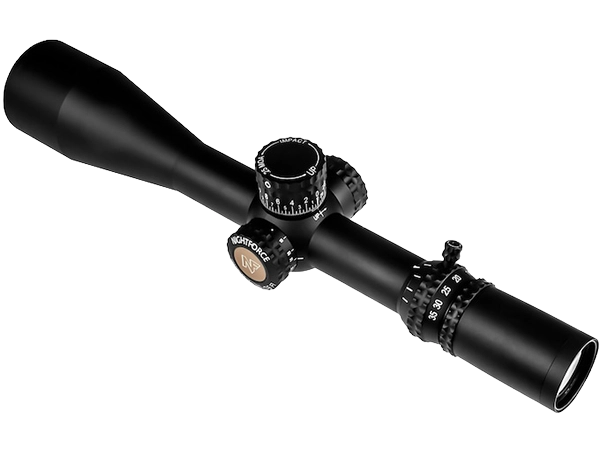
Nightforce ATACR 7-35×56 F1
The ATACR’s reputation is built on surviving abuse. It handles heavy recoil, transport, and weather without complaint, and around 32 mils of travel covers most magnum applications.
The 7x minimum magnification is the honest limitation. On tight, close stages with fast transitions, you will occasionally want 5x and not have it.
For known-distance work, ELR, and any rifle that lives in a truck bed, the durability argument holds up well.
Nightforce ATACR 7-35×56 F1
- Magnification: 7-35x
- Objective Lens: 56mm
- Tube Diameter: 34mm
- Focal Plane: First Focal Plane (FFP)
- Max Elevation Travel: 29 MRAD / 100 MOA
- Weight: 39.3 oz
- Length: 16.0″
When you use the link above to shop for one of the products, we receive a small commission from the sale, at no extra cost to you. This helps us keep this site going, and does not affect the price you would pay usually in any way whatsoever.
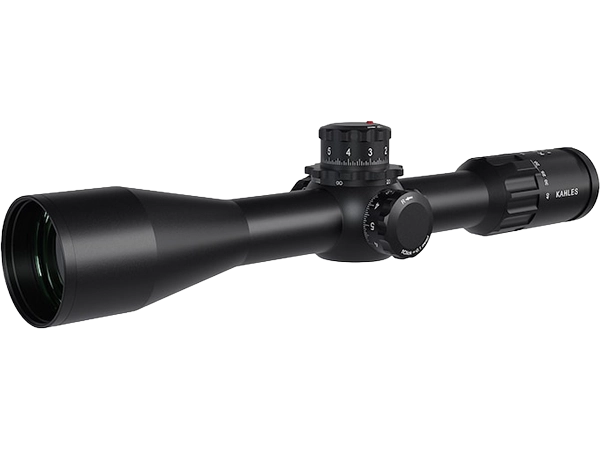
Kahles K540i 5-40x56i
The K540i succeeds the widely used K525i with a broader magnification range and a wider field of view. Kahles has always executed the left-side windage and parallax layout well, and it remains one of the fastest scopes to operate under time.
Forty power is more useful for target identification and spotting than for shooting, since mirage usually caps practical magnification well below that.
The reticle options and the twist guard on the elevation turret make it a strong competition choice for shooters who want range flexibility.
Kahles K540i 5-40x56i
- Magnification: 5-40x
- Objective Lens: 56mm
- Tube Diameter: 36mm (Upgraded from the 34mm K525i)
- Focal Plane: First Focal Plane (FFP)
- Max Elevation Travel: 29 MRAD (2.9 meters at 100m)
- Weight: 39.1 oz (1110 g)
- Length: 16.1″
When you use the link above to shop for one of the products, we receive a small commission from the sale, at no extra cost to you. This helps us keep this site going, and does not affect the price you would pay usually in any way whatsoever.
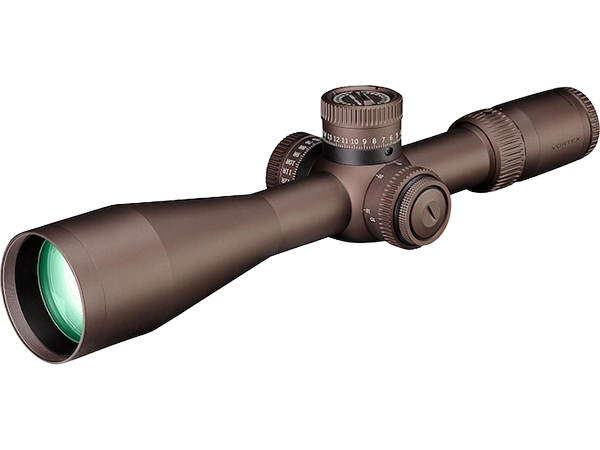
Vortex Razor HD Gen III 6-36×56
The Razor HD Gen III delivers roughly 90 percent of the alpha-tier experience at a meaningfully lower price. Tracking is reliable, travel is generous at around 33 mils, and the glass is genuinely good.
The EBR-7D reticle is one of the best-executed Christmas trees available, with floating dots that stay precise without cluttering the view.
Weight is the drawback at roughly 45 ounces. On a heavy PRS rifle that is fine; on anything you carry, it is a real consideration.
Vortex Razor HD Gen III 6-36×56
- Magnification: 6-36x
- Objective Lens: 56mm
- Tube Diameter: 34mm
- Focal Plane: First Focal Plane (FFP)
- Max Elevation Travel: 36.1 MRAD / 121 MOA
- Weight: 45.1 oz
- Length: 15.3″
When you use the link above to shop for one of the products, we receive a small commission from the sale, at no extra cost to you. This helps us keep this site going, and does not affect the price you would pay usually in any way whatsoever.
Zeiss LRP S5 5-25×56
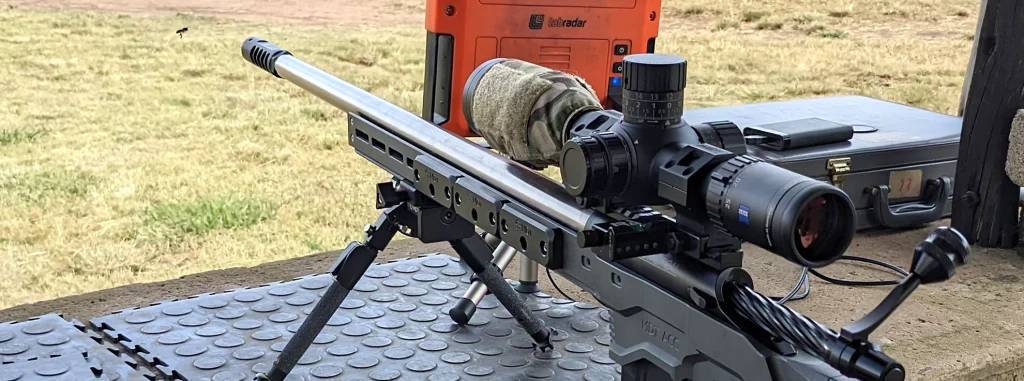
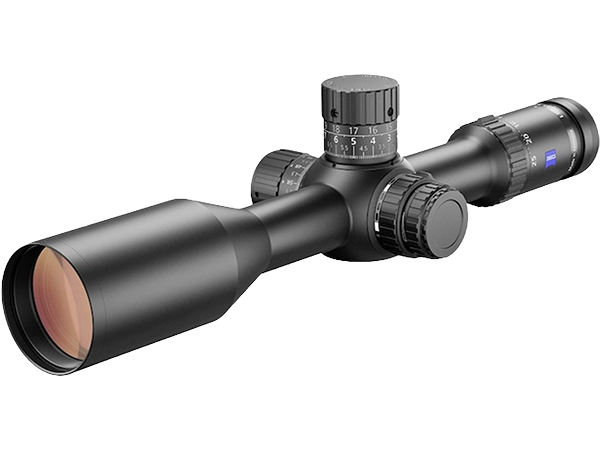
The LRP S5 offers an unusual option: 1-MRAD-per-click turrets alongside the conventional 0.1-mil version. If you dial in whole mils and want fewer rotations, that configuration is genuinely faster.
Zeiss glass performs well in low light, and around 34 mils of travel is competitive with anything in this group.
Turret feel is tactile and positive without being stiff. It is a well-priced entry into the alpha conversation, particularly if the 1-MRAD click concept appeals to how you shoot.
Zeiss LRP S5 5-25×56
- Magnification: 5-25x
- Objective Lens: 56mm
- Tube Diameter: 34mm
- Focal Plane: First Focal Plane (FFP)
- Max Elevation Travel: 40.7 MRAD / 140 MOA (Massive elevation travel)
- Weight: 36.3 oz
- Length: 15.6″
When you use the link above to shop for one of the products, we receive a small commission from the sale, at no extra cost to you. This helps us keep this site going, and does not affect the price you would pay usually in any way whatsoever.
Matching an Optic to Your Rifle and Discipline
The correct scope is a function of your rifle’s weight budget, your typical target distances, and how much time pressure you shoot under. A 45-ounce optic that is perfect for a 22-pound PRS gun is a poor choice for a backcountry rifle.
PRS and NRL Competition Rifles
Prioritize field of view, fast turrets, and a forgiving eye box over maximum magnification. Most engagements fall between 300 and 1,000 yards, where 5-25x is entirely sufficient.
A wide FOV at 15x to 20x is what actually helps you find targets from awkward positions. The ZC527, Kahles K540i, and Razor HD Gen III all serve this role well.
Weight is largely irrelevant on a rifle you carry from the truck to the stage.
Hunting-Capable Precision Rifles
Here weight and low-light performance dominate. The Leupold Mark 5HD is the standout at around 30 ounces, and it still gives you FFP mil holds and repeatable tracking. If you want a thicker reticle for hunting at closer ranges and in the forrest and bush, get the PR-1 illuminated reticle in the 3-18x magnification model.
Consider whether you need 25x at all. A 5-25x is more versatile than a 7-35x on a rifle that might see a 150-yard shot in timber.
Locking or capped windage is worth having so you do not lose your dope on a pack strap.
ELR and High-Magnification Applications
Past 1,500 yards, elevation travel becomes the constraint. Combine a scope with 32 mils or more of internal travel with a 30 to 40 MOA canted base, and verify you can still reach mechanical zero.
Higher magnification helps with target identification and impact spotting, but mirage frequently limits you to 20x to 25x regardless of what the scope offers.
The Nightforce ATACR 7-35×56 and Zeiss LRP S5 both work well in this space. Building reliable dope at these distances depends heavily on verified muzzle velocity and BC data, which is where the ballistics tools and load development resources at LoadDevelopment.com earn their keep.
Rifle Balance, Mount Height, and Rail Cant
Mount height should match your cheek weld, not a spec sheet. Most shooters running a 56mm objective on a modern chassis land between 1.5 and 1.93 inches of ring height.
Too low forces you to compress into the stock; too high creates a shaky head position that costs you consistency in unsupported positions.
A canted rail moves your usable elevation up-range. Twenty MOA is the sensible default for a 6.5 Creedmoor to 1,200 yards; 30 to 40 MOA suits magnums and ELR.
Verifying Tracking Before You Trust a Scope
No scope is exempt from verification, including a $4,000 one. Spend an hour confirming tracking and return to zero before you build a ballistic profile around it.
Tall Target Testing
Hang a plumb-verified target at a laser-measured 100 yards. Mark a lower aiming point and precise vertical reference marks at known intervals.
Shoot a group at the aiming point, dial 5 mils of elevation, and shoot again without moving the aiming point. The group should move exactly 5 mils, which is 17.7 inches at a true 100 yards.
Measure the actual displacement and calculate the percentage error. If your scope moves 17.2 inches instead of 17.7, you have a 2.8 percent tracking error, and you can correct for it in your ballistic solver.
Confirm the vertical line is plumb and the reticle is level, or you will chase a cant error and blame the turrets.
Zero Return and Turret Repeatability
Run a box test: dial 4 mils up, 4 right, 4 down, 4 left, shooting a group at each corner. The final group should land on the original point of impact.
Then dial the full elevation range up and back down several times and re-shoot. A scope that returns to zero after light use but drifts after 30 rotations is a scope you will not trust in a match.
Note any backlash. If reversing direction requires a click or two before the reticle moves, always approach your zero from the same direction.
Confirming Ballistic Data at Distance
Truing your data starts with a chronographed muzzle velocity, not a factory box estimate. Shoot at a known distance past 600 yards and adjust velocity or BC in your solver until predicted and actual elevation match.
Do this in stable conditions with verified atmospheric data. Truing in gusting wind produces a profile that only works in gusting wind.
Re-verify seasonally. Temperature swings shift muzzle velocity enough to matter past 800 yards, particularly with temperature-sensitive powders.
Final Selection Guidance
Three clear recommendations depending on whether you are optimizing for absolute performance, carry weight, or dollar-per-capability.
Best Overall Mechanical and Optical Package
The Zero Compromise Optic ZC527 sets the standard. Field of view at high magnification, resolution, and turret execution are all at or near the top of the category, with roughly 34 mils of travel to back it up.
If budget is not the primary constraint and your rifle is a dedicated precision platform, this is the optic other scopes get compared against. The Tangent Theta 5-25×56 is the close alternative if turret feel is your highest priority.
Best Lightweight Premium Crossover
The Leupold Mark 5HD 5-25×56 at roughly 30 ounces is the practical answer for a rifle that has to be carried. You give up some resolution and field of view relative to the top of the field, and you gain eight or more ounces back.
The PR2-MIL reticle is well judged for holds without visual clutter, and the PSR contract pedigree speaks to its mechanical reliability.
Best Value Among Flagship FFP Scopes
The Vortex Razor HD Gen III 6-36×56 delivers the largest share of alpha-tier capability per dollar. Tracking is dependable, the EBR-7D reticle is excellent, and 33 mils of travel covers nearly everything short of extreme ELR.
At around 45 ounces it is heavy, so it is better suited to a match rifle than a hunting build. The Zeiss LRP S5 5-25×56 is the alternative worth considering, particularly if the 1-MRAD click option fits how you dial.
Frequently Asked Questions
For most serious precision shooters, the ZCO ZC527 represents the current benchmark for optical resolution, field of view, and turret execution. That said, the Leupold Mark 5HD and Vortex Razor HD Gen III deliver most of that capability for less money or less weight, and the best choice depends on your discipline and rifle.
Any quality FFP scope with at least 25 mils of usable elevation travel and verified tracking will handle 1,000 yards. A 5-25×56 in MRAD with a Christmas tree reticle, paired with a 20 MOA canted rail, is the practical standard configuration.
Between 12x and 20x is typically the useful range at 1,000 yards, since mirage often limits what higher magnification can resolve. Anything from a 5-25x on up gives you sufficient power, and the wider field of view at moderate magnification usually helps more than extra top-end power.
If flagship pricing is out of reach, look for an FFP MRAD scope with at least 25 mils of travel, a locking zero-stop turret, and a documented tracking record. Verify tracking with a tall target test before building your ballistic data around it, because consistency matters more than glass quality at this price point.
The Leupold Mark 5HD 5-25×56 is the strongest crossover pick, weighing roughly 30 ounces while retaining FFP mil holds and repeatable tracking. For hunting rifles, prioritize weight, low-light performance, and a magnification range that starts at 5x or lower for close shots.
The Razor HD Gen III 6-36×56 is Vortex’s flagship for precision rifle work, with reliable tracking, roughly 33 mils of travel, and the well-designed EBR-7D reticle. Its main drawback is weight at around 45 ounces, which makes it better suited to a match rifle than a rifle you carry into the field.

AJ Deysel is a competitive rifle shooter in the PRS and NRL Hunter series, a lifelong hunter, and a recognized ballistics specialist whose load development expertise has been featured by industry leaders like Hornady. He is the founder and lead editor of LoadDevelopment.com. Read more about AJ or view our Editorial & Testing Guidelines.