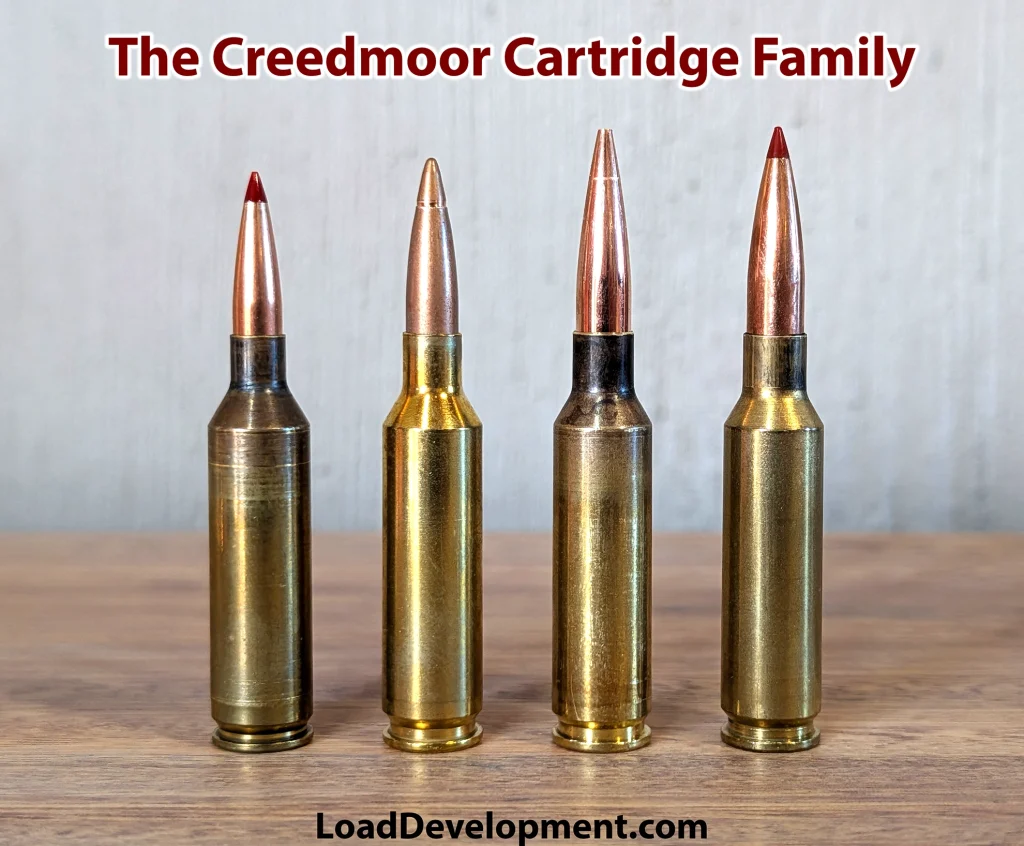
When I compare 308 vs 30-06, I do not start with hunting stories or military nostalgia. I start at the loading bench, because that is where the real differences show up, in case capacity, seating room, powder efficiency, recoil, and the kind of rifle each cartridge fits best.
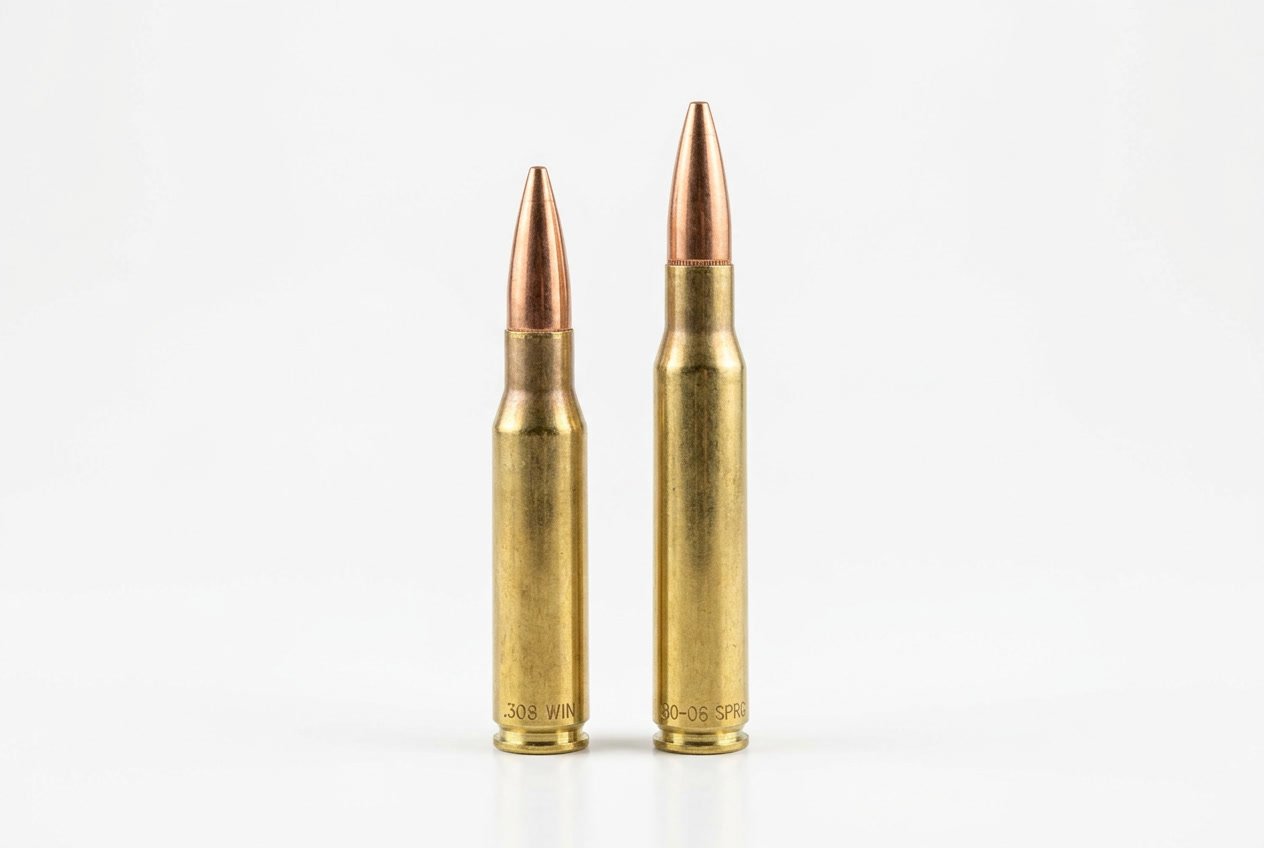
If I want the most efficient, practical, easy-to-load .30-caliber option for most shooters, I pick the .308 Winchester, and if I want more room for heavier bullets and a little more velocity headroom, I pick the 30-06 Springfield.
Both are proven rifle cartridges with strong ballistics, broad component support, and a long record in the field. The real question is not whether one works. It is which tradeoffs make more sense for your rifle, your bullet weight range, and your load development goals.
Key Takeaways
- I see the .308 Winchester as the better fit for most reloaders and shooters.
- I use the .30-06 when I want extra case capacity and more flexibility with heavy bullets.
- I care more about rifle fit, powder efficiency, and seating depth than small paper differences in factory ballistics.
The Short Answer
For most shooters, the .308 Winchester gives me nearly everything I want with less powder, less felt recoil, and a short-action rifle. The 30-06 Springfield gives me more case capacity, more room to work with heavier bullets, and a little more top-end performance.
308 vs 30-06 Ballistics Chart
To compare external ballistics fairly, we must normalize the variables. Below is a comparison using identical 168-grain match bullets fired from identical 24-inch barrels, assuming a 100-yard zero and a 10 mph crosswind.
| Metric (168gr Bullet) | .308 Winchester | 30-06 Springfield |
|---|---|---|
| Muzzle Velocity | 2,700 FPS | 2,850 FPS |
| Muzzle Energy | 2,719 ft-lbs | 3,030 ft-lbs |
| Drop at 300 Yards | -14.5 inches | -12.2 inches |
| Drop at 500 Yards | -52.8 inches | -44.1 inches |
| Wind Drift at 500 Yds | 21.4 inches | 19.5 inches |
Note: The 30-06 shoots flatter and drifts slightly less in the wind due to its higher initial velocity. If you want to run custom drop charts for your specific environment and barrel length, download one of our recommended Ballistic Solvers.
Which One Makes More Sense for Most Shooters
If someone asks me for the shortest honest answer in the 308 vs 30-06 debate, I say .308 Winchester. Its shorter case length, shorter overall length, and short-action rifle compatibility make it efficient and easy to live with.
It also tends to be easier on powder, easier on recoil, and easy to find in both factory and reloading form. For the average handloader, that is hard to beat.
When the .308 Winchester Is the Better Fit
I lean toward .308 when I want a compact rifle, faster bolt cycling, and a cartridge that performs well without needing a lot of case capacity. It is especially strong with midweight bullets, practical field rifles, and target setups where consistency matters more than squeezing out every last foot per second.
If I am loading common bullet weight range options like 150 to 175 grain, .308 is usually the cleaner answer.
When the .30-06 Springfield Pulls Ahead
I choose the .30-06 when I want more room in the case and more flexibility at the heavy end. That extra space matters when I am loading 180 grain bullets and up, or when I want to reach a velocity target without crowding the pressure ceiling too quickly.
It also makes sense when I already own a long-action rifle and want one cartridge that can cover a wide span of hunting and field use.
Case Dimensions, Capacity, and Rifle Fit

The biggest mechanical differences between these cartridges show up in case length, case capacity, and the action they require. Those details affect bolt throw, magazine space, seating depth, and the way I approach a handload from the start.
Case Length, COAL, and Water Capacity
The .308 Winchester has a case length of about 2.015 inches and a standard overall length near 2.80 inches. The 30-06 Springfield stretches to about 2.494 inches with an overall length near 3.34 inches.
Typical case capacity runs around 58 grains of water for .308 and 68 grains of water for .30-06, though brass brand matters. That extra capacity is the core reason the .30-06 can push equal bullet weights a bit faster.
| Cartridge | Case Length | Overall Length | Approx. Case Capacity |
|---|---|---|---|
| .308 Winchester | 2.015″ | 2.80″ | 58 gr H2O |
| 30-06 Springfield | 2.494″ | 3.34″ | 68 gr H2O |
Short-Action Vs Long-Action Platforms
The .308 fits short-action rifles. The 30-06 needs a long-action rifle.
That sounds simple, though it matters a lot in practice. A short-action rifle usually means a more compact receiver, slightly less rifle weight, and a shorter cycle. The .308 Winchester also shares dimensional lineage with 7.62x51mm NATO, or 7.62×51mm, even though I do not treat commercial .308 and military 7.62x51mm as interchangeable without checking the rifle and chamber first.
Historically, the Winchester Model 70 helped popularize .308 in sporting rifles, while the M1 Garand cemented the .30-06 as a classic. The FN FAL and other 7.62x51mm rifles pushed the shorter cartridge into a different class of platforms.
Bolt Throw, Magazine Space, and Seating Depth
A short-action rifle has less bolt throw, and I notice that immediately on bolt action rifles. The movement is shorter, the rhythm is quicker, and follow-up work feels more efficient.
Magazine space matters to reloaders too. In .308, long-for-caliber bullets can eat into powder space sooner. In .30-06, I get more room to seat longer bullets without crowding the case as badly, which can make load tuning easier with certain bullet shapes.
Powder Efficiency and Load Development Tradeoffs
From a reloader’s perspective, this is where the comparison gets interesting. The .308 Winchester gets impressively close to 30-06 ammo performance with less powder, while the .30-06 ammo starts to justify its larger case when bullet weight climbs or velocity goals get more ambitious.
Why the .308 Winchester Delivers So Much With Less Powder
The .308 is one of the best examples of efficient cartridge design. I can get strong muzzle velocity and useful muzzle energy without burning as much powder as the .30-06.
That efficiency pays off in several ways:
- Lower powder consumption per round
- Less recoil in similar rifles
- Good performance from shorter barrels
- Less sensitivity to wasted case volume with common bullet weight choices
For a high-volume reloader, that matters. Over a few hundred rounds, the savings in powder and wear add up.
Where the .30-06 Springfield Uses Extra Capacity Well
The 30-06 Springfield shines when I actually use its extra case capacity instead of just duplicating .308 loads in a longer case. It starts to make more sense with 165 to 180 grain bullets, and especially with 180 grain hunting loads where extra velocity can improve ballistics and terminal performance.
That is where 30-06 ammo has real separation, not magical separation, just real and useful.
Velocity Goals Without Chasing Pressure
I try not to treat published max numbers like a finish line. In both cartridges, accuracy nodes often show up before maximum charge weight, and that is usually where I stop.
With .308 ammo, I can often hit practical velocity goals quickly. With .30-06 ammo, I have more room to work, though I still want stable brass, sane pressures, and consistent SDs. On LoadDevelopment.com, I usually point people toward calculators and simple comparison tools first, because a small velocity advantage is not worth unstable load behavior.
Bullet Weight Sweet Spots and Downrange Performance
Both cartridges shoot the same .308-inch bullets, though they do not behave the same across the full bullet weight range. I think of the .308 as excelling in the middle, while the .30-06 gains ground as bullets get heavier and longer.
Best Bullet Weight Range for .308 Winchester
The .308 Winchester is at home with bullets from about 147 to 175 grain. My favorite working range is usually 150 to 168 grain for general use, with 175 grain still fitting well for longer-range work.
Inside 300 yards, there is little practical difference for many field loads. Out to 500 yards, a well-built .308 load still holds up well if the bullet has a decent ballistic coefficient and the velocity spread is controlled.
Why Heavy Bullets Favor the .30-06 Springfield
The .30-06 Springfield handles 180 grain bullets with less compromise. It can also make better use of longer heavy bullets without intruding as deeply into powder space, especially when magazine limits matter.
That does not make the .308 weak. It just means the .30-06 has more room to breathe at the heavy end, and I notice that on the bench before I notice it on paper.
Trajectory, Bullet Drop, and Ballistic Coefficient
Trajectory differences between the two are often smaller than people expect with similar bullet design. At 300 yards, bullet drop differences are modest. At 500 yards, the faster .30-06 may hold a slight edge if bullet weight and ballistic coefficient are matched.
At 800 yards and beyond, and especially toward 1,000 yards, bullet selection and consistency matter more than internet claims. For long-range shooting, the .308 remains proven, though its effective range is limited more by wind drift and velocity loss than by inherent accuracy. The .30-06 can carry a little more speed, which helps, though it has never dominated precision circles the way .308 once did.
Recoil, Accuracy, and Shootability
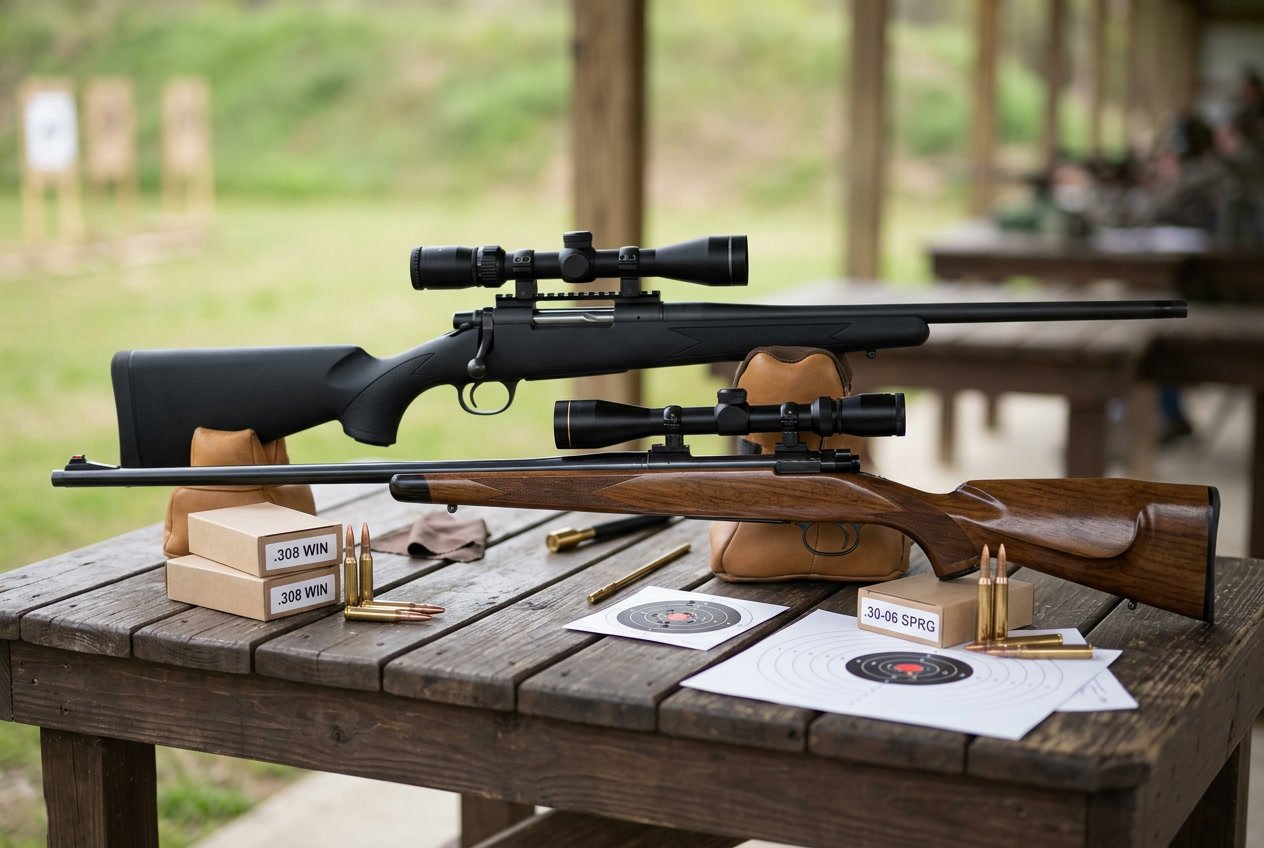
For practical shooting, I care less about abstract power and more about what I can shoot well, repeatably, from real positions. Recoil, rifle weight, action length, and the way a rifle tracks under fire all matter at least as much as a small velocity edge.
Felt Recoil in Rifles of Similar Weight
In rifles of similar weight, the 30-06 produces more recoil and more felt recoil. The exact gap depends on load and rifle weight, though the pattern is consistent.
That difference is not huge, though it is real. In a light hunting rifle, I notice it quickly. In a heavier target shooting setup, it matters less, though the .308 is still easier to shoot for long strings and easier to spot impacts with.
If you want exact estimates, a recoil calculator is more useful than guesswork.
Why Short Actions Often Get the Accuracy Edge
Short-action receivers have long been associated with accuracy, mostly because they are compact and rigid. I think that edge is real in theory, though modern rifle quality has narrowed it.
The bigger practical advantage is system efficiency. Short-action bolt action rifles tend to feel faster, cleaner, and more settled in use. That is one reason .308 became so common with military snipers and police snipers for so long.
Follow-Up Shots and Practical Field Handling
Follow-up shots are easier when the rifle recoils less and cycles faster. That is one reason I often prefer .308 in field rifles and practical match-style setups.
A 30-06 hunting rifle still handles well, and I have no issue carrying one when I want its heavier-bullet flexibility. I just shoot the .308 a little faster and with less fatigue over time.
Brass, Ammunition Availability, and Best-Use Cases
For reloaders, component supply often decides more than raw ballistics. Brass quality, primer size, factory ammo selection, and intended use all shape the smarter choice between these two hunting cartridges.
Brass Availability, Cost, and Primer Variations
Both cartridges are widely available, and both have strong brass support. I usually find .308 ammo and brass a little easier to source in volume, especially once I start looking at match-oriented inventory.
A few practical notes matter:
- .308 brass is common in both commercial and military-pattern forms
- Some .308 Winchester brass uses large rifle primers, and some match brass uses small rifle primers
- 30-06 brass is still common, especially in hunting-focused product lines
- Military 7.62x51mm brass can differ in internal volume from commercial .308 brass
When I switch brass lots, I reduce and rework the load. I do not assume case capacity stays the same.
Factory Ammo Options and Component Flexibility
Factory .308 ammo tends to offer more target shooting and precision-oriented choices. Factory .30-06 ammo tends to shine in traditional hunting rifle roles, with many premium hunting loads built around 165 grain and 180 grain bullets.
Both are flexible for reloaders. If I am tuning for accuracy and volume, I prefer .308. If I want one rifle for a wider spread of hunting applications, .30-06 gives me more room.
For parts compatibility, I also like checking bolt face dimensions before a build, which is why I often keep a bolt face database handy.
Choosing for Deer Hunting, Big Game Hunting, and Range Work
For deer hunting, including whitetail hunting and hunting deer in normal field conditions, either one works extremely well. I would not hesitate to use either with a good bullet.
For big game hunting, the .30-06 gets my nod when bullet weights get heavier and penetration becomes a bigger part of the discussion. For range work and target shooting, I give the edge to .308 because it is efficient, common, and easier to shoot well.
If someone is considering a 300 Winchester Magnum instead, I usually ask a simple question: do you need magnum performance, or do you just want it? Most shooters do not need it.
Frequently Asked Questions
At common hunting distances, both are very close with similar bullet designs. The .30-06 usually carries a little more energy and a slight velocity edge, while trajectory differences inside 300 yards are small enough that shot placement matters far more.
The 30-06 Springfield typically produces more felt recoil in rifles of similar weight. That comes from greater powder charge and slightly higher velocity with comparable bullet weights.
.308 ammo is often easier to find in bulk, match, and training-oriented loads, and it is commonly a little cheaper. .30-06 ammo is still very available in the U.S. market, especially in hunting loads, though the selection leans more toward field use than precision use.
For deer hunting, I think they are both excellent. If I had to pick one for pure simplicity, I would say .308 for lighter recoil and broad ammo choice, while .30-06 gets the edge if I also want to step up bullet weight for larger game.
The .308 has a long, proven track record for long-range accuracy, especially with quality 168 and 175 grain loads. The .30-06 can extend velocity and energy a bit farther, though in practical field conditions the shooter, rifle, and bullet consistency usually matter more than the cartridge name.
The .308 became more common in precision and sniper roles because it fit short-action systems, produced manageable recoil, and delivered strong consistency with match bullets. It was easier to build accurate rifles around it, and that practical advantage mattered more than the .30-06’s extra case capacity.

AJ Deysel is a competitive rifle shooter in the PRS and NRL Hunter series, a lifelong hunter, and a recognized ballistics specialist whose load development expertise has been featured by industry leaders like Hornady. He is the founder and lead editor of LoadDevelopment.com. Read more about AJ or view our Editorial & Testing Guidelines.