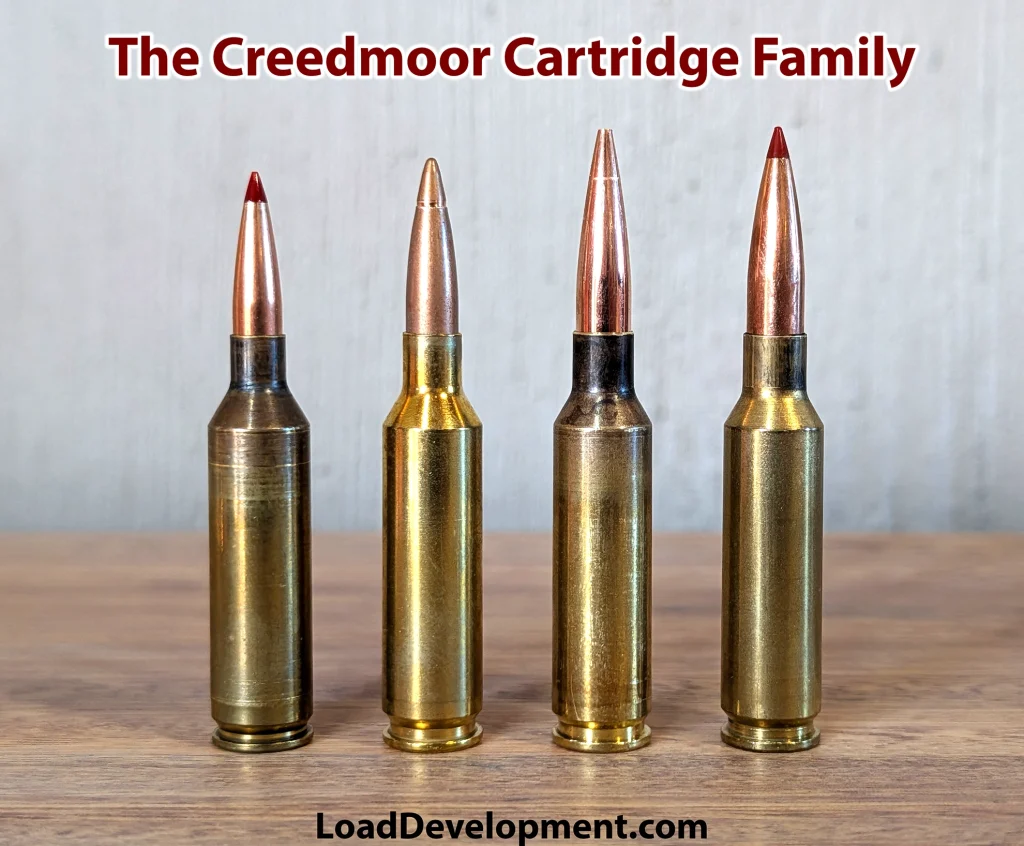
When Hornady introduced the Precision Rifle Cartridge (PRC) family, they weren’t just releasing new calibers to sell more brass; they were fundamentally fixing the chamber and case geometry issues that have plagued legacy magnums for over half a century.
The 6.5 PRC, 7mm PRC, and 300 PRC were designed from the ground up for modern long-range shooting. They eliminate the useless belts found on legacy magnums, utilize faster twist rates to stabilize long, high-Ballistic Coefficient (BC) bullets, and feature throat geometries that keep the bullet’s bearing surface out of the powder column.
If you are building a new rifle or rebarreling an existing action, deciding between the 6.5 PRC, 7mm PRC, and 300 PRC comes down to understanding action lengths, recoil management, and terminal energy requirements. Here is the technical breakdown of how these three cartridges compare, their inherent reloading quirks, and which one fits your application.

The Core Concept Behind the PRC Family
Before looking at the individual cartridges, you have to understand the engineering baseline Hornady used for the entire PRC lineup. All three cartridges share these modern design principles:
- Beltless Cases: They are all based on the .375 Ruger parent case geometry (shortened or necked down). The lack of a belt means they headspace off the shoulder, providing better concentricity in the chamber and longer brass life.
- Magnum Bolt Face: All three utilize a standard .532″ magnum bolt face.
- Optimized Freebore: Legacy magnums (like the .300 Win Mag) have short throats, forcing reloaders to seat long, heavy bullets deep into the case, eating up powder capacity. The PRC chambers are cut with long freebores, allowing long, high-BC bullets to be seated out where they belong.
- Fast Twist Rates: SAAMI spec twist rates for the PRC family are faster than legacy counterparts (e.g., 1:8 for the 7mm PRC vs 1:9.5 for the 7mm Rem Mag) to stabilize modern ELD-M, ELD-X, and heavy Berger bullets.
6.5 PRC vs 7mm PRC vs 300 PRC: Ballistics and Specs
Here is the baseline SAAMI specification and average performance matrix for the three commercial PRC cartridges:
| Specification | 6.5 PRC | 7mm PRC | 300 PRC |
|---|---|---|---|
| Action Length | Short Action / Medium | Long Action | Magnum Action |
| Bolt Face | .532″ (Magnum) | .532″ (Magnum) | .532″ (Magnum) |
| Max SAAMI Pressure | 65,000 psi | 65,000 psi | 65,000 psi |
| Case Capacity (H2O) | ~67.6 grains | ~81.0 grains | ~97.0 grains |
| Standard Bullet Weight | 143gr – 147gr | 175gr – 180gr | 212gr – 225gr |
| Average Muzzle Velocity | 2,950 fps (143gr) | 2,950 fps (180gr) | 2,850 fps (225gr) |
6.5 PRC (The Short Action King)
The 6.5 PRC is essentially a magnum 6.5 Creedmoor. It pushes a 143gr bullet about 200-250 fps faster than the Creedmoor. While it is billed as a short-action cartridge, handloaders pushing high-BC bullets seated close to the lands often find standard short actions restrictive. It feeds much better in a medium action (like a Defiance XM) or a short action with a Wyatt’s extended magazine box.
It is the ideal choice for crossover PRS/hunting setups where recoil spotting is critical, but you want more kinetic energy on target than a standard 6.5mm provides.
For complete powder charges, brass availability, and velocity charts, view our full 6.5 PRC Load Data and Ballistics Guide.
7mm PRC (The Modern Sweet Spot)
The 7mm PRC is the cartridge the 7mm Remington Magnum should have been. It fits perfectly in a standard long action (3.340″ COAL) and is designed specifically to push 175gr to 180gr bullets at around 2,950 fps.
Because of the 7mm’s inherently high ballistic coefficients, the 7mm PRC retains energy incredibly well at 1,000 yards while generating significantly less free recoil than the 300 PRC. For the modern western hunter targeting deer, elk, and antelope, this is currently the most balanced cartridge on the market.
For case dimensions, barrel life expectations, and trajectory charts, view our complete 7mm PRC Ballistics Guide.
300 PRC (The Heavyweight)
The 300 PRC requires a true magnum-length action (3.700″ COAL). It was designed for Extreme Long Range (ELR) shooting and heavy game. It completely outclasses the 300 Win Mag by allowing 225gr+ bullets to be seated properly without intruding past the neck-shoulder junction.
Recoil is substantial. If you are building a 300 PRC, you need a heavy rifle profile and a highly efficient muzzle brake or suppressor.
For deep-dive 1000-yard energy comparisons and load data, see our 300 PRC Ballistics Breakdown.

Typical Bullet Weights, Factory Loads, and Ammo Availability
| Cartridge | Typical Bullet Weights | Common Factory Load | Muzzle Velocity |
|---|---|---|---|
| 6.5 PRC | 140–147 gr | Hornady Precision Hunter 143 gr ELD-X | ~2,960 fps |
| 7mm PRC | 175–195 gr | Hornady Precision Hunter 175 gr ELD-X | ~3,000 fps |
| .300 PRC | 208–230 gr | Hornady Precision Hunter 212 gr ELD-X | ~2,860 fps |
Ammo availability has improved significantly for all three, but the 6.5 PRC and 7mm PRC are easier to find on shelves in 2026. The .300 PRC still has a smaller factory load selection, and you may find fewer options from manufacturers outside Hornady. If you reload, component brass and reloading data are readily available for all three through sources like LoadDevelopment.com’s cartridge pages and powder databases.
The Hornady 6.5 PRC and Hornady 7mm PRC lines both offer multiple Precision Hunter and match loads. The .300 PRC factory catalog is narrower, leaning heavily toward Hornady Precision Hunter and ELD Match offerings.
Ballistics, Trajectory, and Wind Performance

The 7mm PRC and .300 PRC hold clear advantages in retained energy and wind resistance over the 6.5 PRC, but the 6.5 PRC’s trajectory is remarkably flat for its recoil class. Where these numbers actually matter depends on whether your priority is punching steel at distance or putting an animal down cleanly.
Muzzle Velocity and Downrange Energy
The 6.5 PRC launches a 143-grain ELD-X at roughly 2,960 fps, delivering about 2,780 ft-lbs at the muzzle. At 500 yards, retained energy drops to approximately 1,610 ft-lbs.
The 7mm PRC sends a 175-grain ELD-X at about 3,000 fps, producing around 3,500 ft-lbs at the muzzle and roughly 2,140 ft-lbs at 500 yards. That 33% energy advantage at 500 yards over the 6.5 PRC is meaningful on elk-sized game.
The .300 PRC with a 212-grain ELD-X at roughly 2,860 fps generates about 3,850 ft-lbs at the muzzle and retains approximately 2,400 ft-lbs at 500 yards. It carries the most downrange energy of the three at every distance.
| Cartridge | Muzzle Energy (ft-lbs) | 500 yd Energy (ft-lbs) | Muzzle Velocity (fps) |
|---|---|---|---|
| 6.5 PRC (143 gr) | ~2,780 | ~1,610 | ~2,960 |
| 7mm PRC (175 gr) | ~3,500 | ~2,140 | ~3,000 |
| .300 PRC (212 gr) | ~3,850 | ~2,400 | ~2,860 |
Ballistic Coefficient, High-BC Bullets, and Wind Drift
This is where the PRC family earns its reputation. All three cartridges were designed around high-BC bullets, and the larger bore diameters allow progressively higher ballistic coefficients.
The 143-grain 6.5mm ELD-X carries a G1 BC around .623. The 175-grain 7mm ELD-X comes in near .689. The 212-grain .30-caliber ELD-X sits around .673, though heavier 230-grain match bullets like the ELD-M can push past .740.
At 1,000 yards in a 10 mph crosswind, the 6.5 PRC drifts roughly 58 inches, the 7mm PRC about 50 inches, and the .300 PRC (with a heavy match bullet) approximately 44 inches. Those differences grow with distance and wind speed.
For long-range target shooting and competitive shooting, the wind drift advantage of the 7mm and .300 PRC is significant. The 6.5 PRC remains competitive, but its lighter bullet sheds velocity faster beyond 800 yards.

What the Numbers Mean for Long-Range Shooting
Trajectory differences between the three are smaller than most shooters expect inside 600 yards. All three drop within a few inches of each other at 500 yards when zeroed at 100. The separation really opens up past 700 yards, where the 7mm PRC’s combination of high BC and high muzzle velocity gives it the flattest trajectory of the group.
For precision shooting at 1,000 yards and beyond, the 7mm PRC and .300 PRC both outperform the 6.5 PRC in wind resistance and retained velocity. If you are building a dedicated long-range precision rifle, the 7mm PRC offers the best ballistic performance relative to recoil. The .300 PRC buys you the most wind resistance but demands a heavier rifle and more recoil management.
Recoil, Shootability, and Barrel Life
Recoil drives flinching, and flinching ruins accuracy. The PRC family spans a wide recoil range, from genuinely comfortable to punishing in a lightweight rifle. Barrel life varies just as dramatically, which shapes how much you can practice before re-barreling.
Free Recoil and Real-World Recoil Energy
In an 8.5-pound scoped rifle, approximate free recoil energy breaks down like this:
| Cartridge | Recoil Energy (ft-lbs) | Felt Recoil Character |
|---|---|---|
| 6.5 PRC | ~15–17 | Low recoil, easy to manage |
| 7mm PRC | ~22–25 | Moderate recoil, noticeable but controllable |
| .300 PRC | ~30–35 | Heavy recoil, requires weight or muzzle brake |
The 6.5 PRC feels similar to a .308 Winchester, making it accessible for smaller-framed shooters and those who want to shoot high volumes without fatigue. The 7mm PRC sits in comfortable territory for most experienced hunters. The .300 PRC demands a good muzzle brake or suppressor and a heavier rifle to stay manageable during practice sessions.
The “Bolt Click” Issue in PRC Cartridges (And How to Fix It)
If you reload for the PRC family—especially the 6.5 PRC and 7mm PRC—you need to be aware of the “bolt click” or hard bolt lift issue.
Many shooters find that after 2 or 3 firings of virgin brass, their bolt becomes incredibly stiff at the top of the bolt lift during primary extraction. You will hear and feel a distinct “click.” This is often misdiagnosed as over-pressure, but it is actually a sizing issue.
Why it Happens
The PRC cases are relatively fat and have minimal body taper. Upon firing, the brass expands to grip the chamber walls. The issue occurs right at the case web (the thickest part of the brass just above the extractor groove, around the .200″ line).
Standard Full Length (FL) sizing dies have an internal radius at the mouth of the die to allow the brass to enter smoothly. Because of this radius, the die physically cannot size the last .150″ to .200″ of the case web. Over multiple firings, that web area continues to expand outward until it causes a friction fit in the chamber, resulting in hard bolt lift.
How to Fix It
If you are running into bolt click on your PRC, standard dies won’t save you. You have three practical solutions:
- Use Specialized Sizing Dies: Die makers like Short Action Customs (SAC) and Cortina Precision make sizing dies specifically engineered to reach further down the case body to size the web.
- The DIY / Roll Sizing Method: You can use a Larry Willis collet die (originally designed for belted magnums) to specifically squeeze the web area back down to SAAMI spec without touching the rest of the case.
- Custom Reamers (AW Spec): If you are having a custom rifle built, ask your gunsmith to use an “AW” (Alex Wheeler) spec reamer. These reamers are cut slightly larger at the .200″ line, giving the brass more room to expand before it binds, effectively eliminating the issue with standard dies.
Pushing the Limits: PRC-Based Wildcats
Because the PRC cases are beltless, have excellent case capacities, and utilize a standard magnum bolt face, they have become the premier parent cases for modern wildcatters looking to push the limits of internal ballistics.
- 6mm PRC: By necking the 6.5 PRC down to 6mm, wildcatters are pushing high-BC 110gr and 115gr 6mm bullets at blistering speeds (3,200+ fps). It is an absolute laser for predator hunting, though it is notoriously hard on barrels.
- 22 PRC: Taking the 6.5 PRC case down to .224 caliber. Pushing heavy 85gr to 95gr .22 caliber bullets at over 3,500 fps. This is the bleeding edge of diminished returns and overbore capacity, but it delivers devastating terminal ballistics.
- 6.5-300 PRC & 6.5-7 PRC: Necking down the massive 300 PRC or 7mm PRC cases to 6.5mm creates incredibly overbore wildcats that rival or exceed the 26 Nosler and 6.5-300 Weatherby Magnum.
Want to see exactly how these cartridges perform at your specific altitude and density altitude? Run the numbers yourself using the Trajek Calculator.
Frequently Asked Questions
PRC stands for Precision Rifle Cartridge. It is a line of modern, beltless rifle cartridges designed by Hornady to utilize high ballistic coefficient bullets seated outside the powder column.
Yes. The 6.5 PRC, 7mm PRC, and 300 PRC all require a standard magnum bolt face (.532″).
The 6.5 PRC has the least recoil of the family. It generates roughly half the free recoil energy of the 300 PRC and about 25% less recoil than the 7mm PRC, making it highly manageable for target shooting and hunting.
No. While they both fire the same .264 caliber diameter bullets, the 6.5 PRC case is significantly wider and longer. Firing a 6.5 Creedmoor in a 6.5 PRC chamber will result in a catastrophic case rupture.

AJ Deysel is a competitive rifle shooter in the PRS and NRL Hunter series, a lifelong hunter, and a recognized ballistics specialist whose load development expertise has been featured by industry leaders like Hornady. He is the founder and lead editor of LoadDevelopment.com. Read more about AJ or view our Editorial & Testing Guidelines.