The 7 SAUM is the 7mm Remington Short Action Ultra Magnum, a short magnum rifle cartridge that gives you near-big-magnum ballistics in a compact package. If you want a 7mm that can shoot flat, handle wind well, fit a short action, and still stay practical for hunting or match use, this is one of the most relevant cartridges to evaluate.

For many shooters, the 7 SAUM hits the balance point between velocity, recoil, action length, and easy load development better than almost any other modern 7mm option.
You will also see it written as 7saum, 7mm SAUM, or 7mm Remington SAUM. In practice, people are usually talking about the same rifle cartridge, known for strong ballistics, efficient load development, and real utility in both long-range hunting and competition rifles.
A lot of the current interest comes from what you notice at the range, not from catalog hype. The cartridge tends to shoot heavy-for-caliber 7mm bullets very well, it does not require an oversized long action to get magnum-level performance, and it has earned a reputation as a forgiving short magnum when the rifle is built correctly.
Key Takeaways
- You get magnum-class 7mm performance from a short-action-capable cartridge.
- You need to pay close attention to magazine length, seating depth, and twist rate.
- You will get the most from it if you handload and tune it around your rifle.
What Makes This Short Magnum Relevant Today
The 7mm Remington Short Action Ultra Mag still matters because it solves a real problem. You get a compact short action rifle with ballistics that sit very close to larger 7mm magnums, especially inside the practical hunting and match distances most shooters care about.
Where It Came From and Why Remington Built It
Remington introduced the 7mm Remington Short Action Ultra Magnum in 2002. The goal was simple, build a short magnum that gave you 7mm magnum performance in a lighter, handier rifle than a long action setup.
It was designed around the short action concept, especially rifles like the Remington Model Seven and short action Model 700 variants. That made sense at the time, because short magnum cartridges were being pushed as a way to cut rifle length and weight without giving up too much velocity.
The Niche It Fills Between Lighter and Larger Magnums
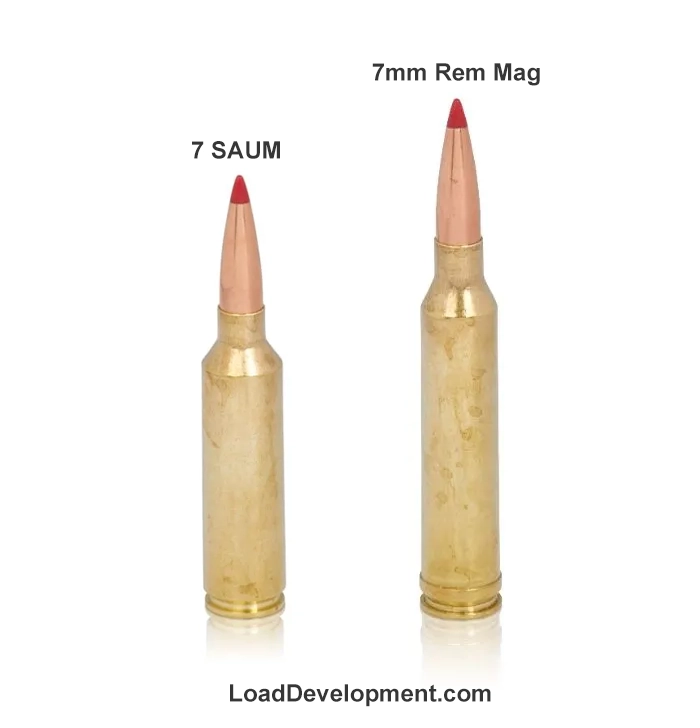
If you compare it to smaller 7mm cartridges, the 7 SAUM gives you more case capacity, higher muzzle velocity, and better support for heavier bullets. If you compare it to larger 7mm magnums, it usually gives up only a modest amount of speed while saving action length and often making for a more compact hunting rifle.
That middle ground is why the cartridge never really disappeared. It is not just another 7mm magnum. It fits a very specific use case for shooters who want serious ballistic performance without committing to a full long action rifle.

Why Shooters Call It a Short-Action 7mm Sweet Spot
Once you spend time behind one, the appeal becomes obvious. You get the wind performance and terminal reach that make 7mm magnums attractive, and you can still build the rifle around a short action.
That does not mean every short action magazine setup is ideal for every bullet. It means the cartridge offers enough efficiency that many shooters accept those limits because the performance is so close to bigger 7mm magnums. That is the sweet spot people are talking about.
Cartridge Design, Dimensions, and Action Fit
The 7 SAUM looks simple on paper, yet your success with it depends heavily on dimensions and rifle setup. If you ignore COAL, magazine length, twist, and feeding details, you can turn a very good cartridge into a frustrating one.
Case Capacity, COAL, and Overall Length Limits
Published cartridge specifications put case capacity around 72.6 grains of water, with a SAAMI overall length near 2.825 inches. Bullet diameter is the standard .284 inch, so it takes the broad family of 7mm bullets you already know.
For many shooters, the important part is not the spec sheet. It is how close your loaded rounds run to your actual usable magazine length and throat. The 7 SAUM is compact enough for a short action rifle, yet long modern bullets can eat up that space quickly.
Magazine Length, Seating Depth, and Heavy-Bullet Constraints
This is where the cartridge gets real. If you want to run heavy bullets in the 175 to 180 grain class, seating depth becomes a major factor in a true short action.
A standard short action magazine may force you to seat deep, which can reduce usable case capacity. Some rifles also show feeding issues depending on magazine geometry, follower setup, and shoulder position. Many custom builders solve this with extended magazine boxes, longer throats, or by choosing an action and bottom metal combo built around modern high-BC bullets.
Rifling Twist, Barrel Length, and Feeding Considerations
Older factory specs often show a 1:10 rifling twist. That works for many 140 to 168 grain loads. If you want to stabilize modern long 7mm bullets consistently, especially in colder air or at lower MV, a faster twist is usually the smarter choice.
A 24 inch barrel is one of the most practical setups for the cartridge. It gives you strong velocity without making the rifle awkward. You can go shorter for a suppressed hunting rifle, and I have seen 20 to 22 inch guns perform very well, though you should expect some speed loss. Feeding can be excellent when the rifle is built around the cartridge, and mediocre when it is forced into a generic short magnum setup.
Ballistic Performance and Real-World Use
The 7 SAUM earns its reputation on target and in the field. You get the kind of ballistic performance that makes long-range shooting easier to manage, especially when you pair the cartridge with efficient 7mm bullets and a sensible barrel length.
Typical Muzzle Velocity and Muzzle Energy by Bullet Weight
Your exact muzzle velocity depends on chamber, freebore, powder, barrel length, and pressure. Still, these are realistic working ranges many shooters see in a 24 inch barrel:
| Bullet Weight | Typical MV | Approx. Muzzle Energy | Common Use |
|---|---|---|---|
| 140 gr | 3150 to 3250 fps | 3080 to 3280 ft-lb | Deer-sized game, flatter trajectory |
| 150 to 160 gr | 2975 to 3100 fps | 3050 to 3410 ft-lb | All-around hunting |
| 168 to 175 gr | 2850 to 2950 fps | 3030 to 3370 ft-lb | Long-range hunting, steel |
| 180 gr class | 2775 to 2875 fps | 3080 to 3300 ft-lb | F-Open, ELR-style use |
For a short magnum, that is a very strong spread. Muzzle energy stays useful across a wide range of bullet weight choices.
Trajectory, Wind Drift, and BC at Distance
This is where the cartridge makes sense. A good 7mm bullet with respectable BC gives you noticeably less wind drift than many lighter cartridges, especially by 600 yards and beyond.
That matters more than raw speed alone. In long-range shooting, you usually care about a combination of trajectory, retained velocity, and reduced wind error. The 7 SAUM handles that mix well, especially with high sectional density bullets in the 160 to 180 grain range.
Long-Range Hunting and Target Roles
For long-range hunting, the 7 SAUM gives you flat enough trajectory and strong terminal performance for deer, elk, and similar game when your bullet choice matches impact velocity and expected distance. It is not magic. It just carries energy and velocity efficiently.
For long range target shooting, it gives you a useful step up from mid-size cartridges without jumping straight into larger magnum recoil and rifle bulk. Factory ammo exists, though not in the variety or availability you get with more mainstream cartridges. That is one reason serious shooters often treat it as a handloader’s cartridge.
Competition and Hunting Applications
The 7 SAUM has credibility in both match rifles and hunting rifles because it solves different problems with the same basic strengths. You get high-BC 7mm bullets, useful magnum speed, and manageable shootability in a package that can be built light or built heavy.
Why It Works in F-Class and F-Open
You will see the 7 SAUM discussed often in F-Class and F-Open circles, including on AccurateShooter and many forum threads for good reason. It pushes long, efficient bullets fast enough to stay very competitive in wind, and it does so without the bulk or recoil jump of some larger magnum cartridges.
Its reputation as a forgiving tuner is a big part of that. Many shooters describe it as having a broad, easy accuracy node when the chamber and throat are set up for the bullet you actually want to run. That is part of the cartridge’s “7mm Dasher” appeal.
Practical Benefits for Precision Rifles and Suppressed Builds
In a precision rifle, the cartridge gives you a strong balance of recoil and performance. It recoils more than a 6.5, no question, though it stays very manageable in a well-braked or suppressed rifle.
For suppressed hunting builds, a 20 to 24 inch barrel can make a lot of sense. You still get enough velocity to keep the cartridge useful at distance, and the short action helps keep the finished rifle from becoming too long or front-heavy.
Bullet Selection for Game and Steel
For game, proven hunting bullets like the Nosler AccuBond and Nosler Partition still make a lot of sense, especially in the 140 to 160 grain window. If you want a tougher all-around hunting bullet with good reach, those are easy places to start.
For steel and match use, high-BC Berger VLD, Berger Hybrid Target and similar heavy bullets are common choices. The right answer depends on your magazine length, throat, and intended velocity. If your rifle is built around heavy bullets, the 7 SAUM becomes much more interesting.
Reloading Approach and Powder Selection
If you reload, the 7 SAUM starts to make even more sense. This is one of those cartridges that tends to reward careful handloaders with very usable velocity, good brass life, and tuning behavior that often feels easier than you would expect from a magnum-class round.
Why Handloaders Find It Easy to Tune
A lot of experienced handloaders describe the cartridge as forgiving. In practice, that means you can often find a stable load without chasing tiny charge changes for weeks.
That reputation is one reason you see the cartridge stay relevant even when factory ammo support is limited. At LoadDevelopment.com, this is the kind of cartridge that fits a structured workflow well, especially if you are using ballistic tools or a system like LoadForge to track velocity, seating depth, and node behavior.
Common Powders and Component Choices
Common powder choices include H4350, IMR 4350, H4831SC, Hodgdon H4831SC, Reloder 22, and Vihtavuori N560. Lighter bullets often work well with faster options in the 4350 class, while heavier bullets usually push you toward slower powders like 4831SC-class choices.
Large rifle magnum primers are standard. For bullets, most shooters end up picking one of these lanes:
- 140 to 150 grain bullets for lighter hunting loads
- 156 to 168 grain bullets for all-around use
- 175 to 180 grain heavy bullets for match or long-range work
A useful field table looks like this:
| Bullet | Barrel Length | Typical Powder Range | Practical Goal |
|---|---|---|---|
| 145 gr hunting | 22 to 24 in | H4350, IMR 4350 | Lightweight hunting rifle |
| 160 gr hunting | 24 in | H4831SC, RL22 | General big-game use |
| 175 gr match | 24 to 26 in | H4831SC, N560 | Long-range steel |
| 180 gr class | 26 in | H4831SC, slow magnum powders | F-Open, heavy-bullet setup |
Brass Prep, Sizing, and Case Life
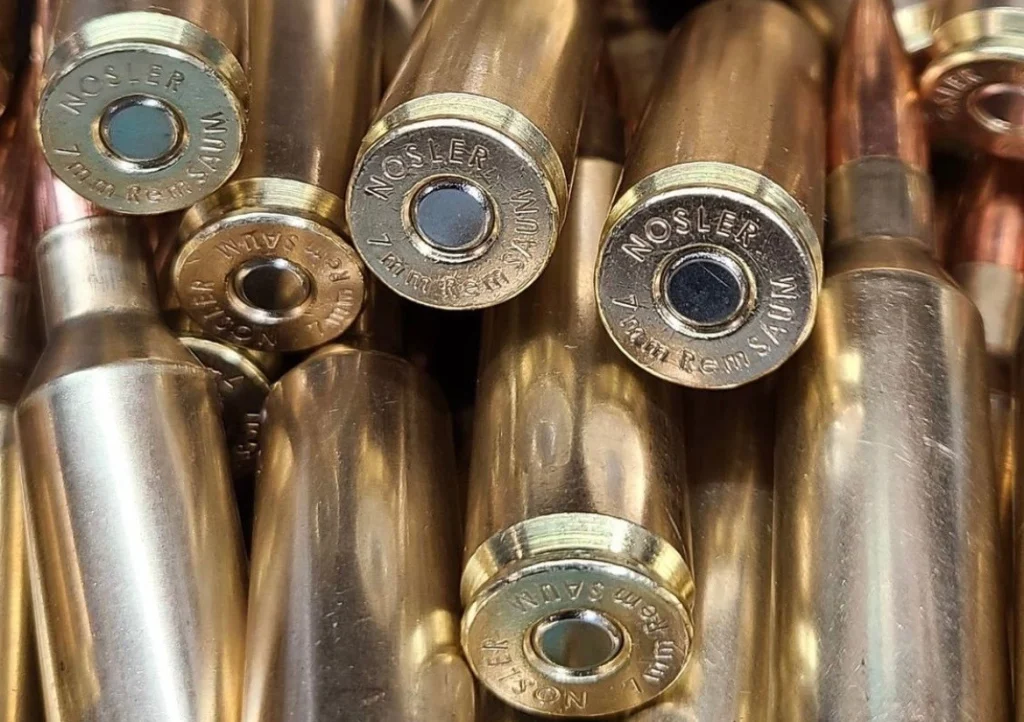
Good 7mm SAUM brass matters. Norma brass has been popular for years, and many shooters also look for Nosler brass or formed options depending on availability. Older Winchester cases discussions usually come up in the context of short magnum comparisons rather than true SAUM brass being easy to source.
For prep, keep it simple and consistent:
- Uniform your case prep routine
- Use full-length sizing for reliable chambering
- Watch shoulder bump closely
- Annealing helps maintain neck consistency and extend case life
- Track primer pocket looseness before pushing for extra speed
This cartridge is easy to like when you stop chasing every last fps. A moderate, repeatable load usually gives you the best return.
How It Compares With Other 7mm Options

The 7 SAUM is rarely judged in isolation. Most shooters compare it directly to the 7mm WSM and the 7 PRC, because those are the cartridges closest to it in purpose, ballistics, and buyer decision points.
7 SAUM vs 7mm WSM
The 7mm WSM, also called 7 WSM, 7wsm, or 7 Winchester Short Magnum, is the closest comparison. In raw ballistics, the two are nearly twins. Case capacity is very similar, and muzzle velocity differences are usually small enough that your barrel and load matter more than the headstamp.
The bigger differences show up in fit and feeding. The Winchester Short Magnum family can present more feeding issues in some rifles, while the SAUM often fits certain short action builds more naturally. Rifle-specific geometry matters a lot here.
7 SAUM vs 7 PRC
The 7 PRC gives you modern support, better factory ammo availability, and more room for long heavy bullets because it is built around a long action. If you want to run long high-BC bullets without fighting short-action COAL constraints, that is a real advantage.
The 7 SAUM gives you a shorter action and a more compact rifle. If your priority is short action handling with strong ballistics, the SAUM still holds its place. If your priority is effortless heavy-bullet packaging and easy factory support, the 7mm PRC is often the easier path.
Who Should Choose Which Cartridge
Choose 7 SAUM if you want:
- A short action rifle
- Handloading flexibility
- Near-top-tier 7mm ballistics in a compact package
- A proven hunting and match cartridge
Choose 7mm WSM if you already have that rifle platform or component support and it feeds well in your setup.
Choose 7 PRC if you want:
- Better factory ammo access
- Fewer seating depth and magazine length compromises
- A long action optimized for modern heavy bullets
If you are a serious handloader, the 7 SAUM remains one of the most appealing middle-ground options in the 7mm space.

AJ Deysel is a competitive rifle shooter in the PRS and NRL Hunter series, a lifelong hunter, and a recognized ballistics specialist whose load development expertise has been featured by industry leaders like Hornady. He is the founder and lead editor of LoadDevelopment.com. Read more about AJ or view our Editorial & Testing Guidelines.