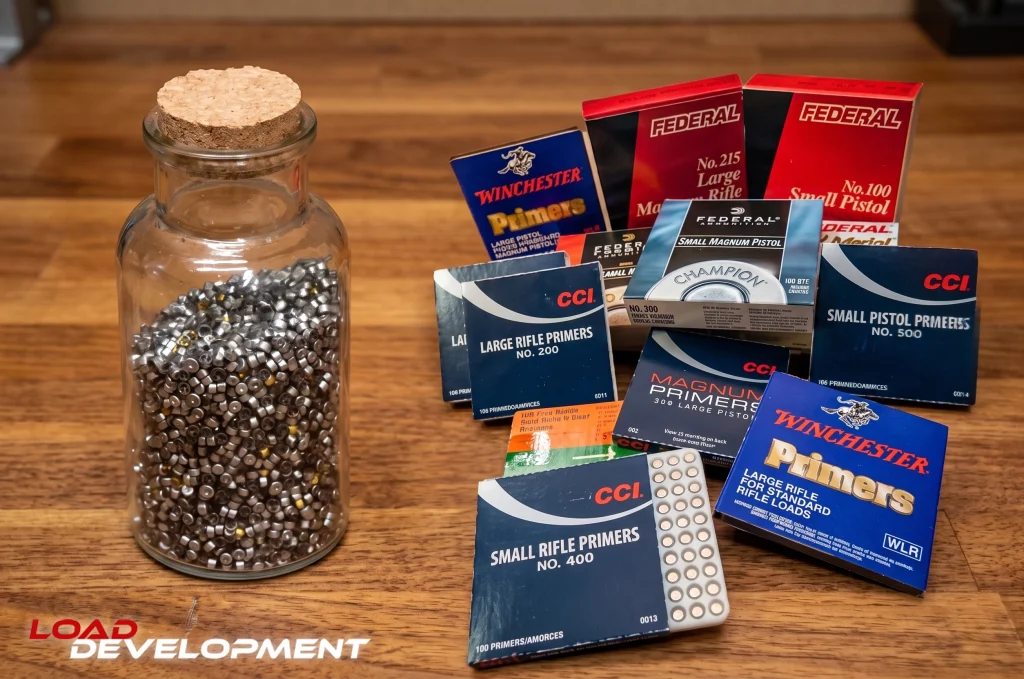
A reloading primer is the small, metallic cup inserted into the base of a brass casing that ignites the gunpowder when struck by the firing pin. Without a primer, your rifle is just an expensive paperweight.
For beginners, buying primers is one of the most confusing parts of load development. If you look at a shelf of reloading supplies, you will see Small Rifle, Large Rifle, Magnum, Match, and Pistol primers.
Choosing the wrong primer will not only ruin your accuracy and cause erratic velocities, but it can also be incredibly dangerous. Here is the straightforward, no-nonsense guide to understanding primer sizes, types, and exactly which one you need for your cartridge.
The 4 Basic Primer Sizes
Primers are categorized by two main factors: Size (diameter) and Application (Rifle vs. Pistol).
- Small Rifle (SR): Measures 0.175 inches in diameter. Used in smaller cartridges like the .223 Remington, 5.56 NATO, and modern precision cartridges like the 6mm Dasher.
- Large Rifle (LR): Measures 0.210 inches in diameter. Used in standard short-action and long-action cartridges like the .308 Winchester, 6.5 Creedmoor, and .30-06 Springfield.
- Small Pistol (SP): Measures 0.175 inches in diameter. Used in 9mm, .38 Special, etc. (Note: While they are the same diameter as Small Rifle primers, the metal cup is thinner. Never use a pistol primer in a rifle cartridge, as the high pressure will pierce the primer and vent hot gas into your face).
- Large Pistol (LP): Measures 0.210 inches in diameter. Used in .45 ACP, .44 Magnum, etc.
Primer Quick Reference Chart
| Primer Type | Diameter | Common Calibers |
|---|---|---|
| Small Rifle (SR) | 0.175″ | .223 Rem, 5.56 NATO, 300 BLK, 6mm Dasher |
| Large Rifle (LR) | 0.210″ | .308 Win, .270 Win, .30-06, 6.5 Creedmoor* |
| Large Rifle Magnum (LRM) | 0.210″ | .300 Win Mag, 7mm PRC, .338 Lapua, 7mm Rem Mag |
*Note on 6.5 Creedmoor: Standard 6.5 Creedmoor brass uses Large Rifle primers. However, premium precision brass (like Lapua or Alpha Munitions) is often manufactured with Small Rifle primer pockets to handle higher pressures. Always check your specific brass before buying primers.
*Note on 6.5 Creedmoor: Standard 6.5 Creedmoor brass uses Large Rifle primers. However, premium precision brass (like Lapua or Alpha Munitions) is often manufactured with Small Rifle primer pockets to handle higher pressures. Always check your specific brass before buying primers.
Standard vs. Magnum Primers: When to Use Them
Once you know the size of your primer pocket, you have to decide on the intensity of the spark.
A Standard Primer provides a normal spark, which is perfect for igniting 40 to 50 grains of extruded stick powder in a standard cartridge like a .308 Winchester.
A Magnum Primer has a slightly thicker metal cup (to handle higher chamber pressures) and contains more explosive compound (brisance). It throws a longer, hotter flame into the powder column.
You should use a Magnum Primer if:
- You are loading a Magnum Cartridge: Cartridges like the .300 PRC or .338 Lapua hold 70 to 90+ grains of powder. A standard primer cannot ignite that massive powder column efficiently, resulting in delayed ignition (hang-fires) or erratic velocities.
- You are using Ball Powders: Spherical “ball” powders are coated in heavy deterrents to control their burn rate, making them harder to ignite than extruded stick powders. Magnum primers ensure complete ignition.
- You are hunting in Sub-Zero Temperatures: Extreme cold makes gunpowder harder to ignite. If you are hunting in freezing conditions, a magnum primer guarantees reliable ignition.
Standard vs. Match Primers: Are They Worth It?
If you look at a box of CCI or Federal primers, you will see “Standard” versions (like the CCI 200) and “Match” versions (like the CCI BR-2 or Federal 210M). Match primers cost significantly more. Are they worth the money?
If you are just plinking or hunting inside 200 yards, no. Standard primers are perfectly fine.
However, if you are shooting precision rifle matches or trying to hit steel at 1,000 yards, Match Primers are absolutely worth the investment. Match primers are manufactured by the company’s most experienced technicians using tighter tolerances. The explosive compound is weighed and inserted with extreme consistency. This means every single primer throws the exact same spark, which translates to a lower Standard Deviation (SD) in your muzzle velocity. At long range, consistent velocity is the key to hitting your target.
Primer Seating Safety & Best Practices
As outlined in our How to Reload Ammunition guide, seating the primer is a critical step.
- Seat Below Flush: A properly seated primer should sit roughly .003 to .005 inches below the base of the brass casing. If you run your finger over the base, you should feel a slight dip. If the primer is sticking out, the cartridge could fire prematurely when you close the bolt of your rifle.
- Don’t Crush It: You want the primer to hit the bottom of the primer pocket firmly so the internal “anvil” is armed, but if you squeeze too hard and flatten the primer cup, you can crack the explosive compound, causing a misfire.
- Use a Hand Tool: While many presses come with priming attachments, they lack tactile feedback. Precision shooters use a dedicated hand-priming tool (like the Frankford Arsenal Perfect Seat) so they can physically feel the primer hit the bottom of the pocket. (See our Complete Reloading Setup Guide for equipment recommendations).
Soft Primers (e.g., Federal)
Federal primers (like the popular Federal 210M Match) are widely known for having the softest cups on the market.
- The Advantage: They are incredibly easy to ignite. If you have a custom rifle with a lightened firing pin spring or a tuned trigger job, soft primers guarantee reliable ignition.
- The Danger: Because the cup is soft, they show pressure signs very early. If you load a hot, maximum-pressure cartridge with a soft primer, the cup will flatten out or “crater” around the firing pin much faster than a harder primer. Furthermore, you should never use soft primers in a semi-automatic rifle with a free-floating firing pin (like an AR-10 or M1 Garand), as the soft cup increases the risk of a “slam fire” when the bolt closes.
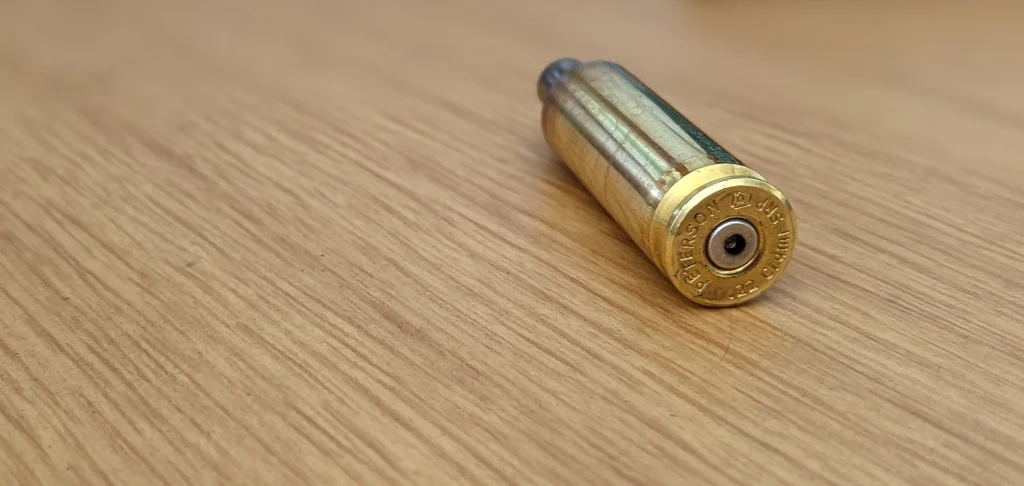
Hard Primers (e.g., CCI and CCI BR Series)
CCI primers (including their BR-2 and BR-4 Match lines) are known for having some of the hardest cups in the industry.
- The Advantage: They can withstand massive chamber pressures without flattening or piercing. If you are shooting a magnum cartridge or running a load near maximum pressure, a hard primer provides an extra margin of safety. They are also the safest choice for semi-automatic rifles (CCI even makes a specific “No. 41” primer with an extra-hard cup specifically for AR-15s).
- The Danger: If your rifle has a weak firing pin spring or excessive headspace, a hard primer may result in a light strike and a failure to fire.
The Rule of Thumb: If you are shooting a standard bolt-action rifle, either brand will work perfectly. But if you are chasing maximum velocity near pressure limits, lean toward a harder cup like CCI. If you are running a tuned competition action with a light firing pin strike, lean toward a softer cup like Federal.
The Next Step: Achieving Single-Digit SDs
Choosing the right match primer is the first step to lowering your velocity spreads. But to truly master internal ballistics, you need to understand how to uniform your primer pockets, read pressure signs on the fired cup, and tune your powder charge to your barrel’s harmonics.
If you are ready to stop making generic ammo and start crafting precision rounds, join my Advanced Precision Reloading Course to learn the exact load development strategies used by the pros.
Frequently Asked Questions

AJ Deysel is a competitive rifle shooter in the PRS and NRL Hunter series, a lifelong hunter, and a recognized ballistics specialist whose load development expertise has been featured by industry leaders like Hornady. He is the founder and lead editor of LoadDevelopment.com. Read more about AJ or view our Editorial & Testing Guidelines.