Disclaimer: LoadDevelopment.com is reader-supported. When you buy through links on our site, we may earn an affiliate commission at no extra cost to you.
You cannot buy your way into long-range accuracy. You can spend $10,000 on a custom rifle and premium glass, but if you don’t understand the physics of external ballistics, wind deflection, and shooter mechanics, you will still miss your target at 600 yards.
As a competitive PRS and NRL Hunter shooter, I am constantly asked how to get started in long-range shooting. My answer is always the same: before you buy a magnum rifle or a $3,000 scope, you need to read, then attend a few competitions as an observer.
Here is the definitive reading list for long-range shooters. Whether you are a novice looking to hit your first target at 500 yards, or an advanced handloader trying to understand the mathematics of Weapon Employment Zones (WEZ), these are the books you need on your shelf.
1. The Best Book for Beginners
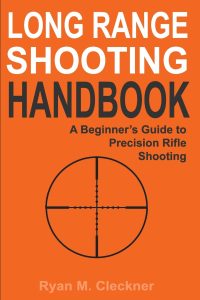
Long Range Shooting Handbook by Ryan Cleckner
If you only buy one book on this list, make it this one. Ryan Cleckner is a former Ranger sniper instructor, and he has a unique gift for explaining complex ballistic concepts in plain, digestible English.
- What it covers: Equipment selection, rifle setup, the fundamentals of marksmanship (trigger control, natural point of aim), and a very practical introduction to internal and external ballistics.
- Why I recommend it: A lot of ballistic books get bogged down in calculus immediately. Cleckner keeps it practical. He teaches you how to mount a scope properly, how to understand MOA vs. MRAD, and how to actually operate your rifle under field conditions. It is the perfect bridge between a novice and an intermediate shooter.
- Get it here:
2. The Bible of External Ballistics
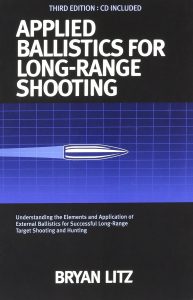
Applied Ballistics for Long Range Shooting by Bryan Litz
Bryan Litz is the Chief Ballistician at Berger Bullets and the undisputed king of modern external ballistics. If you want to understand why a bullet drops and drifts the way it does, this is the textbook.
- What it covers: The deep physics of bullet flight. It explains the exact differences between G1 and G7 Ballistic Coefficients, aerodynamic drag, spin drift, and the Coriolis effect.
- Why I recommend it: This book separates the amateurs from the pros. If you are using advanced solvers (like our Trajek Calculator) to shoot past 1,000 yards, you need to understand the math the solver is doing. Litz mathematically proves why high-BC bullets beat high-velocity bullets in the wind. (If you want a primer on this, read our free guide on What is Ballistic Coefficient?).
- Get it here:
3. The Best Book for Wind Reading
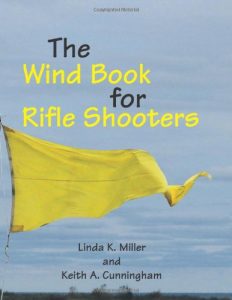
The Wind Book for Rifle Shooters by Linda K. Miller & Keith A. Cunningham
Drop is a science; wind is an art. Knowing your bullet drop at 800 yards is easy—you just look at your calculator. But reading the wind is the hardest skill in long-range shooting, and it is the #1 reason shooters miss.
- What it covers: How to read mirage, how to read terrain features, and how to calculate wind values (full value vs. half value) based on the angle of the wind relative to your bullet’s flight path.
- Why I recommend it: Most books dedicate a single chapter to wind. This book dedicates 150 pages to it. It teaches you how to look at the grass, trees, and mirage halfway to your target to estimate exactly what the wind is doing where the bullet will actually be flying.
- Get it here:
4. The Best Book for Hit Probability
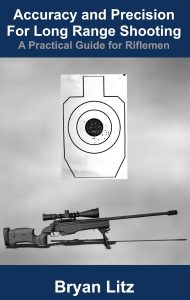
Accuracy and Precision for Long Range Shooting by Bryan Litz
This is Bryan Litz’s second major book, and it focuses entirely on the statistical probability of hitting your target.
- What it covers: The concept of the Weapon Employment Zone (WEZ). It breaks down exactly how much a 10fps variance in muzzle velocity, or a 2mph error in wind reading, will affect your percentage chance of hitting a 10-inch plate at 1,000 yards.
- Why I recommend it: It forces you to stop chasing useless upgrades and focus on what matters. For example, the math in this book proves that upgrading to a laser rangefinder that is 1% more accurate will result in more impacts than spending $1,000 to make your rifle shoot 0.25 MOA tighter. It is a masterclass in statistical shooting.
- Get it here:
5. The Best Book for Handloaders
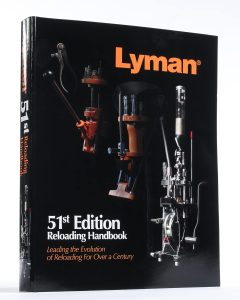
The Lyman Reloading Handbook (51st Edition)
If you are shooting long range, you eventually have to start reloading your own ammunition to achieve single-digit standard deviations. While digital load data is the future, every handloader needs a physical reference manual on their bench.
- What it covers: Safe minimum and maximum powder charges for almost every cartridge in existence, across a wide variety of bullet brands.
- Why I recommend it: Unlike the Hornady or Berger manuals, which only show data for their own bullets, Lyman tests everyone’s bullets. It is the most objective, wide-ranging physical manual on the market. (For a deeper dive on this, read our comparison of the Best Reloading Manuals).
- Get it here:
The Next Step: Apply the Knowledge
Reading these books will give you the theoretical knowledge of a master ballistician. But to put that knowledge into practice, you need the right tools on your bench and in the field.
- Calculate Your Drop: Bookmark our Trajek Calculator to run your drop and wind drift charts.
- Build Your Bench: Ready to start handloading your own precision ammo? Read our guide on How to Build a Custom Precision Reloading Bench to get the exact gear you need.
Frequently Asked Questions

AJ Deysel is a competitive rifle shooter in the PRS and NRL Hunter series, a lifelong hunter, and a recognized ballistics specialist whose load development expertise has been featured by industry leaders like Hornady. He is the founder and lead editor of LoadDevelopment.com. Read more about AJ or view our Editorial & Testing Guidelines.