
Federal’s 6.5 Creedmoor +Peak represents one of the most significant pressure-boundary shifts in modern sporting ammunition. By swapping traditional brass for a proprietary steel alloy case, Federal pushes chamber pressure to 80,000 psi and claims 250 to 300 fps more velocity from existing 6.5 Creedmoor rifles. That is a genuine ballistic gain, roughly closing the gap between the standard Creedmoor and the 6.5 PRC.

The velocity is real, but the system-level consequences for anyone who reloads or thinks critically about internal ballistics deserve serious scrutiny before you buy in. At LoadDevelopment.com, the focus has always been on what actually happens inside the chamber, not what looks good on a box flap. This analysis breaks down the engineering tradeoffs behind the +Peak design, identifies four concrete problems precision reloaders cannot work around, and offers safer paths to similar performance using conventional brass you can actually develop loads with.
If you shoot factory ammunition for hunting and never plan to resize a case, +Peak may genuinely extend your effective range. If you are a handloader who expects to tune nodes, read pressure, and build repeatable loads, the picture is very different.
What Federal Changed To Gain Velocity
Federal’s core move was replacing the brass cartridge case with a harder steel alloy while keeping external dimensions identical to standard 6.5 Creedmoor. This single material change enabled a dramatic increase in maximum average pressure, from the SAAMI ceiling of roughly 62,000 psi to 80,000 psi, unlocking the velocity gains without altering the cartridge’s footprint.
Why Higher Muzzle Speed Requires Higher Chamber Pressure
Velocity is a direct function of the total work performed on the bullet before it exits the muzzle. In a fixed case volume with a fixed bore length, the only way to increase that work is to raise the area under the pressure-time curve. You can do this by using a slower-burning propellant that sustains pressure longer, or by raising the peak pressure itself.
Federal chose the peak-pressure path. Moving from 62,000 psi to 80,000 psi represents roughly a 29 percent increase in maximum chamber pressure. In practical terms, early testing showed 130-grain Terminal Ascent loads reaching 3,078 fps from a 24-inch barrel, compared to approximately 2,840 fps for standard 6.5 Creedmoor loads with similar bullet weight. That roughly 240 fps gain tracks with the pressure increase once you account for friction, bore resistance, and propellant efficiency losses.
Why Steel Alloy Cases Shift The Pressure Ceiling
Brass has a yield strength that limits how much internal pressure a case can contain before it begins to plastically deform. Once brass flows, you get the familiar signs: flattened primers, cratered ejector marks, sticky bolt lift. These are your built-in safety warnings.
Steel alloy has a significantly higher yield strength and elastic modulus. It can contain 80,000 psi while remaining within its elastic range, meaning the case springs back rather than permanently deforming. This is the engineering principle that makes +Peak work. The case material itself becomes the pressure vessel upgrade that standard brass cannot provide.
The tradeoff is that the same properties that allow the case to contain higher pressure also eliminate the progressive deformation signals that handloaders rely on to detect overpressure conditions.

How +Peak Compares To Earlier High-Pressure Case Designs
High-pressure case concepts are not new. Military cartridges have used steel cases for decades, primarily for cost savings rather than performance gains. The 5.56 NATO spec, for example, already runs at higher pressure than its .223 Remington civilian counterpart in part due to chamber and case design differences.
What distinguishes +Peak is the deliberate combination of a high-strength alloy case with a pressure ceiling that substantially exceeds the parent cartridge’s SAAMI spec, while retaining full dimensional compatibility with existing chambers. Earlier steel-case military ammunition was designed to meet existing pressure specs at lower cost, not to push the pressure boundary upward within a legacy chamber.
The +P handgun concept offers a closer analogy. Rounds like 9mm +P raise pressure modestly, typically 10 to 15 percent, in cases that are dimensionally identical. Federal’s +Peak takes that idea and scales the pressure jump to nearly 30 percent, which creates a fundamentally different stress environment for the action, barrel, and bolt face.
Internal Ballistics Tradeoffs Behind The Design
The performance gains from +Peak are mechanically real, but the internal ballistics tell a more complex story than velocity numbers alone. Case behavior, pressure curve geometry, and thermal loading all shift in ways that matter to anyone who pays attention to what happens between ignition and bullet exit.
Case Yield Behavior Versus Traditional Brass
When a standard brass case fires, it expands against the chamber wall, partially obturates to seal gas, and then springs back slightly. The degree of springback depends on the brass alloy’s elastic limit relative to the peak pressure experienced. At 62,000 psi, quality brass is near its yield threshold, which is why you see measurable case head expansion and primer pocket loosening after multiple firings.
Steel alloy at 80,000 psi stays well within its elastic range. The case deforms less permanently per firing cycle. On the surface, this sounds like an advantage. In practice, it means the case grips the chamber wall differently during extraction, and the springback characteristics change the relationship between fired case dimensions and chamber dimensions.
For reloaders, this matters because your sizing die was designed around the elastic and plastic behavior of brass. A steel case that springs back differently will not respond to standard full-length or neck sizing operations the same way.
Pressure Curve Shape, Bullet Start Resistance, And Heat Load
Raising peak pressure by 29 percent does not simply shift the entire pressure curve upward by a uniform amount. The shape of the curve changes. Peak pressure arrives earlier and at a higher magnitude, which increases the instantaneous force on the bullet base during engraving and initial acceleration.
This higher bullet start force generates more friction at the throat and leade. More friction means more heat deposited into the first few inches of rifling during the critical initial milliseconds of bullet travel. Throat erosion is driven primarily by the combination of gas temperature, pressure, and exposure time. All three factors worsen with the +Peak pressure profile.
The propellant charge also burns at a higher sustained temperature to maintain the elevated pressure. This contributes to greater per-round thermal flux into the barrel steel, accelerating throat erosion over the life of the barrel.
Why More Speed Does Not Mean More Margin
A common assumption is that extra velocity translates directly into extra margin for hunting applications. In reality, the margin you gain downrange can be offset by the margin you lose at the system level.
Higher peak pressure increases bolt thrust, which accelerates lug wear and receiver stress. The steeper pressure curve reduces your tolerance for variables like seating depth changes, lot-to-lot powder variation, and ambient temperature swings. A load that runs safely at 70°F may behave very differently at 100°F when you are already operating at 80,000 psi.
The velocity gain is roughly 8 to 10 percent. The pressure increase is roughly 29 percent. That ratio tells you the efficiency of the trade: you are spending a lot of pressure headroom for a moderate speed gain, and the system tolerance narrows with every psi you add.
The Four Problems Precision Reloaders Cannot Ignore
If you reload with the expectation of controlling variables, reading brass, and refining accuracy nodes, +Peak introduces four categories of problems that cannot be solved with better technique or upgraded equipment.
Missing Traditional Overpressure Warnings
This is the most safety-critical issue. Brass cases serve as your analog pressure gauge. Primer flattening, ejector swipes, case head expansion measured with a micrometer, and bolt lift effort all give you graduated feedback as pressure climbs.
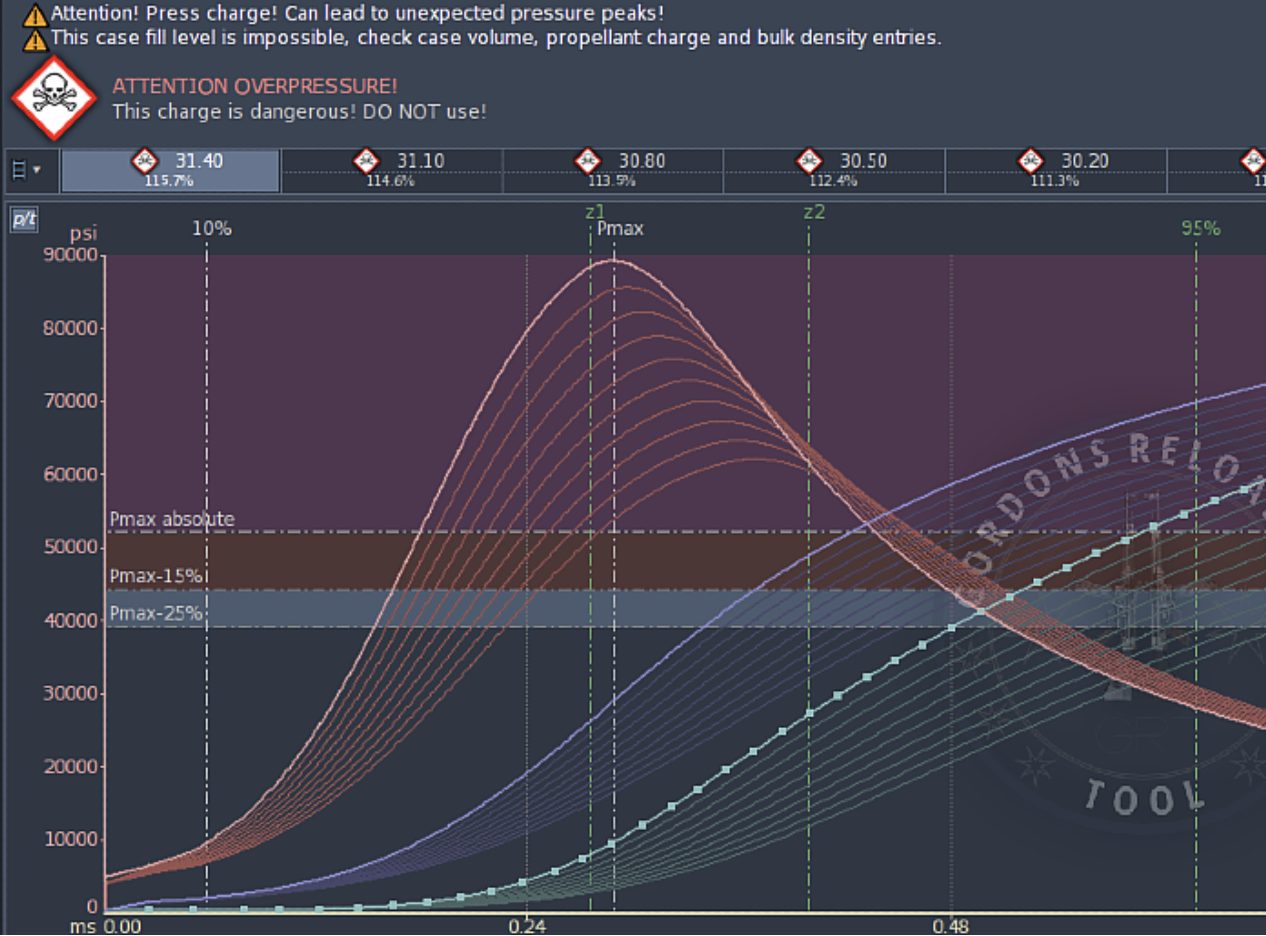
Steel alloy cases at 80,000 psi remain within their elastic limit. The primers seat into pockets machined for the alloy’s dimensions and hardness. Your normal visual and tactile indicators either do not appear or appear at a threshold that may already represent a dangerous condition in the action. You lose the early-warning system that every handloading manual assumes you have.
Without reliable progressive feedback, you are flying blind on pressure. This is not a theoretical concern; it is a structural gap in the safety framework that governs every load workup protocol.
Thermal Spikes, Throat Wear, And String-to-String Instability
Running 80,000 psi through a throat designed for 62,000 psi accelerates erosion. Throat erosion changes your effective freebore, which shifts the pressure curve for a given seating depth. Over the course of a barrel’s life, this feedback loop accelerates.
The higher per-round thermal load also creates string-to-string velocity variation as barrel temperature climbs during a shooting session. If you are chasing single-digit ES numbers, the thermal behavior of +Peak pressures in a standard-contour barrel will work against you. The barrel heats faster, and the throat geometry degrades faster, creating compounding instability in your velocity data.
Sizing Effort, Die Stress, And Workflow Friction
Steel alloy cases resist resizing in ways that brass does not. The higher elastic modulus means more force is required to push the case back to spec. Your standard sizing die was engineered for the forces associated with annealed brass.
Running steel cases through carbide or steel dies increases die wear, raises the risk of stuck cases, and changes the force feedback you rely on to confirm proper shoulder bump. If the case geometry post-firing differs from brass due to different springback behavior, your die settings may not produce the same dimensional results, and your neck tension consistency may suffer.
This is not a minor workflow inconvenience. It is a fundamental incompatibility between the case material and the tooling ecosystem that precision reloaders depend on.
Trimmed Mouth Corrosion And Long-Term Handling Risk
When you trim a brass case mouth, you expose fresh alloy that oxidizes slowly and predictably. Trimming a steel alloy case mouth exposes a surface with different corrosion chemistry. Depending on the specific alloy composition and any surface treatments Federal applies, trimmed steel cases may develop surface corrosion that affects neck tension, bullet pull force, and case mouth integrity over time.
If you store prepped brass for weeks or months before loading, as many precision shooters do, the corrosion behavior of trimmed steel becomes a variable you need to manage. Without published data on the alloy’s corrosion rate in ambient storage conditions, you are introducing an unknown into your process.
Safer Ways To Reach Similar Performance With Reloadable Brass
The velocity gains that +Peak delivers are appealing, but they are not unique to a steel case at 80,000 psi. Several established approaches can achieve comparable or even superior ballistic performance while keeping you within a conventional brass reloading workflow.
40-Degree Ackley Improved Capacity Gains
Reaming your 6.5 Creedmoor chamber to a 40-degree Ackley Improved configuration increases usable case capacity by roughly 5 to 8 percent. The steeper shoulder angle reduces case stretch during firing, improves brass life, and allows you to safely add powder charge weight without exceeding standard SAAMI pressure limits.
In practice, a well-executed 6.5 Creedmoor AI build with quality brass and optimized powder selection can deliver 100 to 150 fps over standard Creedmoor velocities. That does not match the full 250 to 300 fps claim of +Peak, but it does so within a pressure regime where your brass still talks to you, your dies still work correctly, and your barrel life remains predictable.
The tradeoff is a custom reamer and the fire-forming process, which adds cost and time. For a precision reloader who expects to shoot thousands of rounds through a barrel, that investment pays back through lower per-round cost and full process control.
+P Stepped Throating To Moderate Initial Resistance
Combining a moderate pressure increase with a stepped or extended throat geometry reduces bullet start resistance, which shifts the pressure curve. You get more of the propellant’s energy converted to bullet velocity rather than wasted as friction heat at the leade.
This approach lets you run slightly above standard pressure, perhaps 65,000 to 68,000 psi, while achieving velocity gains of 80 to 120 fps. Brass still deforms predictably at this pressure range, and your standard overpressure indicators remain functional. The throat geometry also tends to distribute erosion more evenly, which helps barrel longevity.
This is a more conservative path than a full AI conversion, and it works well for shooters who want a meaningful velocity bump without rebarreling or rechambering.
Why Premium Standard Brass Remains The Better System
Premium brass from manufacturers like Lapua, Peterson, or Alpha provides consistent case weight, uniform wall thickness, and predictable metallurgical behavior across multiple firing cycles. You can anneal it, trim it, prep it, and store it with confidence because the material science is well understood and extensively documented.
The entire precision reloading ecosystem, from dies to gauges to load data, was built around brass. When you choose to work within that system, every variable is controllable. When you step outside it with an exotic case material at an unconventional pressure, you lose control of variables that matter for repeatable accuracy.
For advanced reloaders, the system-level reliability of premium brass will outperform the raw velocity gain of +Peak in every measurable dimension of precision shooting.
LoadDevelopment.com Perspective For Advanced Reloaders
The conversation around +Peak is mostly about marketing velocity numbers. The more useful conversation is about what actually happens inside your chamber and how you verify that your load is safe. That is where LoadDevelopment.com focuses its energy.
How To Evaluate Velocity Claims Through Internal Ballistics
When you see a claim like “300 fps faster,” your first question should be: at what cost in pressure, barrel life, and system tolerance? The relationship between velocity gain and pressure increase is not linear. Gaining the last 100 fps typically requires a disproportionate pressure increase compared to the first 100 fps.
Start by calculating the expected velocity gain from the pressure increase using basic internal ballistics models. If the claimed velocity tracks with the pressure increase and the known case capacity, the claim is plausible. If the velocity seems too high for the pressure delta, something else is at play, whether that is a longer test barrel, a different powder, or optimistic rounding.
At LoadDevelopment.com, the internal and external ballistics calculators and educational resources give you the tools to run these sanity checks yourself rather than relying on box-flap data.
Where LoadForge Fits Into Safe Node Discovery
If your goal is to reach higher velocity safely within a system you can control, the right approach is structured load development with standard brass. LoadForge provides the framework for systematic node discovery, letting you map pressure and velocity simultaneously while maintaining full feedback from your brass.
Rather than accepting a factory-loaded steel case at 80,000 psi with no ability to read pressure signs or adjust variables, you can use LoadForge to find the accuracy node that delivers the best combination of velocity, ES, and group size within a pressure range where your components and your rifle behave predictably.
Safe node discovery depends on being able to read the system. +Peak removes that ability. The tools at LoadDevelopment.com are designed for reloaders who want to keep it.
Who Should Use It And Who Should Avoid It
The answer depends entirely on what you plan to do after you pull the trigger and pick up the case.
Why Factory Hunters May Still Find It Useful
If you hunt with factory ammunition, never reload, and want more velocity from your existing 6.5 Creedmoor rifle, +Peak delivers a genuine performance increase. The 130-grain Terminal Ascent at roughly 3,078 fps from a 24-inch barrel closes the gap to the 6.5 PRC and extends your effective range on medium game by a meaningful margin.
For a deer or mule deer hunter who shoots a box or two per season and does not save brass, the higher pressure and steel case are Federal’s problem, not yours. The rifle takes the stress, and you get the flatter trajectory.
At an expected MSRP starting around $59.99 per box, the cost is higher than standard Creedmoor ammunition. Whether that premium justifies the velocity gain is a personal calculation based on how often you shoot and how far you expect to take shots in the field.
Why Serious Handloaders Are Better Off Passing
If you reload for precision, +Peak creates problems at every stage of the process. You cannot read pressure reliably. You cannot size the cases with standard tooling and expect consistent results. You cannot predict corrosion behavior on trimmed case mouths. You cannot anneal steel alloy on the same schedule or with the same equipment you use for brass.
The velocity it offers is achievable through conventional means, specifically AI chambers, optimized throating, and careful load development with premium brass. Those paths give you full control, full feedback, and full compatibility with the reloading ecosystem you have already invested in.
The verdict is straightforward. If you are a factory-ammo hunter, +Peak may be worth trying when it ships. If you are a reloader, your time, money, and barrel life are better spent on approaches that keep you in command of the process.
Frequently Asked Questions
Pre-production testing with 130-grain Terminal Ascent bullets produced groups around 0.84 MOA from a Tikka with a 24-inch barrel. Production ammunition may tighten that figure, but sub-MOA performance at hunting distances out to 400 yards appears achievable based on early results.
The 130-grain Terminal Ascent load clocked 3,078 fps from a 24-inch barrel in early testing. That translates to roughly 2,730 ft-lbs of muzzle energy. The Terminal Ascent 130-grain bullet carries a published G1 BC of approximately .532, which combined with the higher velocity delivers noticeably less drop at 300 and 400 yards compared to standard 6.5 Creedmoor loads.
At +Peak velocities, the 130-grain Terminal Ascent arrives at 400 yards with energy and expansion velocity that standard 6.5 Creedmoor loads typically deliver at 200 to 250 yards. This effectively extends your terminal performance window by 150 to 200 yards on medium game. It approaches 6.5 PRC performance levels without requiring a new rifle or bolt face.
MSRP starts at approximately $59.99 per 20-round box, with initial availability expected around August 2026. Street prices will vary by retailer and demand, but expect a meaningful premium over standard 6.5 Creedmoor hunting ammunition, which typically runs $30 to $45 per box for comparable bullet quality.
The initial offerings with Terminal Ascent and Fusion Tipped bullets are optimized for hunting. Federal has announced plans to release Gold Medal Sierra Tipped MatchKing, Berger Elite Hunter, and Barnes LRX options later in 2026 and into 2027, which will expand the line into precision and long-range applications. For high-volume range use, the per-round cost and accelerated throat erosion make it a poor choice compared to standard-pressure loads.
The standard 1:8 twist rate found in most 6.5 Creedmoor rifles stabilizes the 130-grain and 155-grain bullets used in the +Peak lineup without issue. Barrel length matters more than twist rate here; a 22- to 24-inch barrel captures the most benefit from the higher pressure curve. Shorter barrels will still see gains over standard loads, but the velocity advantage narrows as barrel length decreases. Your rifle should be in good mechanical condition, with a properly headspaced bolt and a barrel that is not already near the end of its throat life.

AJ Deysel is a competitive rifle shooter in the PRS and NRL Hunter series, a lifelong hunter, and a recognized ballistics specialist whose load development expertise has been featured by industry leaders like Hornady. He is the founder and lead editor of LoadDevelopment.com. Read more about AJ or view our Editorial & Testing Guidelines.

AJ,
New to your site and interested in learning more about steel cases.
Reload-ability aside, leading new cases to desired performance levels is where I am looking.
I am not familiar with the +Peak cases, but I have dabbled with Shell Tech NAS3 cases in 556. I can only speak to what seems to be the paradigm shift. Thin walled, wider ore uniform powder column, larger flash hole, less heat loss, increased case volume (30.55 grn LC20 to 33.15 grn NAS3) produced nearly identical velocities with the same charge which is counterintuitive as capacity directly relates to pressure. Big Downside may be case adhesion and bolt thrust….
Stepping up to moderately increased charges using GRT, predictions closely tracked with resultant velocity, so a big assumption – Pmax ought to be fairly correct in GRTs output, I think, and that’s where v I want more validation.
I’d be interested in your thoughts. I’ll peruse your site and see if your tools can be of help. I want to see where this goes, as a high power competitor, and an engineer.
Regards
APC
MAJ,USA ret
Distinguished Rifleman
The steel cases is a whole new avenue in internal ballistics that has opened up a new branch in the field. I too am interested to see what the future holds for them.
You’ve put your finger on the one thing most solver users skip: you have a case whose inputs have changed(capacity, wall thickness, flash hole, thermal behaviour) and you want to know whether the output(pressure) can still be trusted. I don’t think GRT is able to answer that thoroughly, I would rather try LoadForge.app for that exploration if I were you, as it was not built around a single number.
Looking at what you observed with NAS3 vs LC20, going from 30.55 to 33.15 gr H2O is roughly an 8.5% increase in capacity. At a fixed charge that drops loading density by about the same amount, and a simple closed-form model says velocity and peak pressure should both fall. Getting near-identical velocity means something is giving energy back. The two candidates worth separating are (a) less heat lost to the case and chamber wall early in the event, and (b) a genuinely different burn history(lower initial pressure with a wider, shorter powder column and a larger flash hole changes the early pressure rise, and burn rate is pressure-dependent, so the propellant “catches up” later in the travel. Same muzzle velocity via a flatter, later pressure curve is entirely consistent with what you saw) and it is also exactly the case where velocity agreement tells you almost nothing about Pmax agreement. Velocity integrates the whole pressure-time curve and Pmax is one point on it. Two curves can enclose the same area and differ materially in height.
Heat loss is an explicit physical term, not a fudge factor buried in a coefficient. The solver integrates the coupled ODEs in time (Vieille burn law, Noble-Abel gas state, Sebert correction for the accelerating gas column, engraving force over the first few millimetres of travel) with convective loss to the wall modelled as a pressure-scaled term. Your “less heat loss” hypothesis is therefore something you can actually probe, by running the two cases at identical charge and comparing predictions rather than just eyeballing peaks.
Calibration is tiered by what your data can actually support, the part I think will matter most to you as an engineer. One chronograph string cannot separate a level error from a slope error, so LoadForge applies a velocity offset only and leaves pressure explicitly uncalibrated. Two or more strings at distinct charges unlock a fit of the propellant’s burn-rate coefficient itself, with a leave-one-out stability check that refuses the fit if dropping a single string swings it too far. So a solver that “closely tracks velocity” gets you a validated level; it does not get you a validated Pmax, and it says so rather than letting velocity agreement launder the pressure number.
For your case family specifically the honest answer is that composite and steel-case data is thin, and you are exactly the person who would thicken it. Log your NAS3 strings: charge, COAL, ambient, ES/SD or a Garmin-style summary group data. That will show per-string residuals against the model, which is the closest thing to Pmax validation available without a strain gauge or piezo.
It still will obviously not model bolt thrust or case adhesion, and no interior-ballistics solver does, that’s a case-head-support and chamber-friction problem, not a gas-dynamics one.
Regards