
If you want a reliable 6.5 Creedmoor ballistics chart with real drop, drift, velocity, and energy numbers out to 1,000 yards, you are in the right place. This article gives you two complete ballistic tables built around the most common 6.5 Creedmoor loads: the 140gr Hornady ELD-M for precision and competition work, and the 143gr Hornady ELD-X for hunting. Both are calculated under standard atmospheric conditions with a 100-yard zero so you can use them as a starting point for your own DOPE.

The 6.5 Creedmoor’s real advantage is not just a flat trajectory; it is the combination of high ballistic coefficients, manageable recoil, and remarkably low wind drift that makes it the dominant cartridge in precision shooting and an increasingly popular choice for deer hunting. These ballistics charts give you the data you need to confirm that for yourself at your range and in your conditions.
Beyond the tables, you will find a detailed breakdown of what the numbers actually mean downrange, a side-by-side comparison with .308 Winchester, and practical guidance on how barrel length, handloading, and atmospheric conditions shift your results. Every number in these charts is a starting point. Your rifle, your load, and your environment will always be the final authority.
Key Takeaways
- The 140gr ELD-M and 143gr ELD-X give you two purpose-built ballistic profiles for target shooting and hunting, respectively, with complete data from 100 to 1,000 yards.
- Wind drift, not bullet drop, is the primary challenge past 400 yards, and the 6.5 Creedmoor’s high-BC bullets handle it better than most comparable cartridges.
- Real-world variables like barrel length, muzzle velocity, and atmospheric conditions will shift any published chart, so treat these tables as baselines to verify with your own chronograph and ballistic calculator.
140gr Hornady ELD-M Baseline Data
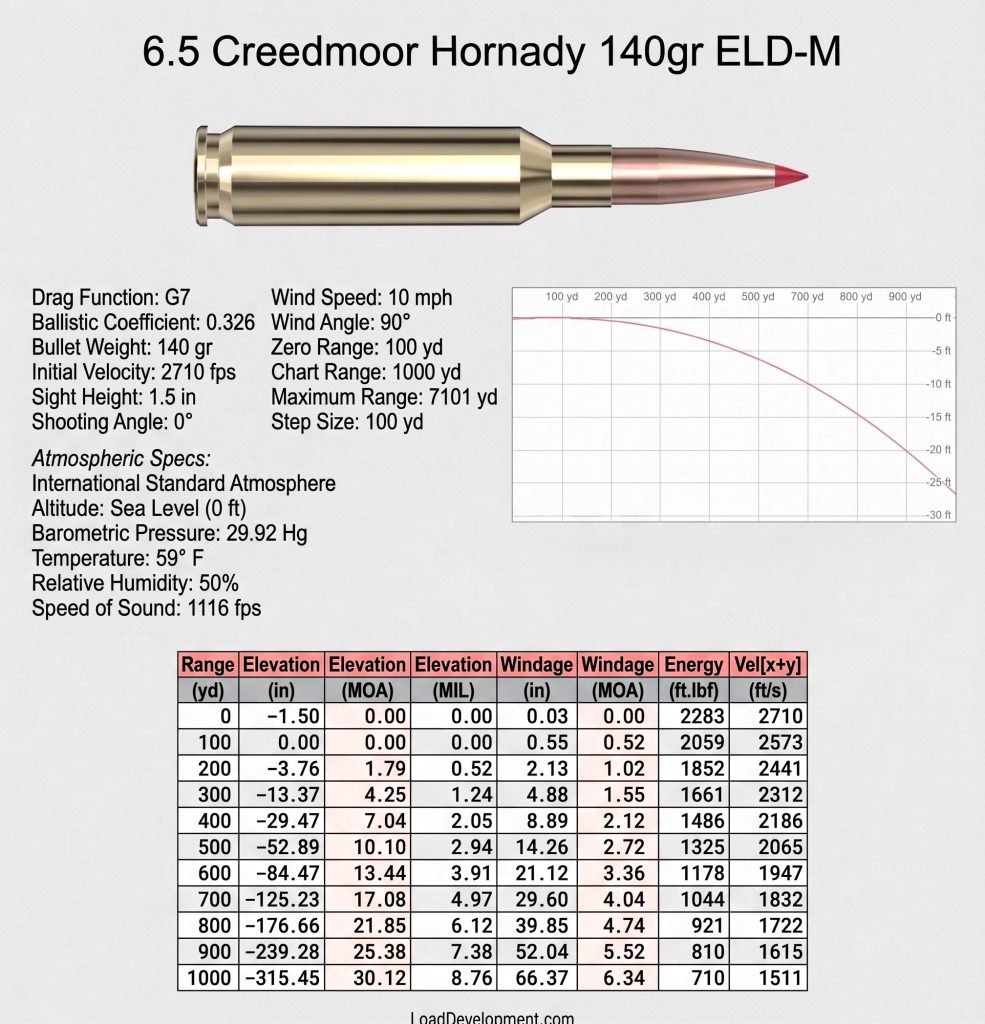
The 140gr Hornady ELD-M is the benchmark 6.5 Creedmoor load for long-range precision and competition. With a G1 BC of .646 and a G7 BC of approximately .326, this bullet retains velocity exceptionally well and stays supersonic past 1,200 yards under standard conditions. The table below gives you the baseline ballistics data you need to build your come-up cards.
Reference Setup and Assumptions
These numbers are calculated with the following inputs:
- Bullet: 140gr Hornady ELD-M
- G1 BC: .646 / G7 BC: ~.326
- Muzzle Velocity: 2,710 fps (24-inch barrel)
- Zero Distance: 100 yards
- Altitude: Sea level
- Temperature: 59°F
- Humidity: 50%
- Wind: 10 mph full-value crosswind (for drift column)
If your barrel is shorter than 24 inches, expect to subtract roughly 25 fps per inch lost. Temperature swings of 20°F can shift velocity by 15 to 30 fps depending on the powder. Always chronograph your actual load and plug those numbers into a ballistic calculator for precise results.
Drop, Velocity, Energy, and Wind Table to 1,000 Yards
| Range (yds) | Drop (in) | MOA Correction | MIL Correction | Velocity (fps) | Energy (ft-lb) | 10 mph Wind Drift (in) |
|---|---|---|---|---|---|---|
| 100 | 0.0 | 0.0 | 0.0 | 2,569 | 2,052 | 0.7 |
| 200 | -3.8 | 1.8 | 0.5 | 2,433 | 1,840 | 2.9 |
| 300 | -13.4 | 4.3 | 1.2 | 2,301 | 1,646 | 6.7 |
| 400 | -29.6 | 7.1 | 2.1 | 2,173 | 1,468 | 12.3 |
| 500 | -53.3 | 10.2 | 3.0 | 2,049 | 1,305 | 19.7 |
| 600 | -85.1 | 13.6 | 3.9 | 1,930 | 1,158 | 29.2 |
| 700 | -126.4 | 17.2 | 5.0 | 1,815 | 1,024 | 40.8 |
| 800 | -178.2 | 21.3 | 6.2 | 1,705 | 903 | 54.7 |
| 900 | -242.0 | 25.7 | 7.5 | 1,600 | 796 | 71.1 |
| 1,000 | -319.3 | 30.5 | 8.9 | 1,501 | 700 | 89.9 |
At 1,000 yards, you are looking at roughly 319 inches of drop, which is entirely manageable with a properly dialed scope. The wind drift of approximately 90 inches in a 10 mph crosswind is where things get demanding, and that is why wind reading matters far more than memorizing drop data at distance.
How to Read MOA and MIL Corrections
The MOA and MIL columns in the table above tell you how much elevation adjustment to dial on your scope to put the bullet on target at each distance. MOA (Minute of Angle) equals approximately 1.047 inches per 100 yards; MIL (milliradian) equals approximately 3.6 inches per 100 yards.
If your scope is in MOA, use the MOA column. At 600 yards, you would dial 13.6 MOA of elevation up from your 100-yard zero. If your scope is in MIL, dial 3.9 MIL.
These corrections assume your actual muzzle velocity matches the 2,710 fps baseline. A 50 fps difference changes your 1,000-yard drop by roughly 15 to 20 inches. That is why truing your data with a chronograph and confirming at distance is not optional. It is the difference between hits and misses. You can test your own load’s numbers on the external ballistics calculator at LoadDevelopment.com to see exactly how your inputs change the outputs.
143gr Hornady ELD-X Hunting Data
The 143gr Hornady ELD-X is the most popular hunting bullet for the 6.5 Creedmoor, and for good reason. It pairs a high ballistic coefficient with controlled expansion across a wide velocity window, giving you reliable terminal performance from close range out to distances that would have been considered unreasonable a generation ago. The data below gives you a field-ready ballistics table and practical guidance on ethical engagement distances.
Reference Setup and Assumptions
These numbers are calculated with the following inputs:
- Bullet: 143gr Hornady ELD-X
- G1 BC: .623 / G7 BC: ~.315
- Muzzle Velocity: 2,700 fps (24-inch barrel)
- Zero Distance: 100 yards
- Altitude: Sea level
- Temperature: 59°F
- Humidity: 50%
- Wind: 10 mph full-value crosswind (for drift column)
The ELD-X has a sectional density of .293, which contributes to deep penetration on deer-sized game. The slightly lower BC compared to the 140gr ELD-M means marginally more wind drift at extreme range, but the difference is minor inside 700 yards.
Drop and Wind Table for Field Use
| Range (yds) | Drop (in) | MOA Correction | Velocity (fps) | Energy (ft-lb) | 10 mph Wind Drift (in) |
|---|---|---|---|---|---|
| 100 | 0.0 | 0.0 | 2,557 | 2,076 | 0.8 |
| 200 | -3.9 | 1.9 | 2,420 | 1,860 | 3.1 |
| 300 | -13.8 | 4.4 | 2,287 | 1,661 | 7.1 |
| 400 | -30.4 | 7.3 | 2,158 | 1,479 | 13.0 |
| 500 | -54.6 | 10.4 | 2,033 | 1,312 | 20.9 |
| 600 | -87.3 | 13.9 | 1,912 | 1,161 | 31.0 |
| 700 | -129.6 | 17.7 | 1,796 | 1,024 | 43.3 |
| 800 | -183.0 | 21.8 | 1,685 | 901 | 58.0 |
For a hunting table, going past 800 yards is unnecessary for most ethical engagement scenarios. At 600 yards, the 143gr ELD-X still carries over 1,160 ft-lb of energy, which is well above common minimums for deer-sized game.
Expansion Window and Ethical Distance Considerations
The Hornady ELD-X is designed to expand reliably at impact velocities between approximately 1,600 fps and 3,100 fps. Based on the table above, the bullet stays above 1,600 fps out to approximately 900 yards. That does not mean you should shoot at game at 900 yards.
Energy matters alongside expansion. A common benchmark for deer-sized game is 1,000 ft-lb of retained energy at impact. The 143gr ELD-X crosses below that threshold right around 700 to 750 yards under these conditions. Calculate your exact bullet energy on our free Muzzle Energy Calculator.
Your practical ethical distance depends on your ability to read wind, range accurately, and place the shot in the vitals. For most hunters in field conditions, 400 to 500 yards is a realistic maximum that accounts for the reality of imperfect positions, unknown winds, and elevated heart rates. The cartridge can reach further. The question is whether you can.
What the Numbers Mean Downrange
The tables above are only useful if you understand why the numbers change the way they do. Two factors dominate the 6.5 Creedmoor’s long-range performance: a high ballistic coefficient that preserves velocity, and the wind drift advantage that high BC creates at every distance past 300 yards.
Why High-BC 6.5mm Bullets Hold Velocity
Ballistic coefficient is a measure of how efficiently a bullet overcomes air resistance. The 140gr ELD-M’s G1 BC of .646 means it sheds velocity more slowly than heavier, less aerodynamic bullets from larger cartridges.
This is why a 140gr 6.5mm bullet at 2,710 fps arrives at 1,000 yards with roughly 1,501 fps remaining. A typical 168gr .308 Winchester match bullet starting at 2,650 fps will be around 1,300 fps or less at the same distance. The 6.5mm bullet is lighter but slipperier.
The G7 BC is the more accurate drag model for modern long-range bullets with secant ogive profiles. The 140gr ELD-M’s G7 of .326 is what most serious ballistic calculators use. If you are plugging numbers into a solver, use G7 when available.
How Wind Drift Becomes the Real Separator Past 400 Yards
Bullet drop is a known quantity. You dial it on your scope and it is repeatable. Wind is not.
At 400 yards, the 140gr ELD-M drifts about 12.3 inches in a 10 mph crosswind. At 1,000 yards, that number jumps to nearly 90 inches. The relationship between drift and distance is not linear; it accelerates because the bullet spends more time in the air as it slows.
This is where the 6.5 Creedmoor’s advantage over cartridges like the .308 Winchester becomes most apparent. Roughly 20% less wind drift at 1,000 yards means the margin for error in your wind call is noticeably wider. When you are shooting in variable conditions, that 20% can be the difference between a hit and a miss.
Zero Distance, Atmospherics, and Calculator Inputs
The charts in this article use a 100-yard zero, which is the most common reference for precision shooters building DOPE cards from scratch. Some hunters prefer a 200-yard zero to flatten trajectory at common hunting distances. Either works; just be consistent.
Atmospheric conditions change your trajectory. Higher altitude means thinner air and less drag, resulting in less drop and less drift. Higher temperatures also reduce air density. A 5,000-foot elevation change can shift your 1,000-yard drop by 20 or more inches compared to sea-level data.
Always enter your actual conditions into a ballistic calculator. The ballistic calculator at LoadDevelopment.com lets you input your exact altitude, temperature, and muzzle velocity to generate a chart specific to your setup.
6.5 Creedmoor vs. .308 Winchester
The .308 Winchester has been the standard short-action cartridge for decades. The 6.5 Creedmoor was purpose-built to improve on its long-range performance. The comparison is straightforward once you look at the ballistics data side by side, but both cartridges still serve distinct roles depending on what you need.
Drop and Drift at 1,000 Yards
Here is a direct comparison using common match loads for each cartridge:
| Metric | 6.5 CM (140gr ELD-M, 2,710 fps) | .308 Win (168gr BTHP, 2,650 fps) |
|---|---|---|
| G1 BC | .646 | .462 |
| Drop at 1,000 yds (in) | ~319 | ~400+ |
| Wind Drift at 1,000 yds (in) | ~90 | ~115 |
| Remaining Velocity (fps) | ~1,501 | ~1,300 |
| Remaining Energy (ft-lb) | ~700 | ~630 |
The 6.5 Creedmoor has approximately 15% less drop and 20% less wind drift at 1,000 yards. That drift difference is roughly 25 inches, which is over 2 feet of error you do not have to account for.
Recoil, Spotting Impacts, and Practical Tradeoffs
The 6.5 Creedmoor produces noticeably lighter recoil than the .308 Winchester. In a comparable rifle, the difference is roughly 20 to 25% less felt recoil. This matters more than people realize.
Lower recoil lets you spot your own impacts through the scope more easily. In PRS-style competition, that means faster corrections and faster follow-up shots. Over a long day of shooting, reduced recoil also means less fatigue and more consistent shot placement.
The .308’s recoil is not punishing, but the 6.5 Creedmoor is flat-out easier to shoot well over extended strings of fire.
When Each Cartridge Makes More Sense
Choose the 6.5 Creedmoor when:
- You are focused on precision shooting or competition
- Long-range target shooting is your primary application
- You want maximum wind performance in a short-action rifle
- You hunt at moderate to extended distances
Choose the .308 Winchester when:
- You need the widest possible ammunition availability, especially in remote areas
- Barrel life is a concern (the .308 typically delivers 8,000 to 10,000 rounds vs. 2,500 to 3,000 for the 6.5 CM)
- You already have a proven .308 system and shoot inside 600 yards
- Cost per round matters and you are buying factory ammunition in bulk
Neither cartridge is wrong. But for flat trajectory, wind performance, and competition use, the 6.5 Creedmoor is measurably better past 400 yards.
Rifle and Load Variables That Shift the Chart
Every ballistics chart is a snapshot of one specific set of conditions. Your rifle, your ammunition, and the air between you and the target will always produce numbers that differ from published data. Knowing which variables matter most lets you adjust intelligently.
Barrel Length and Muzzle Velocity Changes
The baseline tables in this article assume a 24-inch barrel, which is standard for most 6.5 Creedmoor bolt-action rifles. If your barrel is shorter, your muzzle velocity will be lower.
A rough rule of thumb for the 6.5 Creedmoor is 25 fps lost per inch of barrel reduction. So a 22-inch barrel would give you approximately 2,660 fps instead of 2,710 fps with the 140gr ELD-M. A 20-inch barrel drops you closer to 2,610 fps.
That 100 fps difference shifts your 1,000-yard drop by roughly 30 to 40 inches. It is not trivial. If you are running a shorter barrel, chronograph your loads and rebuild your data card accordingly.
Short-Action Rifle Benefits and Limits
The 6.5 Creedmoor was designed from the start to work optimally in a short-action rifle. The cartridge feeds reliably, headspaces on the shoulder, and allows long, high-BC 6.5mm bullets to be seated without intruding into the powder column.
This is a genuine design advantage over cartridges that were adapted to short actions after the fact. You get a stiffer, lighter action with a shorter bolt throw, which improves cycling speed and can improve accuracy through increased rigidity.
The limit is case capacity. The 6.5 Creedmoor cannot push heavy bullets as fast as the 6.5 PRC, which uses a larger case in a short-magnum action. If you need 200+ fps more velocity, the 6.5 PRC is the logical step up, but you pay for it with more recoil and shorter barrel life.
Factory Ammo vs. Handloading Data
Factory Hornady 6.5 Creedmoor ammunition is among the best factory match ammo available. The 140gr ELD-M Match load consistently delivers muzzle velocities within 20 to 30 fps of the advertised 2,710 fps from a 24-inch barrel. That consistency is exceptional for factory ammunition.
Handloading gives you the ability to fine-tune velocity, tune to your specific barrel’s harmonics, and potentially improve accuracy. Most top-level PRS competitors handload their 6.5 Creedmoor ammunition using the 140gr ELD-M with powders like H4350 or Varget.
If you are exploring handloading, start with published load data and work up carefully. Chamber tolerances, brass brand, and primer choice all affect pressure. The velocity spread (ES and SD) you achieve through handloading is often where the real precision gains come from, not raw speed.
Choosing the Right Load for Your Use Case
The 6.5 Creedmoor’s versatility comes from having excellent bullet options for both precision shooting and hunting. The best load depends entirely on what you plan to do with it. The two loads featured in this article cover the majority of real-world applications.
Best Fits for Match and Target Work
The 140gr Hornady ELD-M is the standard for a reason. Its G1 BC of .646 and G7 BC of .326 give you minimal wind drift and consistent flight at distance. It stays supersonic past 1,200 yards in standard conditions.
If you want even more BC, the 147gr Hornady ELD-M pushes the G1 to .697. The trade-off is slightly lower muzzle velocity (around 2,695 fps) and potentially more pressure sensitivity. For shooting inside 1,000 yards, the 140gr offers a slightly better balance of velocity and BC.
For target shooting, terminal performance does not matter. You want the tightest groups, lowest ES/SD, and the most predictable wind performance. The ELD-M delivers all three.
Best Fits for Deer-Sized Game
The 143gr Hornady ELD-X is purpose-built for hunting. Its controlled expansion across impact velocities from 1,600 fps to 3,100 fps means reliable performance from point-blank out to ranges where you still have enough energy for a clean kill.
For deer hunting, the 6.5 Creedmoor with the 143gr ELD-X is effective to approximately 400 to 500 yards for most shooters in field conditions. The cartridge has plenty of energy beyond that, but your ability to place the shot accurately in an uncontrolled environment becomes the limiting factor.
The ELD-X’s sectional density of .293 gives excellent penetration on broadside and quartering shots. It is not an elk bullet at long range, but for deer-sized game, it is one of the best options available.
How to Confirm Real-World Data at Your Range
Published ballistics charts are calculated, not measured. Your data needs to be verified.
- Chronograph your load. Use a Magnetospeed, LabRadar, or Garmin Xero to get your actual muzzle velocity and standard deviation.
- Enter your data into a calculator. The ballistic calculator at LoadDevelopment.com accepts your specific velocity, BC, and atmospheric conditions.
- Confirm at distance. Shoot at 300, 600, and if possible 1,000 yards. Compare your actual impacts to your calculated data. Adjust your BC or muzzle velocity in the calculator until they match. This is called “truing” your data.
- Recheck when conditions change. Temperature shifts, altitude changes, and different lots of ammunition or components will shift your numbers.
This process is not complicated, but it is not optional if you want repeatable hits. The chart gets you close. Your verified data gets you on target.
Frequently Asked Questions

AJ Deysel is a competitive rifle shooter in the PRS and NRL Hunter series, a lifelong hunter, and a recognized ballistics specialist whose load development expertise has been featured by industry leaders like Hornady. He is the founder and lead editor of LoadDevelopment.com. Read more about AJ or view our Editorial & Testing Guidelines.

Great information love it
Thank you.
Great info. I opted for a 6.5 Creedmoor because I am in my 70’s and there is a lot less recoil, especially when rifle is fitted with quality muzzle brake. I can still effectively shoot a .308, love the round, but am still planning to hunt into my 80’s. So, the Creedmoor is a better option for me.