
Why check Hodgdon, then Sierra, then Nosler? Compare Hodgdon powder with Berger bullets right here.
Load data is only useful when it is treated as a system, not a single number on a page. A load data database helps compare pressure-tested recipes across sources, which matters because one manual’s starting charge, test barrel, and brass lot can differ from another’s.
AJ Deysel, a PRS and NRL Hunter shooter, built LoadDevelopment.com around the same practical approach he uses in the field: compare sources, verify components, and work up methodically.
For shooters who want a clearer path through reloading data, LoadDevelopment.com adds value by organizing guidance, tools, and cartridge information in one place. That makes it easier to evaluate published load data without leaning on a single-brand manual as the only reference.
How to Use This Load Data App
The safest way to use any load data app is to treat it as a reference system, not a recipe dispenser. Start with the published limits, verify every component, and work from the lowest practical charge upward in small steps. When you find a velocity you like that is not yet showing any pressure signs, move over to LoadForge and develop a perfect, repeatable and accurate load for your rifle.
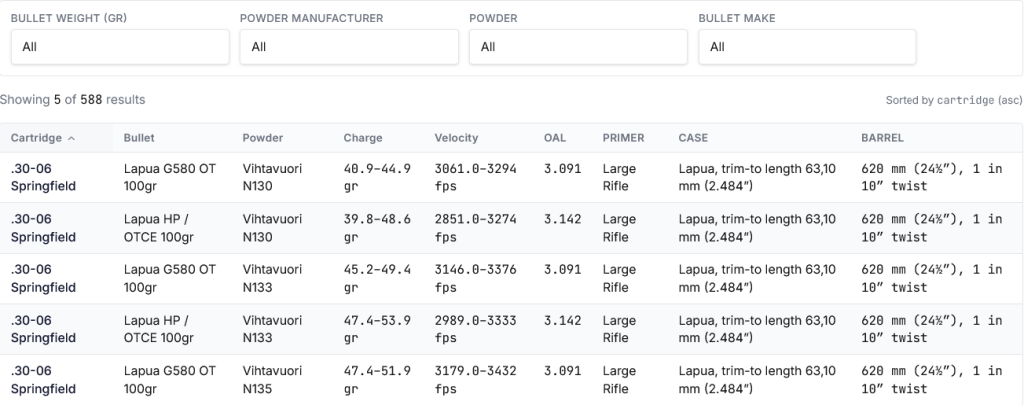
Navigating The Aggregated Database
Use the database to compare multiple sources for the same cartridge, bullet weight, powder, and primer combination. Look for patterns in starting charges, maximum charges, and expected velocity, then narrow the field to the components actually on hand.
A good workflow is simple: filter by cartridge, confirm bullet construction, and check whether the listed data came from a rifle or a universal receiver. That context matters as much as the charge weight itself.
Starting 10% Below Listed Charges
A common baseline is to begin roughly 10% below the listed maximum when no better starting data is available, then work up carefully. That margin is not a guarantee of safety, it is a conservative starting point that helps account for rifle-specific variation.
If a manual already lists a starting load, use that first. The 10% rule is a fallback method, not a replacement for published starting data or common sense at the bench.
Matching Components Before Testing
Match cartridge, bullet, powder, primer, and brass before assuming two loads are interchangeable. A change in primer cup hardness, case capacity, or bullet bearing surface can shift pressure enough to change the usable charge window.
Before any range test, confirm lot numbers where possible and record seating depth, overall length, and environmental conditions. Reloading is easier to repeat when the notes are precise.
The Master Theory of Load Development
Load development works best when the shooter thinks in pressure, not just velocity. The goal is a stable combination that stays safe in the rifle, produces consistent ignition, and remains repeatable across component lots.
Starting Loads Vs. Maximum Loads
Starting loads are built to give the handloader a safe entry point, while maximum loads sit near the edge of published pressure limits. The spread between them is where a rifle often shows its best accuracy node, not necessarily where the highest speed appears.
A maximum load that looks good on paper can still be too hot for a specific chamber, throat, or brass lot. A lower charge with better consistency often wins in practical use.
Reading Pressure Signs
Heavy bolt lift is one of the clearest field indicators that pressure may be rising too far for that rifle. Flattened primers can add context, though they are less reliable on their own because primer shape and cup hardness vary.
Other signs include ejector marks, sticky extraction, and unusually sharp recoil impulse. Any one sign should prompt a closer look, and multiple signs together should stop the test immediately.
How Seating Depth (CBTO) Alters Pressure
Changing cartridge base to ogive, or CBTO, changes how quickly the bullet engages the rifling. Seating deeper can raise pressure in some rifles because it reduces usable case volume, while seating closer to the lands can also increase pressure as the bullet enters the throat sooner.
Small changes matter. A .005 to .010 inch adjustment can shift both pressure and precision, so seating depth tests should be treated as part of the load, not as a separate cosmetic setting.
Why Cross-Reference Reloading Data
No two manuals are built from identical test conditions, so cross-referencing is standard practice. The same powder charge can look safe in one source and overly warm in another because the test setup was different.
Test Barrel Differences Across Manuals
Manuals often use different barrel lengths, twist rates, chamber dimensions, and pressure equipment. A long test barrel can produce higher velocity than a shorter hunting rifle, which can make one source look more efficient than another.
That difference is one reason published velocity should be treated as a reference, not a promise. Real rifles rarely match lab conditions exactly.
Brass Volume And Case Capacity Variation
Case capacity changes pressure more than many new reloaders expect. Two brands of brass in the same cartridge can hold different amounts of powder space, which affects burn rate and peak pressure.
Even within the same brand, fired brass from different chambers can vary. Measuring water capacity or at least segregating brass by lot helps keep the data honest.
Lot-To-Lot Component Changes
Powder lots, primer lots, and even bullet lots can change how a load behaves. A charge that printed tight groups last season may need a small adjustment after a new lot is opened.
That is why published load data should be treated as a baseline. Careful loaders validate again whenever a component changes.
Popular Cartridge Load Data
The most useful cartridge pages are the ones a shooter checks repeatedly for hunting, PRS, and general reloading work. The placeholders below are set up for the most common internal load data pages and can be expanded as the database grows.
- 6.5 Creedmoor Load Data
- .308 Winchester Load Data
- 7mm-08 Remington Load Data
- .243 Winchester Load Data
- .223 Remington Load Data
- 6mm Creedmoor Load Data
- 6.5 PRC Load Data
- .300 Winchester Magnum Load Data
- .30-06 Springfield Load Data
- .22 Creedmoor Load Data
Frequently Asked Questions
No published load data can be assumed safe in every rifle. Chamber dimensions, throat length, brass capacity, and primer choice all affect pressure, so every load still needs to be worked up carefully in the specific rifle that will fire it.
Primer substitution should be treated as a load change. Different primers can alter ignition strength and pressure behavior, especially in temperature-sensitive powders or compressed charges.
Published velocity is usually generated from a specific test barrel under controlled conditions. Barrel length, chamber spec, bore friction, altitude, temperature, and chronograph setup can all make a real rifle shoot faster or slower than the listed number.
“Having the right load data is only the first step. If you want to stop guessing and start mathematically predicting your optimal barrel time and seating depth, run these numbers through LoadForge—the premier cloud-based internal ballistics tool. Or, if you want to master the complete science of precision load development from start to finish, enroll in our Precision Reloading Course.”