When you pick up a rifle scope and look through it, you’re relying on a precision optical-mechanical instrument that either helps you connect at distance or costs you the shot. The difference between a scope that performs and one that fails comes down to glass quality, mechanical tracking, coatings, and build integrity. Too many shooters fixate on magnification numbers or brand logos while ignoring the engineering that actually matters.
After years of competing in PRS and NRL Hunter matches, plus countless days in the field chasing game from whitetails to elk, the lessons become clear. A scope is only as good as its weakest link. You can have the clearest glass on the market, but if your turrets don’t track, you will miss. You can have flawless mechanicals, but if your coatings rob you of light at last shooting light, you lose the opportunity. This guide breaks down every factor that separates a reliable optic from an expensive paperweight, giving you the technical knowledge to make a confident purchase.

- Design Physics for Objective-Relay-Eyepiece Matching
- What Makes One Scope Better Than Another
- Coatings
- What Lens Coatings Do and Why They Matter
- Different Types of Glass Used in Rifle Scopes: HD and ED
- Which One Is Best Between Rifle Scope Lens Glass From Europe and Japan?
- Big Glass Manufacturers
- Conclusion
- References
- Frequently Asked Questions
Design Physics for Objective-Relay-Eyepiece Matching
Every rifle scope is built around a fundamental optical chain: the objective lens gathers light, a relay (erector) system flips and magnifies the image, and the eyepiece delivers that image to your eye. The magnification you see is the product of the objective and eyepiece working together, multiplied by the magnification contribution of the relay system.
In practical terms, the system magnification can be expressed as a relationship between the objective focal length, the eyepiece focal length, and the relay lens magnification of the intermediate image. If you lock down your desired eye relief and the total tube length, you constrain what combinations of focal lengths and internal spacing will actually work.
Designers iterate through values for the relay focal length, objective focal length, and the internal distances between lens groups until both the target magnification and the physical length of the scope body are satisfied. The eyepiece focal length then falls out of those calculations.

These relationships start as thin-lens approximations. In a real scope, every lens element has finite thickness, so each theoretical thin lens gets replaced by principal planes with defined separations. This makes the finished scope slightly longer than the simplified math predicts, but that is easily accounted for during detailed design.
What this means for you as a buyer is straightforward. A well-engineered scope balances these internal dimensions so that the image stays sharp edge-to-edge, the eye box feels forgiving, and the eye relief keeps you safe from magnum recoil. When manufacturers cut corners on relay lens quality or spacing tolerances, you see it as edge distortion, narrow eye boxes, or inconsistent image quality across the magnification range.
What Makes One Scope Better Than Another
Several measurable factors separate a top-tier optic from a mediocre one. Knowing what to prioritize saves you from overspending on features that do not matter for your application.
Lens Quality
The glass itself is the foundation. Premium scopes use carefully formulated optical glass that minimizes internal distortion and maximizes the percentage of light that passes through each element. Cheap glass introduces subtle wavefront errors that stack up across multiple lens elements, softening the image and reducing contrast. You notice this most at high magnification and in challenging lighting.

Coatings
Even the best raw glass reflects roughly four to five percent of light at every uncoated air-to-glass surface. A scope with 10 or more lens elements can lose a staggering amount of light without proper coatings. Fully multi-coated optics apply multiple anti-reflective layers to every air-to-glass surface, pushing light transmission into the low-to-mid 90 percent range. The coating quality often matters more than the glass formula itself.
Magnification
More magnification is not always better. Higher power narrows your field of view and amplifies mirage, heartbeat, and wobble. The best scopes for a given task strike a balance. A 3-18x covers most hunting and competition needs. A 5-25x or 7-35x suits dedicated long-range work where target detection is not the primary concern.
Objective Lens Size
A larger objective gathers more light, producing a brighter image at any given magnification. But bigger objectives add weight and require taller rings, raising your cheek weld. A 50mm objective paired with a 5-25x scope works well for long-range precision. A 44mm objective on a 3-18x keeps the package lighter for field use.
Reticle Design
Your reticle is your primary aiming and ranging tool. Clean, well-designed reticles with consistent subtension marks let you hold for wind and elevation without dialing. Cluttered or poorly illuminated reticles slow you down. Choose a reticle that matches your shooting style, whether that is a simple duplex for hunting or a detailed Christmas tree for competition.
Durability
A scope must survive recoil, drops, temperature swings, and rough handling. Quality scopes use aerospace-grade aluminum tubes, are purged with argon or nitrogen to prevent fogging, and undergo rigorous shock testing. If your scope cannot hold zero after being dragged across barricades or banged against a tree stand, nothing else about it matters.
What Lens Coatings Do and Why They Matter
Lens coatings are microscopically thin layers of material applied to glass surfaces to control how light behaves at each interface. Without coatings, every time light passes from air into glass or from glass back into air, a percentage of that light bounces away as reflection. Those reflections reduce the brightness of the image you see and create internal glare that washes out contrast.
Anti-reflective coatings are the most critical type. They work by creating a thin film whose thickness is tuned to cause destructive interference with reflected light waves. Each additional layer targets a different wavelength range, which is why multi-layer coatings outperform single-layer ones. A scope labeled “fully multi-coated” has multiple anti-reflective layers on every air-to-glass surface. This is the standard you should accept as a minimum.
The difference in real-world performance is dramatic. Shooting at dawn or dusk, a fully multi-coated scope can give you an extra 10 to 15 minutes of usable light compared to a coated or multi-coated scope. In PRS matches, that translates to clearer target identification under shade structures or when mirage is heavy.
Beyond anti-reflective treatments, many manufacturers apply hydrophobic coatings that cause water and oil to bead and roll off the exterior lens surfaces. This keeps your glass cleaner in rain, snow, and dusty conditions. Scratch-resistant coatings made from materials like diamond-like carbon protect the outermost elements from abrasion during field use.
Proprietary coatings from brands like Zeiss (T* multi-coating) and Swarovski (Swarotop and Swarodur) represent some of the best performers in the industry. These coatings are not just marketing labels. They deliver measurably higher transmission percentages and noticeably better contrast when you compare them side by side with budget alternatives.
When evaluating a scope, always ask about coating type and layer count. It is one of the most cost-effective ways manufacturers improve optical performance, and it is one of the first things that gets cut in cheaper optics.
Different Types of Glass Used in Rifle Scopes: HD and ED
Not all optical glass is created equal. The type of glass in your scope’s lens elements directly affects color accuracy, sharpness, and how much chromatic aberration you see at high magnification.
Standard optical glass is made from combinations of crown and flint glass. It gets the job done in budget optics, but it bends different wavelengths of light at slightly different angles. This causes chromatic aberration, which shows up as colored fringing around high-contrast edges. At 20x magnification on a bright day, you will see purple or green halos around dark objects against a light background.
HD (High-Density) glass uses a denser formulation that increases the refractive index. The result is better light transmission and improved contrast, especially in dim conditions. HD glass is produced by adding heavy metal oxides to the melt, which allows more light to pass through each element. Brands like Vortex use HD glass in their Razor HD line to push contrast and resolution higher.
ED (Extra-Low Dispersion) glass tackles chromatic aberration directly. ED elements have a lower dispersion value, meaning they bend different wavelengths more uniformly. This dramatically reduces color fringing and produces a sharper, more color-neutral image. Leupold, for example, uses ED glass in their VX-6HD line for this reason.
Other specialized formulations exist. Fluorite crystal offers outstanding low-dispersion properties but is expensive and difficult to work with. EHRI (Extra-High Refractive Index) glass bends light more efficiently, allowing lens designers to achieve high magnification with fewer elements. LD (Low-Dispersion) glass falls between standard and ED in performance.
From a practical standpoint, if you are shopping for a scope in the $1,000-plus range, you should expect at least one ED element in the optical path. Below that price point, HD glass provides a meaningful upgrade over standard formulations. The glass type alone does not guarantee a great image, though. Lens design, element count, and coating quality all interact to determine what you actually see when you look through the scope.
Which One Is Best Between Rifle Scope Lens Glass From Europe and Japan?
This debate has been going on for decades in shooting circles, and the honest answer is that both regions produce world-class optical glass. The differences are real but often overstated.
European glass, particularly from Schott AG in Germany, is prized for its exceptional clarity, high transmission, and color fidelity. Schott’s manufacturing process melts raw materials at extremely high temperatures and refines them to eliminate impurities, bubbles, and inclusions. Brands like Zeiss, Swarovski, Schmidt & Bender, and Kahles build their reputations on Schott glass. European scope manufacturing also tends to involve more hand craftsmanship in the grinding, polishing, and assembly stages.
Japanese glass, primarily from Hoya Corporation, is known for its durability, scratch resistance, and consistent quality. Hoya’s proprietary process blends silica, boron oxide, and aluminum oxide in precise ratios to produce glass that handles rough field conditions exceptionally well. Japanese manufacturers like Nikon and many of the OEM producers that supply glass to American brands rely heavily on precision automation for consistent lens-to-lens quality.
In real-world use, the optical differences between a top-tier European scope and a top-tier Japanese-made scope are subtle. Side by side at a spotting scope comparison, you might notice slightly warmer color rendition from European glass and slightly cooler tones from Japanese glass. Edge sharpness and light transmission are competitive at the same price tier.
Where the difference becomes more meaningful is in the mid-range market. Japanese manufacturing automation keeps costs lower, which means you can often get excellent glass quality at a more accessible price point. European scopes at the same price may offer superior hand-finished aesthetics but not necessarily better optical performance.
Your decision should come down to intended use and budget. If you demand the absolute best color accuracy and are willing to pay a premium, European glass from brands using Schott delivers. If you want excellent durability, consistent quality, and strong value, Japanese glass from Hoya-sourced scopes is hard to beat.
Big Glass Manufacturers
The rifle scope industry depends on a small number of specialty glass producers. Knowing who makes the glass in your scope helps you understand what you are actually paying for.
Schott AG, headquartered in Mainz, Germany, is one of the most important names in optical glass. The company produces a wide catalog of optical materials, including specialized formulations with high refractive indices and low dispersion values. Zeiss, Swarovski, Kahles, and Schmidt & Bender all source glass from Schott. The company also produces radiation-shielding glass and extreme-temperature-resistant materials for military and tactical applications.
Hoya Corporation, based in Japan, is the other dominant player. Hoya’s ED glass is found in many high-end scopes, including models from Nightforce, Vortex, and numerous other brands that manufacture in Japan or the Philippines. Hoya glass is respected for its transmission properties and manufacturing consistency.
Among the scope brands themselves, each brings its own engineering strengths to the table.
- Zeiss builds the Conquest V6 and V8 series with Schott glass and proprietary T* coatings, delivering some of the brightest images in the industry.
- Swarovski Optik layers Swarotop and Swarodur coatings over premium glass for benchmark-setting clarity.
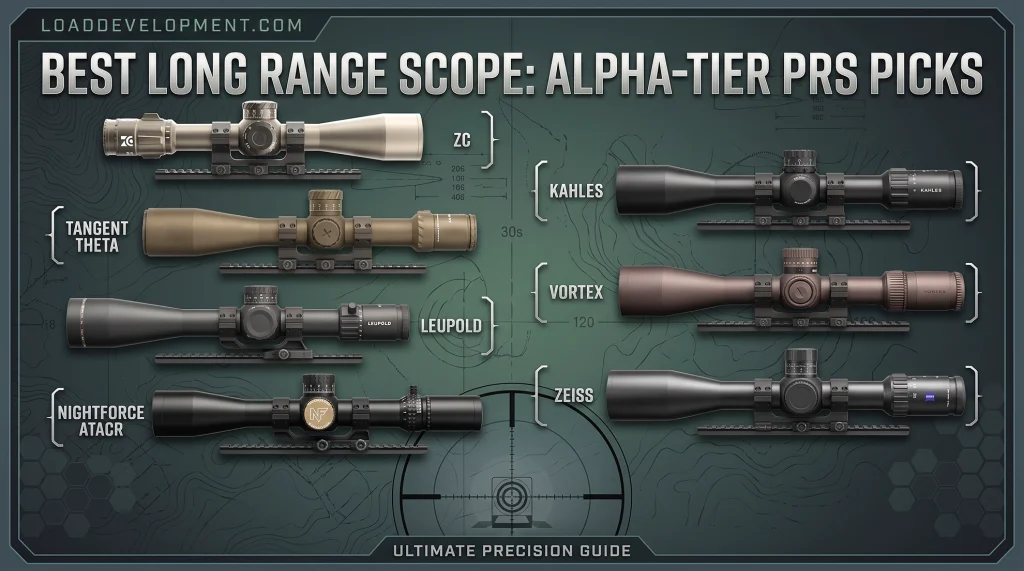
- Nightforce uses Hoya ED glass in scopes like the ATACR and NX8, favored heavily in PRS competition for their combination of optical quality and mechanical reliability.
- Leupold engineers its VX-6HD and Mark 5HD lines with ED glass and proprietary Twilight Max coatings optimized for low-light hunting.
- Vortex Optics offers HD and ED glass in the Razor HD Gen III and Viper PST Gen II lines, delivering strong performance at competitive prices.
- Kahles produces the K525i and K318i with ED glass and advanced coatings, earning a loyal following among European and American precision shooters.
The best scope for your needs depends on how you weight optical performance, mechanical precision, durability, and price. Every brand listed here sources raw glass from proven suppliers. The differences come down to lens design, coating technology, quality control, and mechanical execution.

Conclusion
The quality of glass and coatings in your rifle scope determines what you see. Light transmission, contrast, color accuracy, and edge-to-edge sharpness all trace back to the raw materials and manufacturing precision behind each lens element. Specialty glass types like ED and HD formulations reduce chromatic aberration and boost resolution. Advanced multi-layer coatings push light transmission into ranges that give you real advantages at dawn, dusk, and in shaded environments.
Mechanical reliability matters just as much. Your turrets must track precisely and repeatably, your zero must hold through recoil and temperature changes, and your reticle must stay true across the magnification range. None of that happens without quality internal components and tight assembly tolerances.
Before you buy, decide whether you want a first focal plane or second focal plane scope, and whether you prefer MOA or MRAD adjustments. Then evaluate the glass, coatings, turret quality, and durability within your budget.
Once you have your scope in hand, mounting it correctly is critical. A poorly mounted scope introduces cant errors that compound at distance, and no amount of premium glass can fix a misaligned reticle. Take the time to learn how to level a scope properly before you head to the range. It is the final step in getting the most out of your investment.
References
- W. J. Smith, Modern Optical Engineering, pp. 242-243, McGraw-Hill, New York, 2nd ed., 1990
- Burris Optics, Lens Quality
- Leupold & Stevens, Inc., Coatings
- Nikon, Magnification
- Schmidt & Bender, Durability
- Swarovski Optik, High-Precision Optics: The Technology Behind Every Riflescope
- Vortex Optics, Coatings
- Zeiss, Objective Lens Size
- GPO USA, ED Glass vs HD Glass
- Leupold & Stevens, Inc., Twilight Max HD
- Trijicon, HD Glass
- Hoya Corporation, Hoya Optics
- Schott AG, Optical Glass Overview
- Outdoorsmans, How Does a Rifle Scope Work
Frequently Asked Questions
Focus on glass quality, coating type (fully multi-coated at minimum), turret tracking reliability, reticle design, and build durability. Match the magnification range and objective lens size to your intended use, whether that is hunting, competition, or both. A scope that balances all of these factors will outperform one that excels in only one area.
Glass quality and coatings are the two biggest factors in what you see through the eyepiece. ED or HD glass reduces chromatic aberration and improves sharpness, while fully multi-coated lenses can transmit over 90 percent of available light. Together, they can give you 10 to 15 extra minutes of usable shooting light compared to budget optics with inferior coatings.
If you dial 3.5 MRAD on your turret based on your ballistic solver, the reticle must move exactly 3.5 MRAD inside the scope. Any tracking error stacks with distance and causes misses that have nothing to do with your rifle, ammunition, or shooting technique. Repeatable tracking and reliable return-to-zero are non-negotiable for any serious precision application.
A 4-12x gives you more magnification headroom for shots beyond 300 yards and works well for both hunting and informal target shooting. A 3-9x is lighter, often less expensive, and perfectly adequate for most whitetail hunting inside 250 yards. If you only own one hunting rifle, the 4-12x offers more versatility without significant weight or cost penalties.
A 50mm objective gathers more light and produces a brighter image, especially at higher magnifications and in low-light conditions. A 40mm objective keeps the scope lighter and lower on the rifle, which improves cheek weld and reduces the need for tall mounting rings. For most hunting applications, a 40-44mm objective offers the best balance of brightness and handling.
For most North American hunting scenarios inside 400 yards, a 3-18x or 4-16x magnification range covers nearly every situation you will encounter. You get enough low-end magnification for close shots in timber and sufficient top-end power for precise shot placement at longer distances. Scopes in this range also tend to be lighter and more compact than high-magnification alternatives.

AJ Deysel is a competitive rifle shooter in the PRS and NRL Hunter series, a lifelong hunter, and a recognized ballistics specialist whose load development expertise has been featured by industry leaders like Hornady. He is the founder and lead editor of LoadDevelopment.com. Read more about AJ or view our Editorial & Testing Guidelines.