
In rifle shooting, two terms get tossed around constantly, often interchangeably, but they describe fundamentally different things: accuracy and precision. Misusing these terms leads to misdiagnosed problems at the range, wasted ammunition during load development, and frustration that could be avoided with a clear mental framework.
The distinction is simple in principle: precision measures how consistently your rifle places shots relative to each other, while accuracy measures how close those shots land to where you actually aimed. A rifle can do one without the other, both, or neither. Grasping this difference is the first step toward knowing exactly what to fix when your groups or hits are not where they should be.
In Short
Your shooting results break down into two measurable dimensions. Precision tells you how tightly your shots cluster together, reflecting the consistency of your ammunition and rifle system. Small groups equal high precision. Accuracy tells you how close that cluster sits relative to your point of aim, reflecting how well your optic, zero, and ballistic data are dialed in. A rifle that prints a tiny group two inches left of center is precise but not accurate. A rifle that scatters shots evenly around the bullseye is accurate on average but not precise. You need both working in concert to shoot well at any distance.
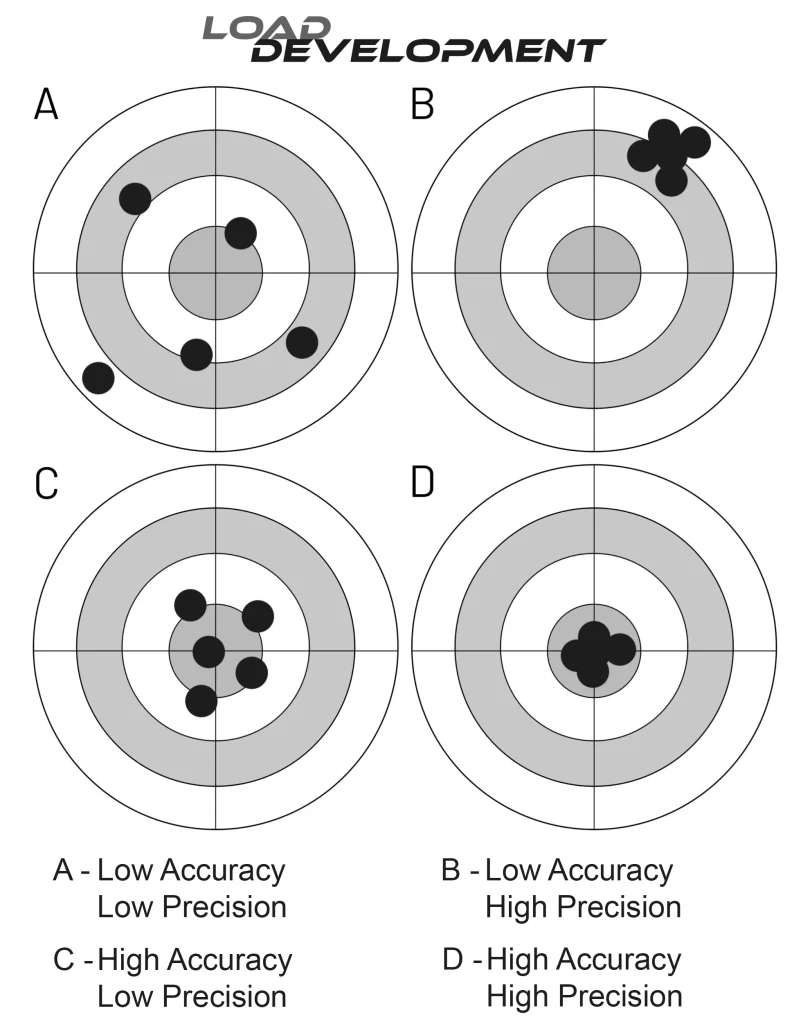
The Core Difference: The Target Matrix Explained
The classic four-target graphic you see on this page illustrates every possible combination of accuracy and precision. Each target represents a distinct diagnostic scenario, and learning to read them will immediately sharpen your ability to identify problems.
Target A: Low Accuracy, Low Precision. Shots are scattered and not centered. Multiple issues are compounding, from inconsistent ammunition to an incorrect zero or poor shooter fundamentals. Systematic troubleshooting is required.
Target B: Low Accuracy, High Precision. Shots form a tight cluster, but that cluster is displaced from the point of aim. The load is extremely consistent; the problem lies in the zero, scope tracking, or an uncorrected ballistic offset. This is the easiest problem to fix because a simple scope adjustment brings that tight group to center.
Target C: High Accuracy, Low Precision. Shots are scattered broadly, but their average center is near the bullseye. The zero appears correct on average, yet the rifle or load is not repeatable. Each individual shot is unpredictable.
Target D: High Accuracy, High Precision. Shots form a tight cluster centered on the point of aim. This is the goal. Your load is consistent, your zero is correct, and your ballistic solution is dialed.
When you look at your targets after a range session, mentally categorize them against this matrix before you start turning turrets or changing loads.
What Dictates Precision in a Rifle?
Precision is a function of mechanical and ballistic repeatability. Every variable that changes from one shot to the next degrades your group size.
Group Size Measurement: MOA and MRAD
Group size is most commonly expressed in MOA (minute of angle) or MRAD (milliradians). One MOA subtends approximately 1.047 inches at 100 yards. One MRAD subtends 3.6 inches at 100 yards. These angular units let you compare group sizes shot at different distances on a common scale.
A competitive PRS shooter typically demands 0.4 MOA or tighter from a rifle and load combination. Benchrest and F-Class shooters push for sub-quarter MOA groups under controlled conditions. In practice, as shot strings increase to 10, 20, or even 50 rounds, nearly all rifle systems open up to roughly 0.5 MOA due to the inherent nature of dispersion.
Internal Ballistics: ES, SD, and Barrel Harmonics
The primary drivers of precision are internal to the cartridge and barrel:
- Extreme Spread (ES) and Standard Deviation (SD): These measure the velocity variation across a string of shots. A low SD (single digits in feet per second) means your powder charge is burning consistently. High ES or SD introduces vertical dispersion, especially at longer ranges where time-of-flight differences translate into meaningful elevation spread.
- Barrel Harmonics: Every barrel vibrates in a sinusoidal pattern when fired. The muzzle traces a figure-eight or circular path. The key is to have the bullet exit the muzzle at a consistent point in this vibrational cycle, ideally at a node where muzzle movement is minimal. This is why small changes in powder charge or seating depth can dramatically shrink or expand groups.
- Seating Depth: Adjusting how far the bullet ogive sits from the rifling lands changes the initial pressure curve and, consequently, the timing of bullet exit relative to barrel harmonics. Fine-tuning seating depth in 0.003-inch increments is a standard precision optimization step.
Optimizing these variables is the core of load development. Tools like LoadForge can streamline this process by helping you organize and track test data across multiple variables systematically.
Other Precision Factors
Brass preparation (uniform neck tension, consistent case weight, and flash hole deburring), primer seating depth, and even lot-to-lot powder consistency all contribute. On the rifle side, action truing, barrel quality, bedding, and consistent bolt lug engagement matter significantly.
What Dictates Accuracy in a Rifle?
Accuracy concerns the relationship between your point of aim (POA) and your point of impact (POI). In simple terms: does the bullet hit where you pointed the crosshair?
Zeroing and Scope Tracking
Your zero is the foundation of accuracy. If your scope is not properly zeroed, every shot will be offset regardless of how precise the load is. Equally important is scope tracking, the ability of your optic to move the POI by exactly the amount you dial. A scope that claims 0.1 MRAD per click but actually moves 0.095 MRAD per click will accumulate error as you dial further from your zero distance. Verifying tracking with a tall target test is essential.
External Ballistics
Beyond your zero distance, maintaining accuracy requires correctly solving for:
- Bullet drop at the given range
- Wind drift from crosswinds and variable wind conditions
- Spin drift (gyroscopic drift), which becomes meaningful past 600 to 800 yards depending on caliber
- Coriolis effect at extreme long range
- Density altitude, which changes drag and therefore trajectory
At distance, even small errors in your ballistic solution compound. A true ballistic solver that accounts for these variables, like Trajek, becomes necessary for maintaining accuracy past a few hundred yards. Relying on basic drop charts or generic calculators introduces error that shows up as POI offset from POA.
Rifle and Barrel Contributions to Accuracy
A canted scope, improperly torqued action screws, or a barrel with a misaligned crown can all create systematic POI shifts. These are accuracy problems, not precision problems, because they move the entire group rather than opening it up.
Diagnosing Your Rifle: Is It an Accuracy or Precision Problem?
This is where the practical value of separating the two concepts becomes clear. When something is wrong at the range, you need to identify which problem you are solving before you start making changes.
Scenario 1: Tight Group, Wrong Location
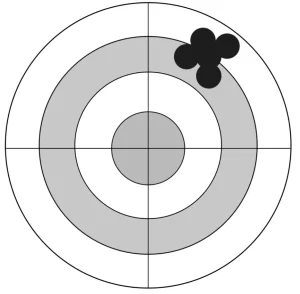
You fire a five-round string and measure a 0.3 MOA group, but the center of the group is 1.5 inches high and 1 inch to the right of your aiming point at 100 yards.
Diagnosis: This is purely an accuracy problem. Your load is performing excellently. Do not change your ammunition. Adjust your scope to bring the group center to your POA. Verify with a confirmation group.
Scenario 2: Centered but Scattered
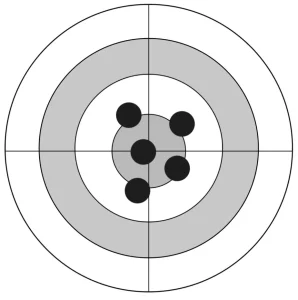
Your shots average out near the bullseye, but they are spread across a 2.5 MOA area with no discernible pattern.
Diagnosis: This is a precision problem. Your zero may be approximately correct, but the rifle, load, or shooter is introducing excessive variation. Investigate ammunition consistency (check ES/SD on a chronograph), shooter fundamentals (trigger pull, breathing, natural point of aim), and rifle mechanics (loose action screws, poor bedding, worn barrel).
Scenario 3: Vertical Stringing
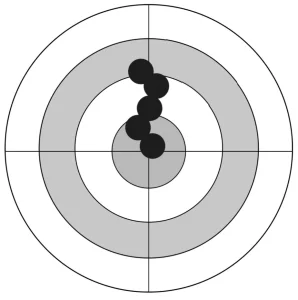
Shots print in a vertical line spanning 1.5 to 2 MOA but are horizontally tight.
Diagnosis: This is almost always a precision problem rooted in velocity variation. Check your SD and ES. Inconsistent powder charges, temperature sensitivity of the powder, or poor neck tension are common culprits. Barrel heat can also cause vertical stringing as the barrel warms and the POI shifts.
Scenario 4: Consistent Shift at Distance
Your rifle shoots centered at 100 yards but impacts 0.4 MRAD left at 700 yards.
Diagnosis: Accuracy problem. Possible causes include unaccounted spin drift, a scope tracking error, a slight scope cant, an incorrect ballistic profile in your solver or a scope that is not level and canted. Your load is likely fine; your data or equipment setup needs correction.
The rule of thumb: if the group is tight, your ammunition and rifle mechanics are working. Fix the zero or ballistic solution. If the group is open, the problem is in the load, the barrel, or the shooter.
Precision vs Accuracy in Hunting vs Competition (PRS)
The relative importance of precision and accuracy shifts depending on how you use your rifle.
Hunting: Accuracy Takes Priority
A hunter needs a first-round hit on an animal’s vital zone, which is roughly 8 to 10 inches on a deer-sized target. The shot opportunity may be fleeting, from an improvised position, at an uncertain distance, and in variable wind.
In this context, accuracy is king. Your rifle needs to hit where you aim, right now, on the first shot. A load that prints 1.2 MOA groups but is properly zeroed and paired with a solid ballistic solution will cleanly kill a deer at 300 yards. A load that prints 0.3 MOA groups but is zeroed incorrectly or paired with bad dope will miss or wound.
That said, reasonable precision (sub-1.5 MOA for most hunting applications) ensures each individual shot stays within the vital zone. You do not need benchrest-level precision, but you need enough to trust the single shot.
PRS and Benchrest Competition: Precision is Non-Negotiable
In PRS competition, you engage steel targets at known and unknown distances, often under time pressure. Targets are small, sometimes as little as 1 to 2 MOA in size. You need tight groups and correct data. Both precision and accuracy must be at a high level, but the margin for precision error is extremely slim.
Benchrest and F-Class competitors take this further. The entire discipline revolves around producing the smallest possible groups under controlled conditions. Extreme precision, sub-0.25 MOA, is the explicit goal. Accuracy (centering those groups on the scoring rings) matters for score, but the pursuit is fundamentally about mechanical and ballistic repeatability.
| Factor | Hunting | PRS Competition | Benchrest / F-Class |
|---|---|---|---|
| Primary focus | Accuracy (first-round hit) | Both equally | Precision (smallest group) |
| Acceptable group size | 1.0–1.5 MOA | 0.3–0.5 MOA | Sub-0.25 MOA |
| Shot count per engagement | 1–2 | 2–10+ per stage | 5–10 per group |
| Conditions | Field positions, variable | Various, often improvised | Bench, controlled |
The Scientific Standard: ISO 5725-1 vs. Range Vernacular
If you have a background in engineering, metrology, or laboratory sciences, you might notice that the practical shooting terminology we use on the firing line differs slightly from international measurement standards—specifically ISO 5725-1:2023. In the strict scientific world, the two-part framework we use to diagnose a rifle is split into three distinct concepts: Precision, Trueness, and Accuracy.
What shooters pragmatically call “accuracy”—getting the average center of a group to align with the point of aim—the ISO standard defines as Trueness (the absence of systematic bias). Under ISO rules, the term Accuracy is actually an umbrella measurement that demands both high precision and high trueness working together.
This means if your rifle scatters shots evenly around the bullseye, a shooter will say the zero is “accurate but not precise.” An engineer looking at that exact same target will say it has “high trueness, low precision, and therefore low accuracy.” For practical load development and turning turrets at the range, our classic two-part system remains the most effective mental framework for troubleshooting your gear. However, understanding the ISO distinction is incredibly useful when evaluating highly technical ballistic solver data or discussing optic tracking with manufacturers.
If we were to rewrite the target matrix using strict ISO terminology, it would look like this:
- Target A (Scattered, off-center): Low Trueness, Low Precision, Low Accuracy.
- Target B (Tight group, off-center): Low Trueness, High Precision, Low Accuracy.
- Target C (Scattered, centered): High Trueness, Low Precision, Low Accuracy. (This is where ther definitions diverge).
- Target D (Tight group, centered): High Trueness, High Precision, High Accuracy.
Frequently Asked Questions
A rifle is accurate when its point of impact consistently matches the point of aim. This requires a properly zeroed optic with verified tracking, correct ballistic data for the distance and conditions, and a mechanically sound platform (properly crowned barrel, square action, and a scope mounted without cant). Accuracy is ultimately about the entire system working together to place shots where the shooter intends.
For hunting, accuracy is more important because you need each shot to strike the vital zone of the animal you are aiming at. A perfectly precise rifle that consistently groups off-target will result in a miss or a poorly placed hit. That said, sufficient precision (generally sub-1.5 MOA for big game) ensures your individual shots stay within the vital area at realistic distances.
Accuracy measures how close your shots land to your intended aiming point. Precision measures how close your shots land to each other. A tight group that is off-center indicates high precision but low accuracy, while a scattered group centered on the bullseye indicates low precision but reasonable average accuracy.
Yes, and it happens frequently. A shooter with a well-zeroed rifle but inconsistent ammunition might scatter shots around the target (accurate on average, not precise). Conversely, a shooter with superb handloads but an incorrect zero might print a tiny group in the wrong spot (precise, not accurate). Identifying which situation applies tells you exactly what to fix.
Group size is a direct measurement of precision. A smaller group means higher precision and greater shot-to-shot consistency. Point of impact offset from the point of aim is a direct measurement of accuracy. A group centered on target means high accuracy. You evaluate both together to get a complete picture of your rifle system’s performance.
Tight groups that are displaced from the aiming point typically result from an incorrect zero, scope tracking errors, uncorrected spin drift, or a canted optic. Scattered groups centered near the bullseye usually stem from inconsistent ammunition (high velocity SD), poor barrel condition, loose action screws, or inconsistent shooter technique. Fixing each requires a different approach.
Shoot a minimum of five-round groups (ten is better for statistical reliability) at a target with a clearly defined aiming point. Measure the center-to-center distance of the widest shots to determine group size (precision). Measure the offset between the center of the group and your aiming point to determine accuracy. Use consistent shooting conditions, a solid rest, and record environmental data. A chronograph provides velocity SD and ES data to supplement your precision evaluation from the target.

AJ Deysel is a competitive rifle shooter in the PRS and NRL Hunter series, a lifelong hunter, and a recognized ballistics specialist whose load development expertise has been featured by industry leaders like Hornady. He is the founder and lead editor of LoadDevelopment.com. Read more about AJ or view our Editorial & Testing Guidelines.

There are international standards. The terms are defined differently in those standards. See ISO 5725-1:2023(E)
You are correct from an engineering standpoint that makes use of the ISO three part framework, where the term Accuracy is actually an umbrella measurement that demands both high precision and high trueness working together. Since the site is aimed at shooting, we stuck to the two part framework used in the shooting world, but I have added another section on the ISO divergence for clarity. Thank you.