
The Creedmoor family has grown well beyond the 6.5mm cartridge that started it all. What began in 2007 as a collaboration between Hornady senior ballistician Dave Emary and Creedmoor Sports vice president Dennis DeMille has branched into a lineup of rifle cartridges spanning .22 caliber through .30 caliber, all built on the same efficient case geometry. If you are trying to figure out which Creedmoor fits your rifle, your shooting discipline, or your hunting plans, a side-by-side comparison saves you hours of scattered forum reading.
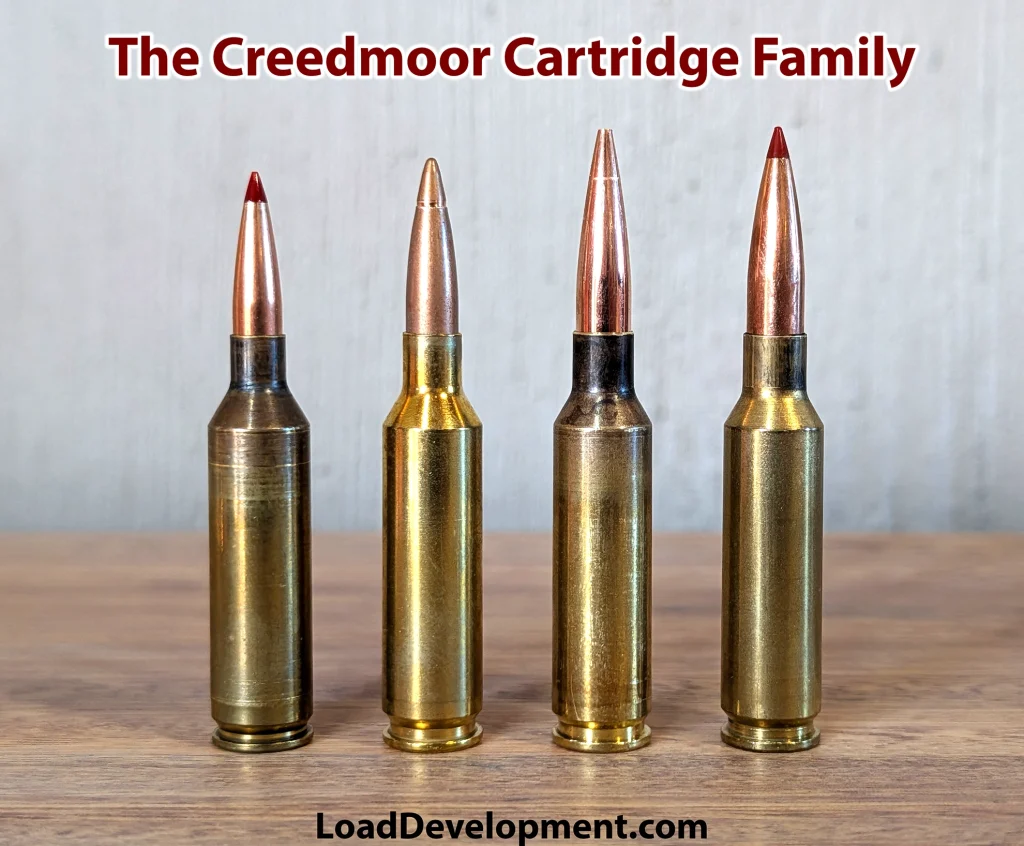
The real value of the Creedmoor family is that every variant shares the same short-action case design, the same bolt face, and the same emphasis on seating high-BC bullets properly, so your choice comes down to caliber, ballistic role, and what you want to do at the other end of the trajectory. The differences between a 22 Creedmoor and a 6.5 Creedmoor are substantial in recoil, barrel life, bullet weight, and terminal effect, yet the brass and the action platform stay remarkably consistent.
This comparison covers the 22 Creedmoor, 6mm Creedmoor, 25 Creedmoor, and 6.5 Creedmoor in practical terms: ballistics, case capacity, twist rates, factory ammo availability, reloading considerations, and real-world use cases. You will also find notes on where the .30-caliber Creedmoor concept fits and when you might be better served by a non-Creedmoor cartridge entirely. If you want to go deeper on any single cartridge, the ballistic tools and cartridge data at LoadDevelopment.com can fill in the specifics once you have narrowed your options.
Creedmoor Family Comparison Chart
The quickest way to understand the Creedmoor lineup is to see the key specs side by side. The numbers below reflect common factory loads and widely used handload data, not cherry-picked outliers. Your results will shift with barrel length, altitude, and component choices, but these figures give you a reliable starting framework.
| Spec | 22 Creedmoor | 6mm Creedmoor | 25 Creedmoor | 6.5 Creedmoor |
|---|---|---|---|---|
| Bullet Diameter | .224 in | .243 in | .257 in | .264 in |
| Common Bullet Weights | 70–88 gr | 90–108 gr | 110–131 gr | 120–147 gr |
| Typical Muzzle Velocity (fps) | 3,200–3,450 | 2,900–3,150 | 2,800–3,050 | 2,680–3,020 |
| Recommended Twist Rate | 1:7 to 1:8 | 1:7 to 1:8 | 1:7.5 to 1:8 | 1:8 |
| Case Capacity (gr H₂O) | ~52.5 | ~52.5 | ~52.5 | ~52.5 |
| Parent Case | .30 TC / 6.5 CM | .30 TC / 6.5 CM | .30 TC / 6.5 CM | .30 TC |
| Max OAL (in) | ~2.825 | ~2.825 | ~2.800 | 2.825 |
| SAAMI Status | SAAMI-accepted | SAAMI-accepted | SAAMI-accepted (2025) | SAAMI-accepted |
| Effective Range (target) | 800–1,000+ yd | 1,000–1,200+ yd | 1,000–1,200+ yd | 1,200+ yd |
| Recoil (relative) | Lowest | Low | Moderate-low | Moderate |
| Barrel Life (approx.) | 1,200–1,800 rds | 1,400–2,000 rds | 1,800–2,800 rds | 2,400–3,000 rds |
| Factory Ammo Availability | Limited/boutique | Good | Growing (Hornady) | Excellent |
How To Read The Cartridge Differences
Every cartridge in this table shares the same parent case lineage and the same .473-inch bolt face. That means you are looking at the same action, the same magazine, and roughly the same brass. The differences come from neck diameter, bullet weight, and how much work you are asking the powder charge to do.
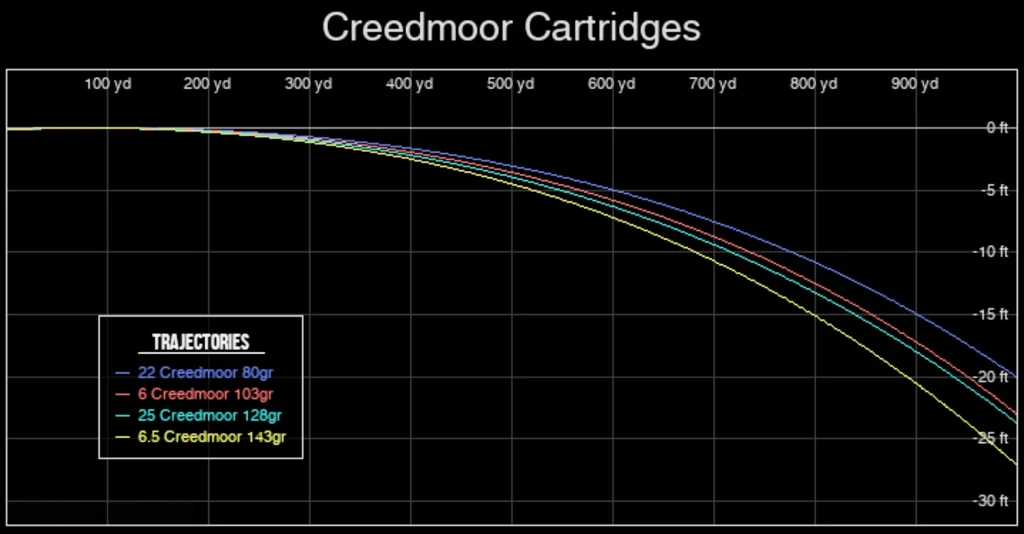
Muzzle velocity and bullet weight move in opposite directions across the family. The 22 Creedmoor pushes lightweight bullets fast, which gives you flat trajectory and less wind drift per inch of bullet drop. The 6.5 Creedmoor launches heavier, higher-BC projectiles at lower velocity but retains energy and resists wind at extreme range.
Twist rate matters because each caliber needs to stabilize its intended bullet length. A 1:7 or 1:7.5 twist in the 22 Creedmoor is built to handle long, heavy-for-caliber .224 bullets. Running the wrong twist for your chosen bullet weight will cost you accuracy before you ever touch the load data.
Note: Typical velocity and recoil figures are estimates based on standard barrel lengths and factory match ammunition. Recoil energy will vary based on the weight of the rifle.
| Cartridge | Bullet Diameter | Typical Bullet Weight | Optimal Twist Rate | Primary Use Case |
|---|---|---|---|---|
| 22 Creedmoor | .224″ (5.7mm) | 75gr – 85.5gr | 1:7 or 1:8 | Long-range varmint/coyote hunting; low-recoil precision target. |
| 6mm Creedmoor | .243″ (6mm) | 105gr – 115gr | 1:7.5 or 1:8 | PRS competitions; long-range CXP2 (deer/antelope) hunting. |
| 25 Creedmoor | .257″ (6.53mm) | 131gr – 135gr | 1:7 or 1:7.5 | NRL Hunter competitions; excellent balance of barrel life and splash visibility. |
| 6.5 Creedmoor | .264″ (6.5mm) | 130gr – 147gr | 1:8 | The ultimate all-rounder; 1,000-yard target shooting and medium game hunting. |
| 308 Creedmoor | .308″ (7.62mm) | 168gr – 185gr | 1:10 | Heavy hitting short-action performance (conceptually derived from the .30 TC). |
What Changes Across The Family
Three things shift meaningfully as you move from .22 to .264: recoil impulse, barrel life, and terminal performance on game.
Recoil climbs with bullet weight. The 22 Creedmoor is easy to spot your own shots through a scope. The 6.5 Creedmoor requires more attention to recoil management, though it is still mild compared to a .308 Win or anything in the magnum class.
Barrel life trends inversely with velocity. The 22 Creedmoor burns throats fastest because it is pushing the most gas through the smallest bore. The 6.5 Creedmoor is the gentlest on barrels in the family.
Terminal ballistics scale with bullet diameter and weight. For deer-sized game, the 25 Creedmoor and 6.5 Creedmoor offer meaningful advantages in penetration and wound channel over the smaller-caliber options. For varmints and predators, the 22 Creedmoor and 6mm Creedmoor are more than adequate. This is also not necessarily the case either as additional velocity makes up for the lighter bullets if the correctly expanding and penetrating bullets are used for the lighter calibers.
Why The Creedmoor Case Design Works
The Creedmoor case was not an accident or a marketing exercise. Dave Emary and Dennis DeMille designed it to solve specific problems competitive shooters were dealing with in the mid-2000s: inconsistent feeding from detachable box magazines, bullets seated too deep into the case to maintain good powder geometry, and the compromises of trying to fit long, high-BC match bullets into existing short-action cartridges like the .260 Remington. The result is a case that balances capacity, pressure, and bullet seating in a way that translates directly to accuracy and consistency.
Short-Action Efficiency And Magazine Fit
The 6.5 Creedmoor’s overall length of 2.825 inches is only .015 inches longer than the .308 Winchester. That means it fits standard short-action receivers from Remington 700-pattern rifles, Savage 110s, Ruger Americans, and AR-10 platforms without modification.
More importantly, the case is slightly shorter than the .260 Remington, which gives you extra room to seat long, high-BC bullets without intruding into the powder column. This is the detail that matters most for reloaders. When you seat a 140-grain ELD Match into a .260 Rem to magazine length, the bullet base can eat into usable case volume. The Creedmoor case solves that problem by design.
The .473-inch bolt face is shared with the .308 Win, .30-06 Springfield, and dozens of other cartridges. Rifle manufacturers do not need proprietary bolt faces. That commonality is a big reason the Creedmoor platform spread so quickly across the industry.
How High-BC Bullets Benefit From The Design
A cartridge is only as good as the bullets it can launch efficiently. The Creedmoor case geometry was purpose-built around modern match bullets with high ballistic coefficients and strong sectional density.
In the 6.5mm bore, bullets like the 140-grain Hornady ELD Match (G1 BC around .646) or 147-grain ELD Match sit at the sweet spot of weight, length, and aerodynamic efficiency. The case has enough capacity, roughly 52.5 grains of water, to drive those projectiles at 2,700+ fps from a 24-inch barrel.
When you neck the same case down to .224, .243, or .257, you gain velocity but shift the BC and sectional density curves. The 6mm Creedmoor running a 108-grain ELD Match still benefits from the same efficient powder burn and consistent ignition. The 22 Creedmoor with an 80-grain ELD Match trades absolute BC for speed, which flattens trajectory at moderate distances.
The design philosophy stays the same across the family: give the bullet enough room to sit properly in the case neck, maintain a 30-degree shoulder for consistent headspacing, and keep the case short enough for reliable magazine feeding.
Tradeoffs In Brass Life And Barrel Life
Nothing in cartridge design comes free. The Creedmoor case operates at SAAMI pressures up to 62,000 psi, which is standard for modern cartridges but not gentle on components.
Brass life depends on how hot you load and how well you anneal. Most shooters report 8 to 12 firings from quality brass like Lapua, Alpha Munitions, or Peterson before case heads start showing signs of fatigue. Budget brass from mixed-headstamp factory ammo may only give you 4 to 6 loadings.
Barrel life is the more significant tradeoff, and it varies sharply across the family. The 22 Creedmoor pushes high-velocity gas through a small bore, which erodes the throat quickly. Expect 1,500 to 2,500 rounds before accuracy degrades noticeably. The 6mm Creedmoor sits in the 2,000 to 3,000 range. The 25 Creedmoor improves to roughly 2,500 to 3,500. And the 6.5 Creedmoor, with its larger bore and lower peak velocity, gives you the best barrel life in the family at 3,000 to 5,000 rounds.
If you are a high-volume competition shooter, barrel life is a real cost consideration. If you are a hunter putting 100 rounds a year downrange, any Creedmoor variant will outlast your interest in the rifle.
22 Creedmoor And 6mm Creedmoor
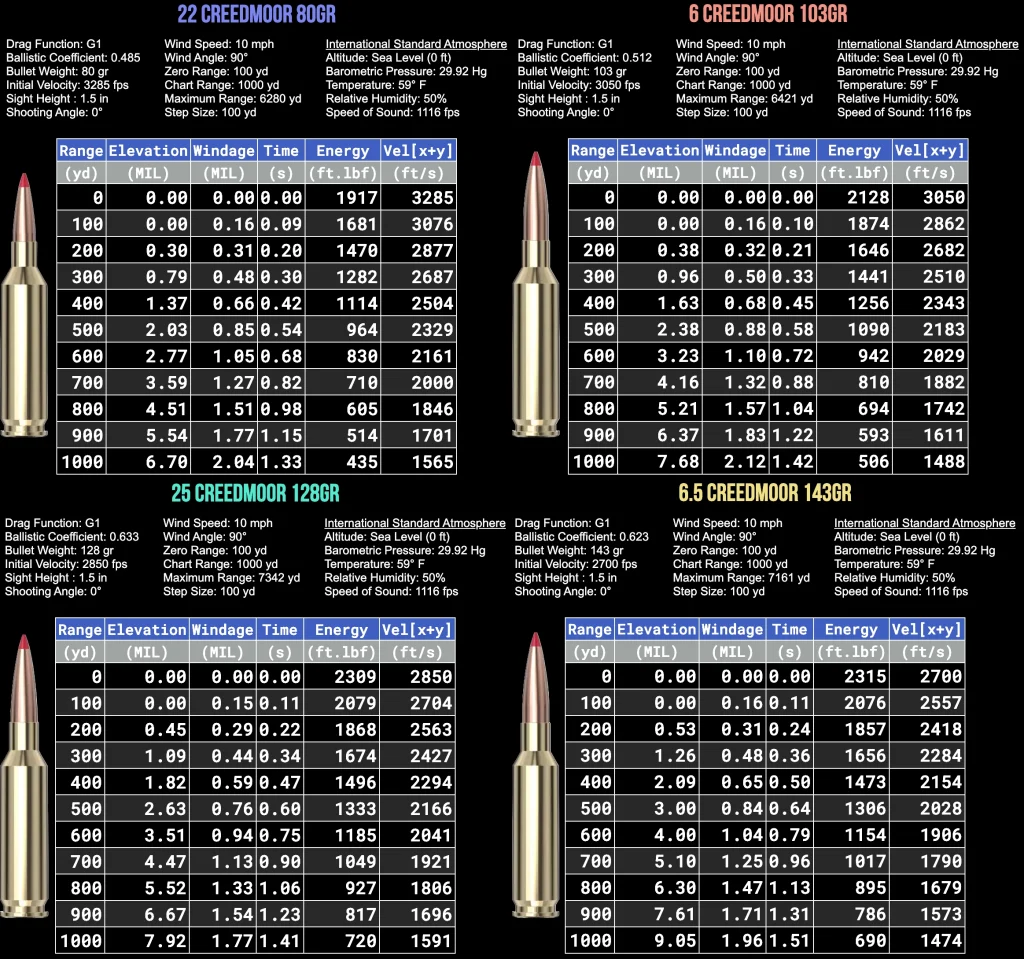
The two smallest members of the Creedmoor family occupy different roles despite sharing the same case and overall length. The 22 Creedmoor is a speed machine built for varmints, predators, and flat-shooting precision work. The 6mm Creedmoor is a competition-proven cartridge that bridges the gap between low recoil and meaningful downrange energy. Choosing between them depends on whether you prioritize velocity or bullet weight.
Check out our complete guide to 22 Creedmoor: Load Data, Ballistics, Twist Rates & Specs, which includes a drop chart and reloading recipes.
22 Creedmoor For Varmints And Speed
The 22 Creedmoor is the 6.5 Creedmoor case necked down to .224 caliber. With a 1:7 or 1:7.5 twist barrel, it stabilizes heavy-for-caliber .224 bullets like the 80-grain ELD Match and 88-grain ELD Match that lighter .22-caliber cartridges cannot handle.
Typical muzzle velocities land between 3,200 and 3,450 fps depending on bullet weight and barrel length. That speed translates to extremely flat trajectory and minimal wind drift inside 600 yards, making it a standout choice for varmint and predator hunting.
Recoil is the lightest in the Creedmoor family. You can spot your own impacts through a scope without losing the target, which matters when you are calling coyotes or shooting prairie dogs in volume.
The main drawback is barrel life. Pushing that much gas through a .224 bore eats throats. Budget 1,200 to 2,000 rounds depending on how hard you run it. Factory ammo is also limited; you will mostly find boutique offerings. If you reload, the 22 Creedmoor becomes significantly more practical.
6mm Creedmoor For Precision Competition
The 6mm Creedmoor necks the parent case down to .243 caliber and has become one of the most popular cartridges in Precision Rifle Series (PRS) and NRL competition. Bullet weights typically range from 90 to 108 grains, with the 105-grain Berger Hybrid and 108-grain ELD Match being common choices. Check out our complete guide to 6mm Creedmoor: Load Data, Ballistics, Twist Rates & Specs, which includes 1,000-yard drop charts and heavy-bullet recipes.
Muzzle velocities in the 2,900 to 3,150 fps range give you a trajectory advantage over the 6.5 Creedmoor while keeping recoil low enough for fast follow-up shots in timed stages. The 108-grain ELD Match running at 3,000 fps stays supersonic past 1,200 yards with good wind-bucking ability.
Factory ammo availability is reasonable. Hornady loads the 108-grain ELD Match and 103-grain ELD-X, and several smaller manufacturers offer match-grade options. For reloaders, component selection is excellent.
Barrel life sits around 2,000 to 3,000 rounds. Not as thirsty as the 22 Creedmoor, but noticeably shorter than the 6.5. Competition shooters running 3,000+ rounds per season factor barrel changes into their budget.
How They Compare With 22-250 Rem, .224 Valkyrie, 6mm BR, And 6mm PPC
The 22 Creedmoor versus 22-250 Rem comparison comes down to bullet options. The 22-250 has been around since the 1960s and runs similar velocities, but its longer case and faster twist limitations historically restricted it to lighter bullets. Modern 22-250 AI chambers close that gap somewhat, but the 22 Creedmoor’s short-action fit and purpose-built throat for heavy .224 bullets make it more straightforward for precision work.
The .224 Valkyrie was designed for the AR-15 platform. It runs lighter bullets at lower velocities than the 22 Creedmoor from a smaller case. If you need an AR-15 long-range option, the Valkyrie makes sense. For bolt-action precision shooting, the 22 Creedmoor outperforms it on every metric except action size.
The 6mm BR and 6mm PPC are benchrest-derived cartridges with outstanding accuracy reputations. The 6mm BR in particular remains popular in competition, and its smaller case capacity can actually extend barrel life compared to the 6mm Creedmoor. The tradeoff is lower velocity, less factory support, and fewer rifle options. The 6mm Creedmoor wins on availability and magazine compatibility, while the BR and PPC can edge it in pure accuracy-per-round-count efficiency.
If you are starting from scratch and want the broadest support ecosystem, the 6mm Creedmoor is the safer bet. If you already have a 223 Rem bolt gun and want a step up without changing platforms, the 22 Creedmoor on a short action gets you there cleanly.
25 Creedmoor In The Middle Ground
The 25 Creedmoor fills the gap between the 6mm and 6.5mm Creedmoor variants by necking the parent case to .257 caliber. It combines flat trajectory and moderate recoil with enough bullet weight to be a legitimate medium-game hunting cartridge. What makes it compelling in 2026 is the convergence of SAAMI acceptance, modern .257 bullet designs, and growing factory support from Hornady. Check out our complete guide to 25 Creedmoor Ballistics and Load Data, which includes 1,000-yard drop charts and heavy-bullet recipes.
What Makes 25 Creedmoor Different
For years, .25-caliber cartridges like the .25-06 Remington and .257 Roberts were held back by bullet selection. Most .257 bullets were designed decades ago for moderate velocities and conventional construction. The 25 Creedmoor changes that equation by pairing the efficient Creedmoor case with modern low-drag projectiles from Berger, Hornady, and others.
Common bullet weights fall between 110 and 131 grains. The Hornady 110-grain ELD-X runs around 3,050 fps from a 24-inch barrel, while heavier options like the Berger 131-grain sit closer to 2,800 fps. The result is a cartridge that shoots flatter than the 6.5 Creedmoor with less recoil while carrying significantly more energy downrange than the 6mm Creedmoor.
The overall length of roughly 2.800 inches fits standard AICS-pattern magazines and short-action receivers. You get the same platform compatibility as the rest of the family.
Hunting And NRL Hunter Appeal
The 25 Creedmoor has found a natural home in two places: medium-game hunting and NRL Hunter competition.
For deer, antelope, and similar-sized game, the 25 Creedmoor delivers plenty of energy inside 500 yards while keeping recoil manageable enough for accurate shot placement. The Hornady ELD-X in particular is designed for controlled expansion at hunting velocities, making it a practical choice for field use.
In NRL Hunter, where competitors engage steel and sometimes hunt live game as part of the format, the 25 Creedmoor offers a favorable balance. It bucks wind better than the 6mm Creedmoor due to heavier, higher-sectional-density bullets, yet recoils less than the 6.5 Creedmoor. Several competitive shooters have moved to the 25 Creed specifically for this reason.
For larger game like elk or moose, the 25 Creedmoor starts to reach its limits. You can make it work with precise shot placement and premium bullets, but the 6.5 Creedmoor or a larger cartridge gives you more margin.
Factory Support Versus Wildcat Roots
The 25 Creedmoor spent several years as a wildcat cartridge, requiring custom reamers and hand-formed brass. Brands like Horizon Firearms and Mountain Forged offered rifles chambered in it, and Alpha Munitions produced purpose-built brass, but factory ammo did not exist.
That changed when Hornady submitted the 25 Creedmoor to SAAMI and began offering factory-loaded ammunition. The SAAMI standardization in 2025 was a turning point; it opened the door for major rifle manufacturers to chamber production guns and for more ammo makers to load for it.
As of mid-2026, factory ammo options are still limited compared to the 6.5 Creedmoor. Hornady’s offerings anchor the market, with a few smaller brands filling in. If you reload, component availability is strong. Quality brass from Alpha Munitions, Hornady, and Peterson is readily available, and .257-caliber bullet options have expanded significantly.
If you are a reloader, the 25 Creedmoor is ready for serious use right now. If you depend entirely on factory ammo, check availability in your area before committing to the platform. The cartridge data and load development resources at LoadDevelopment.com can help you get started on the handloading side.
6.5 Creedmoor And The Larger-Caliber Offshoot Question
The 6.5 Creedmoor remains the anchor of the entire family and the cartridge that most shooters evaluate first. It set the template for everything that followed, and its dominance in factory ammo, rifle availability, and competitive use is unmatched among the Creedmoor variants. Understanding where it sits relative to older 6.5mm cartridges and the .30-caliber concept that preceded it gives you a clearer picture of the whole ecosystem. Check out our complete guide to 6.5 Creedmoor: Load Data, Ballistics, Specs & 308 Comparison, which includes 1,000-yard drop charts and heavy-bullet recipes.
Why 6.5 Creedmoor Became The Standard-Bearer
Three factors converged. First, the case design solved the feeding and seating problems that plagued the .260 Remington in competition. Second, Hornady backed it with factory-loaded match ammo using ELD Match bullets at a time when high-quality factory match ammo was not common in 6.5mm. Third, every major rifle manufacturer, from Ruger and Savage to GA Precision and Weatherby, chambered production guns for it within a few years of its introduction.
The 6.5 Creedmoor pushes 140-grain match bullets at 2,700+ fps from a 24-inch barrel. It stays supersonic past 1,200 yards. It generates roughly 50% less recoil than a .308 Winchester firing comparable-weight bullets. For precision rifle competition, those numbers ended the debate.
Hunters followed. A 143-grain Hornady ELD-X at 2,710 fps delivers over 2,280 ft-lbs at the muzzle and retains enough energy for clean kills on deer-sized game well past 400 yards. The cartridge’s flat trajectory and wind resistance reduce the margin of error on field shots.
In the US market, the 6.5 Creedmoor has effectively replaced the .308 Winchester as the default precision rifle cartridge and has carved a massive share of the hunting market.
How It Stacks Up Against .260 Remington, .243 Winchester, And .308 Winchester
The .260 Remington is ballistically similar to the 6.5 Creedmoor. Both shoot .264-caliber bullets at comparable velocities. The .260 Rem’s longer case, based on the .308 Win, means bullets must be seated deeper to fit short-action magazines. This reduces usable case volume with long, high-BC bullets and can create feeding issues in some rifles. Factory ammo selection for the .260 Rem has dwindled as the 6.5 Creedmoor took over.
The .243 Winchester pushes lighter .243-caliber bullets faster than the 6.5 Creedmoor but carries less energy downrange at distance. It is an excellent deer cartridge inside 400 yards and a capable varmint round. Where it falls short is wind resistance and retained energy past 600 yards. The 6.5 Creedmoor’s heavier, higher-BC bullets outperform the .243 Win in those scenarios decisively.
The .308 Winchester remains relevant for its ammo availability, proven terminal performance, and military/law enforcement pedigree. It hits harder at close range with 168 to 175-grain bullets. But its trajectory drops off faster, it drifts more in wind, and it goes subsonic sooner than the 6.5 Creedmoor. If your shooting stays inside 600 yards and you value the broadest possible ammo selection, the .308 still makes sense. Past 600 yards, the 6.5 Creedmoor pulls away.
The .30-Caliber Creedmoor Concept And .30 TC Lineage
The 6.5 Creedmoor’s parent case is the .30 Thompson Center, a .30-caliber cartridge Hornady developed in partnership with Thompson/Center Arms around 2007. The .30 TC was designed to match .308 Winchester velocities from a shorter case. It never gained significant market traction and has largely been discontinued.
Some shooters have experimented with a “.30 Creedmoor” by fire-forming 6.5 Creedmoor brass or using the .30 TC case directly. The concept puts .30-caliber bullets in the short-action Creedmoor platform. Velocities generally fall short of the .308 Win because the case capacity is slightly less, and the bullet seating constraints get tight with longer .30-caliber projectiles.
In practice, the .30-caliber Creedmoor concept has not gained meaningful traction. If you need .30-caliber performance from a short action, the .308 Winchester is already there with decades of support. If you want to step up in energy, the .300 Win Mag or .300 PRC are established options. The Creedmoor family’s strength is in the 6mm to 6.5mm range, where its case geometry and bullet seating geometry align best with available projectiles.
Choosing The Best Fit For Your Rifle And Use Case
Picking the right Creedmoor variant is less about which one is “best” and more about matching the cartridge to your actual shooting. Your intended game, competition format, rifle platform, and willingness to reload all narrow the field quickly.
Best Options For Hunting, Competition, And General Use
For deer, antelope, and general medium-game hunting, the 6.5 Creedmoor is the default recommendation. Factory ammo is everywhere, rifle options are vast, and terminal performance on deer-sized game is well documented out to 500+ yards. The 25 Creedmoor is a strong alternative if you want less recoil and do not mind a slightly smaller selection of factory loads.
For varmint and predator hunting, the 22 Creedmoor excels. It is fast, flat-shooting, and generates minimal recoil. The 6mm Creedmoor also handles varmint duty well, especially if you want one rifle that crosses over into medium game.
For precision rifle competition (PRS/NRL), the 6mm Creedmoor has dominated scorecards. Low recoil, flat trajectory, and enough BC to stay competitive in wind give it an edge in timed stages. The 6.5 Creedmoor works if you shoot Open class and want a cartridge that also handles hunting duties.
For NRL Hunter specifically, the 25 Creedmoor has emerged as a serious contender. It splits the difference between the 6mm’s low recoil and the 6.5’s terminal authority.
For elk, moose, or larger game, none of the Creedmoor family is the first choice. The 6.5 Creedmoor can work on elk with premium bullets and disciplined shot placement, but a .308 Win, .30-06 Springfield, .300 Win Mag, or .338 Lapua gives you more penetration and energy where it counts.
Rifle Availability, Suppressors, And Action Compatibility
All four Creedmoor cartridges fit short-action receivers and standard .473-inch bolt faces. That means you have access to the full range of Remington 700-pattern actions, Savage 110 variants, Ruger platforms, AR-10 builds, and most custom short-action receivers.
Rifle availability varies by cartridge:
- 6.5 Creedmoor: Virtually every major manufacturer offers multiple models. Ruger, Savage, Weatherby, Tikka, Bergara, Christensen Arms, GA Precision, and dozens more.
- 6mm Creedmoor: Good selection from Ruger, Savage, Bergara, Tikka, and several custom shops.
- 25 Creedmoor: Growing rapidly. Hornady’s SAAMI acceptance opened the door for Horizon Firearms, Christensen Arms, and others. Still fewer off-the-shelf options than the 6mm or 6.5.
- 22 Creedmoor: Primarily custom builds and semi-custom rifles. Limited factory offerings.
Suppressor compatibility is straightforward. Any .30-caliber suppressor handles the entire Creedmoor family. A dedicated 6.5mm or 6mm suppressor works for the matching caliber and anything smaller. Thread pitch is typically 5/8×24 across all variants. Suppressing these cartridges is highly effective because none are pushing extreme powder volumes; sound reduction is noticeable and backpressure effects are manageable.
When To Choose Creedmoor Versus Other Modern Cartridges
The Creedmoor family is not the right tool for every job. If you shoot an AR-15 and want long-range capability, the .224 Valkyrie, 6.5 Grendel, or 6mm ARC fit that platform. If you need serious stopping power for dangerous game, the 8.6 Blackout, .338 Lapua, or traditional magnums are more appropriate.
If your shooting is mostly inside 300 yards with budget ammo, the .223 Rem and .308 Win are cheaper to feed and easier to find. The Creedmoor’s advantages in BC, trajectory, and wind drift become meaningful primarily past 400 yards.
Where the Creedmoor family shines is the 400 to 1,200+ yard window in a short-action, magazine-fed, suppressor-friendly package. If that describes your shooting, one of the four variants covered here will fit your needs. Start with the comparison chart, match it to your use case, and then dig into cartridge-specific load data to dial in the details.
Frequently Asked Questions
The primary Creedmoor cartridge options are the 22 Creedmoor (.224 caliber), 6mm Creedmoor (.243 caliber), 25 Creedmoor (.257 caliber), and 6.5 Creedmoor (.264 caliber). All share the same parent case lineage based on the .30 Thompson Center and fit short-action rifles with a .473-inch bolt face. Each variant is optimized for different bullet weights, velocity ranges, and use cases.
Four Creedmoor variants see meaningful use in 2026: the 22 Creedmoor, 6mm Creedmoor, 25 Creedmoor, and 6.5 Creedmoor. The 6.5 Creedmoor has the broadest adoption, followed by the 6mm Creedmoor in competition circles. The 25 Creedmoor gained SAAMI acceptance in 2025 and is growing quickly, while the 22 Creedmoor remains popular primarily among reloaders and varmint hunters.
The 6.5 Creedmoor fires a .264-inch (6.71mm) diameter bullet from a case measuring 1.920 inches in length with an overall loaded length of 2.825 inches. Case capacity is approximately 52.5 grains of water. The SAAMI maximum average pressure is 62,000 psi, and the standard rifling twist rate is 1:8 inches.
The 6.5 Creedmoor offers a flatter trajectory, less wind drift, and roughly 50% less felt recoil than the .308 Winchester. It stays supersonic past 1,200 yards, while the .308 with 168-grain match bullets typically goes subsonic around 975 yards. The .308 Win hits harder at close range with heavier bullets and has broader ammo availability, making it better suited for shooters who stay inside 600 yards or need the widest possible selection of factory loads.
The 6.5 Creedmoor is an excellent deer cartridge. With a 143-grain Hornady ELD-X at approximately 2,710 fps, it produces over 2,280 ft-lbs of muzzle energy and retains enough energy for clean, ethical kills on deer-sized game past 400 yards. Most hunters find it effective and practical out to 500 yards or slightly beyond, depending on conditions and shot placement discipline.
For a 6.5mm Creedmoor, you need a suppressor rated for at least 6.5mm bore diameter and the cartridge’s operating pressure of up to 62,000 psi. A .30-caliber suppressor also works and gives you the flexibility to use the same can on .308 Win or other .30-caliber rifles. Key factors include thread pitch compatibility (typically 5/8×24), suppressor length and weight relative to your rifle’s balance, and the manufacturer’s barrel-length and rate-of-fire ratings.

AJ Deysel is a competitive rifle shooter in the PRS and NRL Hunter series, a lifelong hunter, and a recognized ballistics specialist whose load development expertise has been featured by industry leaders like Hornady. He is the founder and lead editor of LoadDevelopment.com. Read more about AJ or view our Editorial & Testing Guidelines.


