
A gun torque wrench is one of the few tools I consider mandatory for rifle setup, because guessing by feel is how scope tubes get crushed, base screws loosen, and action screws end up uneven. If I am mounting optics, bedding expectations into a rifle, or trying to hold a reliable zero, I want measured torque, not hand-tight optimism.
If I had to give one simple rule, it would be this: use inch-pound torque for scope rings, bases, and most action screws exactly to spec, and save foot-pound tools for jobs like barrel nuts and muzzle devices.
I have seen rifles shoot erratically for reasons people blamed on ammo, optics, or bedding, when the real problem was basic fastener tension. A proper torque wrench for guns removes that variable and makes your setup repeatable.
Key Takeaways
- I use inch-pound torque tools for nearly all rifle mounting work.
- Wrong torque causes zero shift, damaged optics, and inconsistent action tension.
- The best tool depends on whether I need bench precision, field portability, or both.
Best Picks at a Glance
For most shooters, the best gun torque wrench is not the most expensive one. I look for a useful inch-pound range, repeatable feel, good bit support, and a format that matches how I actually work, on the bench, at the range, or both.
Wheeler Manual F.A.T. Wrench
The Wheeler Manual Firearms Accurizing Torque Wrench is still one of the easiest recommendations I can make for a best torque wrench for scope mounting and general rifle work. It is common for a reason, and MidwayUSA’s discussion of proper screw torque highlights how closely this style of tool is tied to repeatable accurizing work.
Best for:
- New rifle owners
- Bench setup
- Shooters who want a proven inch-pound tool without extra complexity
What I Like:
- Familiar and simple to use
- Good fit for rings, bases, and many action screws
- Easy entry point for a practical gunsmithing torque wrench

Specs: 10 to 65 in-lbs | +/- 2 in-lbs accuracy up to 40 in-lbs.
The Good: Industry standard, highly affordable, comes with 10 gunsmith-specific bits (including the critical Leupold specialty flat blade), repeatable “click” mechanism.
The Bad: A bit bulky for a range bag; must be dialed back to the lowest setting after use to preserve spring calibration.
Verdict: The undisputed king for the home reloading and gunsmithing bench.
When you use the link above to shop for one of the products, we receive a small commission from the sale, at no extra cost to you. This helps us keep this site going, and does not affect the price you would pay usually in any way whatsoever.
Fix It Sticks All-in-One Torque Driver

The Fix It Sticks all-in-one torque driver kit is always in my rifle bag, no matter if I am at a precision rifle match or out on a hunt, it is always with me and has helped me more times than I can count.
If I want one compact torque wrench for gunsmithing that travels well, this style makes a lot of sense. It fits a range bag better than most bench-oriented drivers, and I find it especially useful for scope mounting corrections or field maintenance.
Best for:
- Range use
- Travel kits
- Shooters who value compact gunsmithing torque wrenches
What I like:
- Portable
- Fast to deploy
- Good for hunters and PRS shooters who carry tools
Specs: 15 to 65 in-lbs.
The Good: Incredibly compact and lightweight. Doesn’t use a mechanical “click” spring, so you don’t have to worry about resetting it to zero. Accepts any standard 1/4″ bit.
The Bad: Relies on visual alignment of hash marks rather than a tactile “click,” which takes some getting used to.
Verdict: The ultimate tool for PRS shooters or hunters who need to check torque in the field.
When you use the link above to shop for one of the products, we receive a small commission from the sale, at no extra cost to you. This helps us keep this site going, and does not affect the price you would pay usually in any way whatsoever.

Vortex Optics Riflescope Pro Torque Wrench

The Vortex Optics Torque Wrench stands out for fine adjustment and optics-focused use. A recent product analysis notes its 1 inch-pound increments and signed calibration certificate, which is exactly the kind of detail I want when I am working with expensive rings and scopes.
Best for:
- Premium optics setups
- Shooters who want a dedicated scope torque wrench
- Anyone who values precise low-range settings
What I like:
- Fine adjustment increments
- Strong fit for scope mounting
- Calibration-focused presentation
Specs: 10 to 90 in-lbs.
The Good: Massive torque range up to 90 in-lbs (perfect for heavy action screws or chassis systems). Comes with 13 bits, a 1/2″ socket, and Vortex’s unconditional VIP lifetime warranty.
The Bad: Higher price point.
Verdict: For the shooter who wants a single, buy-it-for-life tool that can handle delicate scope rings and heavy-duty chassis bolts alike.
When you use the link above to shop for one of the products, we receive a small commission from the sale, at no extra cost to you. This helps us keep this site going, and does not affect the price you would pay usually in any way whatsoever.
How Torque Affects Accuracy and Reliability
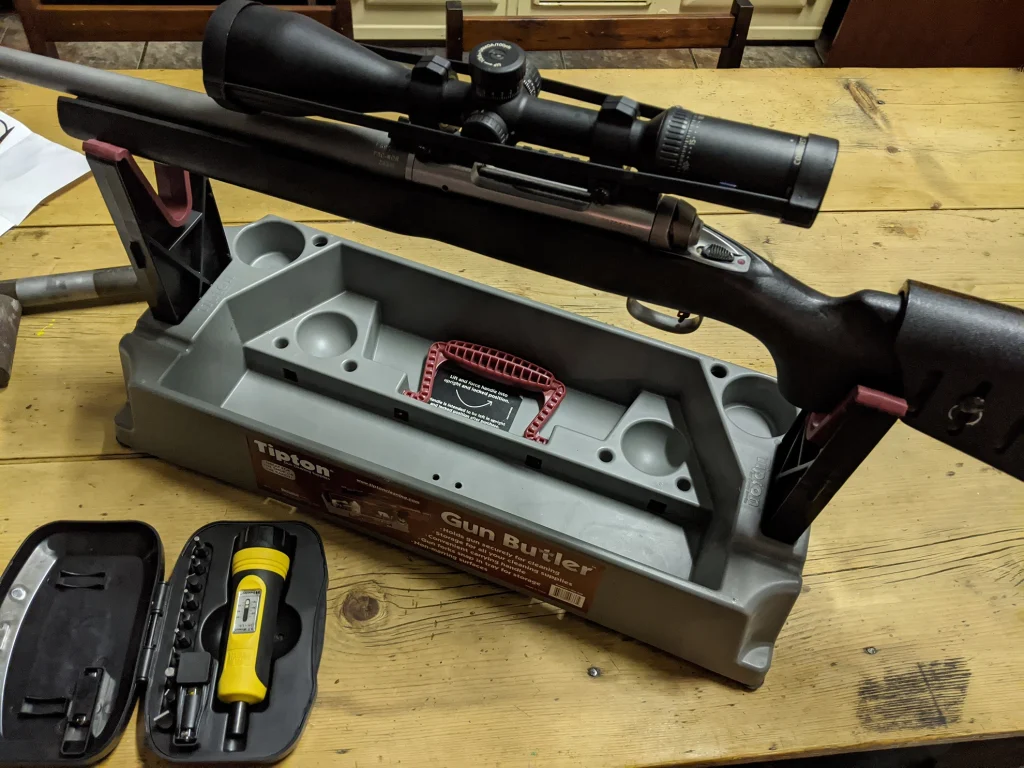
Torque wrench accuracy matters because the rifle does not care what the package says, it only reacts to clamp force at the screw. A firearm torque wrench helps me remove guesswork where zero retention and consistency actually live.
Why Scope Rings and Bases Fail When Torque Is Wrong
Over-torqued rings can dent or distort a scope tube. Under-torqued rings or base screws can let the optic shift under recoil, which shows up as wandering zero or random point-of-impact changes.
That is why manufacturers push torque specs so hard, and Weaver’s note on scope torque importance ties proper torque directly to zero retention and scope protection. I have seen both failures in real setups, and both were preventable.
How Action Screw Tension Influences Zero and Harmonics
Action screws do more than hold the rifle together. Their tension affects how the action sits in the stock or chassis, and that changes stress distribution, consistency, and in some rifles, group shape.
When I test loads, I want the action screws torqued the same every time. That discipline matters just as much as powder charge consistency, and it fits the same practical mindset I apply across rifle setup work on LoadDevelopment.com.
Common Inch-Pound Ranges Shooters Actually Use
These are the ranges I see most often for a torque wrench for firearms:
- Scope ring cap screws: 15 to 25 in-lb
- Scope base screws: 20 to 30 in-lb
- Action screws: 35 to 65 in-lb
Those ranges line up with one gunsmithing torque wrench review roundup and with common field practice. Always defer to the manufacturer’s exact spec for your rings, base, stock, and action.
What to Look for Before You Buy
When I pick a torque wrench, I ignore marketing first and check range, bit fit, and how I will use it. A good adjustable torque screwdriver for rifle work should cover real-world inch-pound needs cleanly and consistently.
Inch-Pounds vs Foot-Pounds
This is the mistake I try to stop first. Most firearm fasteners for optics and stock work use inch-pounds, not foot-pounds.
A foot-pound wrench is for larger jobs like barrel nuts, prefit barrels or some muzzle devices. The small diameter of most gun screws makes the inch-pound scale the right one for typical rifle work.
Useful Torque Range for Rifle Work
If I could choose only one gun torque wrench for optics and action screws, I would want roughly 10 to 65 inch-pounds. That range covers most rings, bases, and many action screws without forcing me into the edge of the tool’s scale.
Bit Compatibility and Gunsmith-Specific Hardware
I want standard 1/4-inch hex bit compatibility. Rifle hardware commonly uses Torx, hex, and slotted bits, and I prefer a tool that accepts quality replacements instead of locking me into proprietary pieces.
A solid gunsmithing toolkit should include:
- T10, T15, T25 Torx bits
- Common hex bits
- Hollow-ground or correctly fitted flat bits
- A compact extension for awkward ring screws
Size, Portability, and Bench vs Range Use
A bench driver is usually easier to read and set precisely. A compact manual torque wrench or torque screwdriver is easier to carry in the field.
If I am a hunter or PRS shooter, portability matters. If I mostly mount optics at home, a larger bench-oriented tool is usually the better buy.
Manual, Click, Beam, and Digital Designs
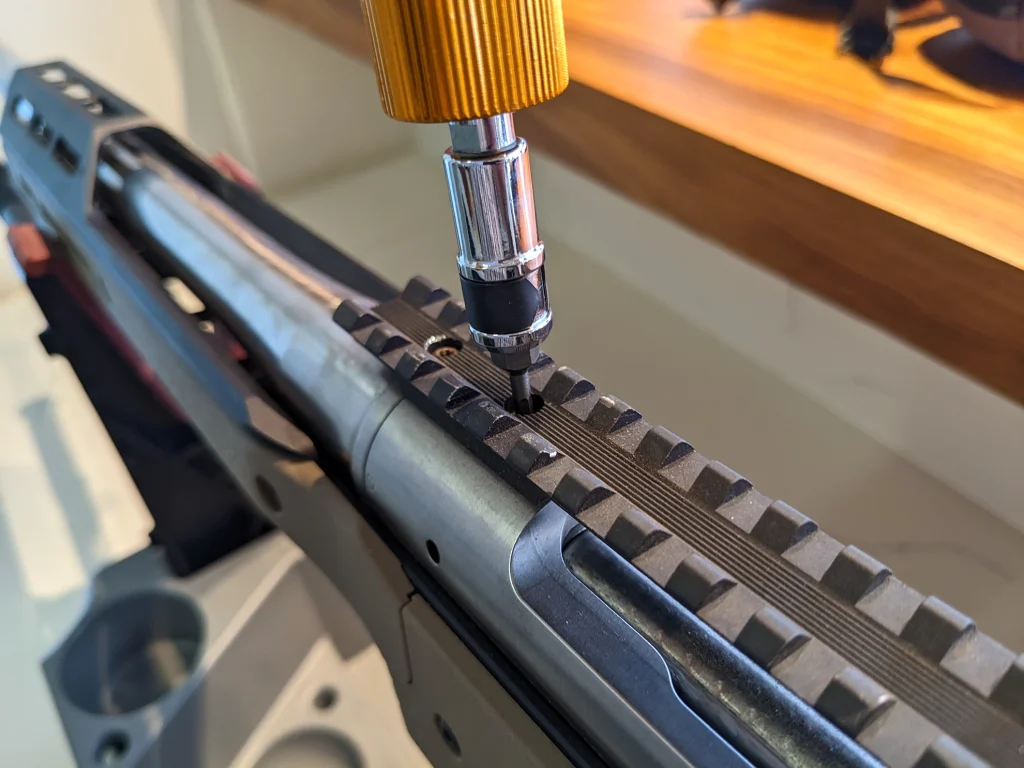
Each design solves a different problem. I choose by torque range, feel, and whether I need compact simplicity or easier readout and logging.
Manual Torque Wrench and Torque Screwdriver Options
A manual torque wrench or adjustable torque screwdriver is usually my first recommendation for rifle owners. It is simple, compact, and well suited to scope mounting, ring screws, and action screws.
These tools are often the best balance of cost and usability. For many shooters, this is the sweet spot in torque screwdrivers.
Click-Type Torque Wrench Pros and Limits
A click-type torque wrench is easy to use because it gives a clear tactile signal at the set point. That makes it fast for repeated tasks.
The limitation is scale and size. Many click wrenches are more common in automotive ranges, so I only like them for firearms if the torque window is truly appropriate for inch-pound work.
Beam-Type Torque Wrench Use Cases
A beam-type torque wrench is simple and does not rely on an internal click mechanism. I like beam designs for basic verification work and for users who want fewer moving parts.
The tradeoff is convenience. They are slower to read and less practical in tight rifle mounting positions.
When a Digital Torque Wrench Makes Sense
A digital torque wrench makes sense when I want easier readout, unit conversion, or alerts at target torque. Digital tools can be very useful for users who want more feedback.
I still keep mechanical tools in rotation because batteries die and electronics add complexity. For many shooters, digital is a preference, not a necessity.
How to Torque a Scope and Action Correctly
Good tools matter, and process matters just as much. I get the best results when I prep the hardware, follow the exact spec, and tighten evenly instead of chasing final torque too early.
Prep the Threads and Confirm the Spec
I start by cleaning screws and threaded holes, then I verify the manufacturer’s spec for that exact ring, base, or action. LoadDevelopment.com’s rifle and scope ring torque guide makes the point clearly, a proper rifle torque wrench is the only reliable way to hit the correct spec.
Dirty threads, oil contamination, or guessed specs create bad results before the first turn.
Tighten in Stages and Use a Cross Pattern
I bring screws up in stages, not all at once. On rings and bases, I alternate sides and use a cross pattern when the hardware layout allows it.
A practical sequence looks like this:
- Snug all screws lightly
- Go to about 50 percent of final torque
- Recheck alignment and gap
- Finish to full torque in sequence
When Threadlocker Changes the Equation
If the manufacturer calls for threadlocker, I use the recommended type and apply it sparingly. Extra compound is not extra security.
I do not invent new torque numbers because threadlocker is present. I follow the published spec unless the manufacturer specifically says otherwise.
Final Checks After Range Time
After the first range session, I inspect witness marks, ring gap symmetry, and any sign of movement. I also verify screw torque if the maker recommends recheck intervals.
This is especially worthwhile on fresh scope installs, hard-recoiling rifles, and new chassis or stock setups.
Calibration, Care, and Tool Longevity
Torque tools drift, get dropped, and wear with use. If I want trustworthy readings, I treat my gunsmithing torque wrenches like measuring tools, not pry bars.
Why Torque Wrench Calibration Matters
Torque wrench calibration matters because even a small error is significant when I am tightening a ring cap screw to 18 inch-pounds. A calibration guide focused on torque accuracy and longevity notes that out-of-calibration tools can lead to under-tightened or over-tightened fasteners, which is exactly the risk I am trying to avoid on optics and actions.
When to Look for a Calibration Certificate
I look for a calibration certificate when I buy a premium tool or when I need more confidence in a low-range precision driver. It is not mandatory for every casual user, though it is a real plus on optics-focused tools.
The Vortex-style approach of including calibration paperwork is one reason some shooters prefer that category.
Storage and Reset Practices for Mechanical Tools
For mechanical tools, I store them clean and dry, and I reset adjustable spring-based models to their lowest setting after use, not below the minimum. I never use them as breaker bars.
Those simple habits line up with standard torque tool maintenance guidance and extend accuracy.
Signs Your Driver Is No Longer Trustworthy
I stop trusting a driver when I notice:
- Inconsistent feel at the same setting
- Visible damage after a drop
- Repeated screw movement when checking known settings
- A click or break point that feels vague or delayed
If a tool starts acting suspicious, I verify it or replace it. Guessing with a bad torque wrench accuracy problem defeats the point of owning one.
Frequently Asked Questions
A good torque wrench for firearms is one that covers about 10 to 65 inch-pounds, accepts common 1/4-inch bits, and delivers repeatable results. I usually point most rifle owners toward a quality manual gunsmithing torque wrench first, because it is simple, affordable, and effective.
Most scope ring cap screws land around 15 to 25 inch-pounds, and many base screws fall around 20 to 30 inch-pounds. Action screws often run higher, commonly 35 to 65 inch-pounds, though the manufacturer’s exact spec always wins.
For most firearm fasteners, I prefer 1/4-inch bit-compatible tools or compact inch-pound drivers. A 1/2-inch drive is usually more relevant for larger jobs such as barrel nuts, not scope rings and small receiver screws.
Digital torque wrenches can be easier to read and may offer very precise feedback, especially at lower values. Reliability depends on build quality and care, and I still trust good mechanical click-style or manual tools because they are simple and less dependent on batteries.
I follow the maker’s interval guidance, avoid drops, and send important tools for professional calibration when accuracy matters. For storage, I keep mechanical spring-based tools clean, dry, and returned to their minimum setting, then I never use them to loosen stuck fasteners.
The 20–100 rule means torque tools are generally best used in the middle-to-upper part of their operating range, not at the extreme bottom. If I routinely torque scope rings to 15 to 20 inch-pounds, I do not want a tool whose range starts at 10 and stretches so high that my normal work sits right at the low edge of its useful window.

AJ Deysel is a competitive rifle shooter in the PRS and NRL Hunter series, a lifelong hunter, and a recognized ballistics specialist whose load development expertise has been featured by industry leaders like Hornady. He is the founder and lead editor of LoadDevelopment.com. Read more about AJ or view our Editorial & Testing Guidelines.