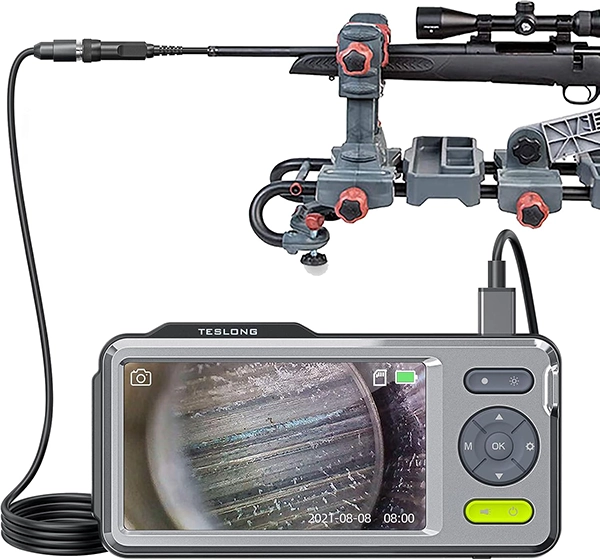
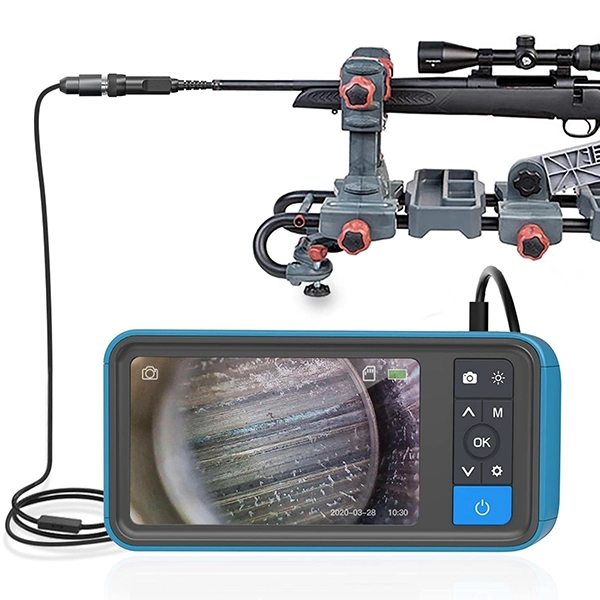
If you want a borescope that lives on the reloading bench and gets used every time you clean a barrel, the two Teslong models worth arguing about are the NTG500 and the NTG450. Both are stand-alone units with their own IPS screen, so there is no phone, no app, and no cable hunt. The difference comes down to a 5-inch screen versus a 4.5-inch screen, a flexible 45-inch probe versus a rigid 26-inch wand on the H variants, and roughly $30 of price separation at current listing.
For most precision-rifle shooters tracking throat erosion and carbon rings across a barrel’s life, the NTG450 does the job at a lower price, while the NTG500’s larger 5-inch display earns its cost only if you inspect frequently, log findings, and want a bigger picture for judging subtle leade changes. That is the short version. The rest of this piece explains what the screen actually buys you at the bench, and what a borescope can and cannot prove about accuracy.

At LoadDevelopment.com the approach to bore inspection is the same as the approach to load development: gather repeatable evidence, write it down, and resist the urge to read too much into a single observation. If you want more of that thinking, along with our reloading guides, ballistics calculators, bullet database, and powder burn rate chart, come join the 4,000+ shooters getting our insider tips by email. It is free, and there is no fluff.
What A Borescope Can And Cannot Tell You
A borescope is a documentation tool, not a diagnostic oracle. It shows you carbon deposits, copper wash, throat cracking, tool marks, and crown damage with real clarity, and it will happily show you a dozen things that mean nothing at all.
Useful Evidence Versus Misleading Visuals
The evidence worth trusting is repeatable. If you see the same feature, from the same probe direction, at the same insertion depth, on two separate inspections, it is real.
Things that reliably fool people:
- Wet solvent film reads as bright copper streaking under LED ring light. Always inspect dry, or at least note that the bore is wet.
- Lighting angle changes apparent depth. A shallow tool mark looks like a groove when the LEDs hit it obliquely. Running the probe in from the muzzle as well as the chamber often kills the illusion.
- Normal machining marks in the grooves are cosmetic on most factory and many custom barrels. They are not erosion.
- Carbon that looks like pitting until you brush and re-inspect. Hard carbon hides real steel condition.
Fire-cracking ahead of the chamber, on the other hand, is unambiguous once you have seen it: a fine alligator-skin pattern in the throat that does not clean out.
Safe Inspection Habits At The Bench
Confirm the rifle is unloaded, bolt removed, magazine out, before anything enters the chamber. Inspect from the chamber end with the action open and the muzzle in a safe direction.
Keep the probe centered. Dragging a 5mm camera head across sharp rifling will scratch the lens window, and a scratched window makes every future image worse. Wipe the probe with a dry cloth after use; solvents attack the lens coating and the mirror adhesive.
If you find something structural, a bulge, a ringed bore, chamber damage, a suspect crown, take the rifle to a gunsmith. A borescope image is a reason to get a professional opinion, not a substitute for one.
Why A Dedicated Display Wins At The Reloading Bench
Every phone-only borescope owner eventually admits the same thing: the tool gets used less because using it is a chore. A self-contained screen removes three or four small frictions that add up to “I’ll check it next time.”
Keeping Phones Free Of Oil And Solvent
Cleaning a barrel means Hoppe’s, carbon-removing solvents, and oily nitrile gloves. Handling a $1,200 phone in that state is either a mess or an interruption, and touchscreen response with gloves is unreliable.
The NTG500 and NTG450 have physical buttons you can work with gloved hands, and an IP67-rated probe you can wipe down without worry.
Avoiding App, Battery, And Cable Friction
Phone borescopes fail at the least convenient moments: an OS update breaks the USB camera permission, the app wants a login, an iPhone refuses the connection, or the phone drops to 12% battery mid-inspection while it powers the camera.
Cable management is its own tax. A phone tethered to a probe means one hand on the phone, one on the wand, and nothing left for the rifle.
Building A Repeatable Inspection Record
Stand-alone units write straight to a microSD card. That matters more than it sounds, because bore inspection is only useful as a time series.
Our recommendation is simple: shoot stills at fixed insertion depths, name the folder with the barrel serial and round count, and file them alongside your load-development notes. A photo of the throat at 400 rounds is worth very little. The same photo at 400, 900, and 1,600 rounds tells you your erosion rate and helps you predict when your seating depth will need to move again.
NTG500 And NTG450 Specifications Compared
Both models sit in the same NTG family and use the same 0.2-inch (5mm) close-focus camera head, so image geometry and caliber compatibility are identical. The separation is display size, probe type, and price.
| Spec | NTG450 / NTG450H | NTG500 / NTG500H |
|---|---|---|
| Screen | 4.5-inch color IPS | 5-inch color IPS |
| Camera probe diameter | 0.2 in (5mm) | 0.2 in (5mm) |
| Probe (base model) | 45-inch flexible | 45-inch flexible |
| Probe (H variant) | 26-inch rigid | 26-inch rigid |
| Caliber fit | .20 cal and larger | .20 cal and larger |
| Listed price | $139.99 / $149.99 | $169.99 |
Display, Imaging, And Probe Configuration
The 500-series adds a half inch of diagonal and a sharper HD IPS panel. On the bench, the practical gain is judging fine throat texture without leaning in.
Both use an LED ring light with adjustable brightness and a removable right-angle side-view mirror. The mirror is what lets you look at land tops and the chamber shoulder rather than straight down the tube, and it is the single most useful accessory in the case.
Do not expect optical-borescope resolution. These are close-focus digital cameras. They are excellent at carbon, copper, and cracking; they are not measuring instruments.
Power, Storage, Connectivity, And Accessories
The NTG500 carries a 3500mAh internal battery and ships with a 32GB memory card, capturing 1080p stills and 720p video. The NTG450 covers the same core functions with a smaller screen and a lower price.
Both charge over USB-C and can output to a PC monitor by cable when you want a large image for a second opinion. Cases include spare mirrors, which you will need, because those tiny mirrors are fragile.
Handling Differences In Long-Action And Short-Action Rifles
This is where configuration matters more than screen size. A 45-inch flexible probe inspects a 30-inch barrel plus chamber in one pass from the breech, including long-action magnums.
The 26-inch rigid wand of the H variants is easier to control and holds rotational orientation better, which helps when you want the mirror pointed at the same land on every inspection. It also runs out of reach on longer barrels, forcing a muzzle-end pass to finish the job.
For a 6mm Dasher or 6.5 Creedmoor short action, the rigid wand is a pleasure. For a 300 PRC with a 28-inch tube, take the flexible probe.
Practical Inspection Workflow For Precision Rifles
A repeatable routine beats a better camera. The sequence below is the one worth building into your cleaning process, and it maps directly onto the load-development records we advocate at LoadDevelopment.com.
Finding Carbon Rings Near The Chamber
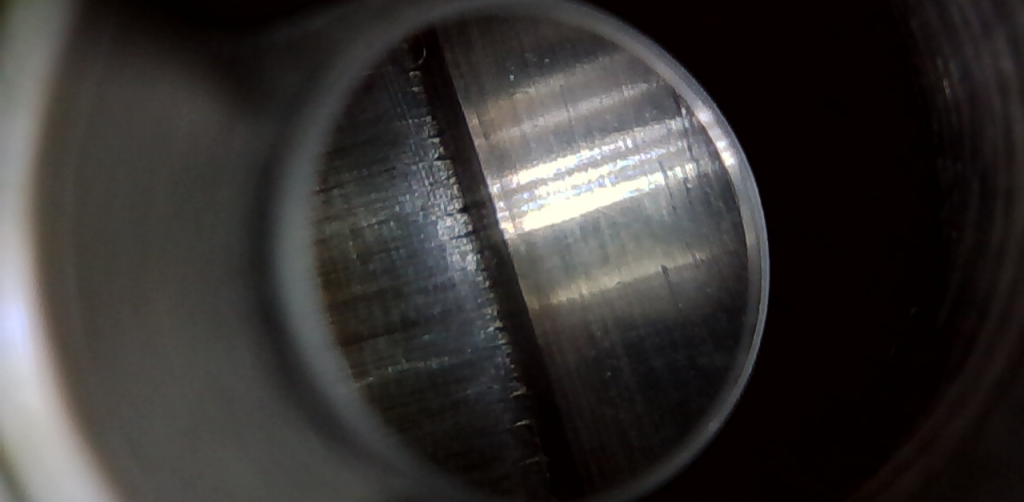
Insert from the breech and stop just ahead of the chamber mouth, at the neck-to-throat transition. A carbon ring shows as a dull, matte band that dims the LED reflection while the surrounding steel still shines.
It matters because a hard ring reduces effective chamber neck clearance and can spike pressure and shift velocity. Mark the insertion depth on the probe with tape so you return to the exact spot next time.
Monitoring Throat Erosion And Leade Changes
Look at where the lands begin. Early erosion appears as rounding and a slight matte texture on the leading edges of the lands, then progresses to visible fire-cracking.
Correlate what you see with hard data: a throat that has moved will show up in your seating-depth chase and rising or falling velocity long before an image tells you much. The borescope confirms the mechanism; your chronograph and comparator measure the amount.
Assessing Copper Fouling And Cleaning Results
Inspect dry. Copper reads as a warm, faintly streaked wash on the groove walls and downstream of the throat.
The useful test is a before-and-after: image the same three depths, run your cleaning regimen, then re-image. This is how you find out whether your brush-and-patch routine is actually removing carbon or just moving it.
Documenting Bore Condition With Round-Count Data
Log round count, powder charge and lot, cleaning method, and inspection stills in one place. Over a barrel’s life you will build a real erosion curve rather than a hunch.
That record also tells you when a group falling apart is a throat problem versus a load, scope, or bedding problem.
Strengths And Limitations Of Each Model
Both units do the same job with the same camera. Pick based on how often you inspect, how long your barrels are, and how much you value screen real estate.
Where The NTG500 Earns Its Larger Display
Pros: 5-inch HD IPS panel makes fine throat texture and early fire-cracking easier to judge; 3500mAh battery handles a long cleaning session; 32GB card included; 1080p stills for a records file.
Cons: roughly $30 more than the NTG450; larger body is slightly more to manage one-handed; the screen upgrade does not improve the camera itself.
Buy it if you inspect barrels weekly, keep a written bore log, or find yourself squinting at the smaller panel.
When The NTG450 Is The More Sensible Choice
Pros: $139.99 for the flexible version, the lowest cost of entry to a stand-alone screen; same 5mm close-focus camera as the 500; 4.5-inch IPS is entirely adequate for spotting carbon rings and copper; lighter in the hand.
Cons: smaller screen makes borderline throat calls harder; less headroom if you later want maximum image size at the bench.
Buy it if this is your first borescope, or if you inspect a few barrels a season and want the money in bullets and powder instead.
Limits Of Visual Inspection For Accuracy Diagnosis
A borescope cannot measure groove diameter, bore straightness, chamber concentricity, or headspace. Ugly bores shoot well and pretty bores sometimes do not.
Treat images as one input alongside velocity data, group size, and case measurements. When something looks structurally wrong, that is a gunsmith conversation, not a camera conclusion.
Final Buying Recommendation
Neither model is a mistake, and the deciding factor is workflow, not screen size alone. Match the probe to your barrel length first, then decide whether the larger display is worth $30 to you.
Best Choice For Dedicated Precision-Rifle Bench Work
Take the NTG500, and choose the H variant with the 26-inch rigid wand if your barrels are 26 inches or shorter and you want consistent mirror orientation. The 5-inch screen, 3500mAh battery, and included 32GB card suit a shooter who inspects after most cleaning sessions and files stills against round count.
If you run long-action magnums or 28- to 30-inch barrels, take the flexible 45-inch NTG500 instead and inspect the whole tube in one pass.
When you use the link above to shop for one of the products, we receive a small commission from the sale, at no extra cost to you. This helps us keep this site going, and does not affect the price you would pay usually in any way whatsoever.
Best Choice For Value-Focused Reloaders
Take the NTG450 at $139.99. You get the identical 5mm close-focus camera, the same right-angle mirror, and a 4.5-inch IPS screen that will show you carbon rings, copper wash, and throat cracking without ambiguity.
Spend the difference on a good bore guide and a carbon-specific solvent. Both will do more for barrel life than a half inch of extra display.
When you use the link above to shop for one of the products, we receive a small commission from the sale, at no extra cost to you. This helps us keep this site going, and does not affect the price you would pay usually in any way whatsoever.
Frequently Asked Questions
Current stand-alone-screen models list from about $139.99 for the NTG450 to $209.99 for the NTG200H bundled with a 5-inch monitor. The NTG500 and NTG500H sit at $169.99, and the rigid NTG450H at $149.99. Phone-and-PC-only USB models run lower.
For dedicated bench inspection of precision rifles, the NTG500 (5-inch screen) and NTG450 (4.5-inch screen) are the practical picks because they need no phone or app. Choose the 45-inch flexible probe for long barrels and the 26-inch rigid H variant for short actions and steadier mirror control.
Some models do and some do not, so check the specific listing before buying. Newer USB-C rigid models are advertised for iPhone 15 and later, while several older USB-A/micro models are Android and PC only. The NTG450 and NTG500 sidestep the issue entirely with their own screens.
The NTG100H is the 26-inch rigid rifle probe in the NTG100 family, while the NTG100-C is a phone-and-PC borescope using a 5mm HD close-focus camera and USB-C connection. Both fit .20 caliber and larger barrels; the H is the rigid-wand configuration, the C is the cable-connected model.
Yes, the NTG150W-series WiFi units use the same 0.2-inch camera and will show carbon, copper, and throat wear on a phone or tablet. The tradeoff is app dependence, pairing hiccups, and phone battery drain, which is why a stand-alone screen is easier to live with at a solvent-covered bench.
Teslong sells direct through its own site and also lists the full NTG range on Amazon, where model and connector variants are easy to compare side by side. Verify the probe length, connector type, and screen size on the exact listing, since the model numbers differ by a single letter.

AJ Deysel is a competitive rifle shooter in the PRS and NRL Hunter series, a lifelong hunter, and a recognized ballistics specialist whose load development expertise has been featured by industry leaders like Hornady. He is the founder and lead editor of LoadDevelopment.com. Read more about AJ or view our Editorial & Testing Guidelines.