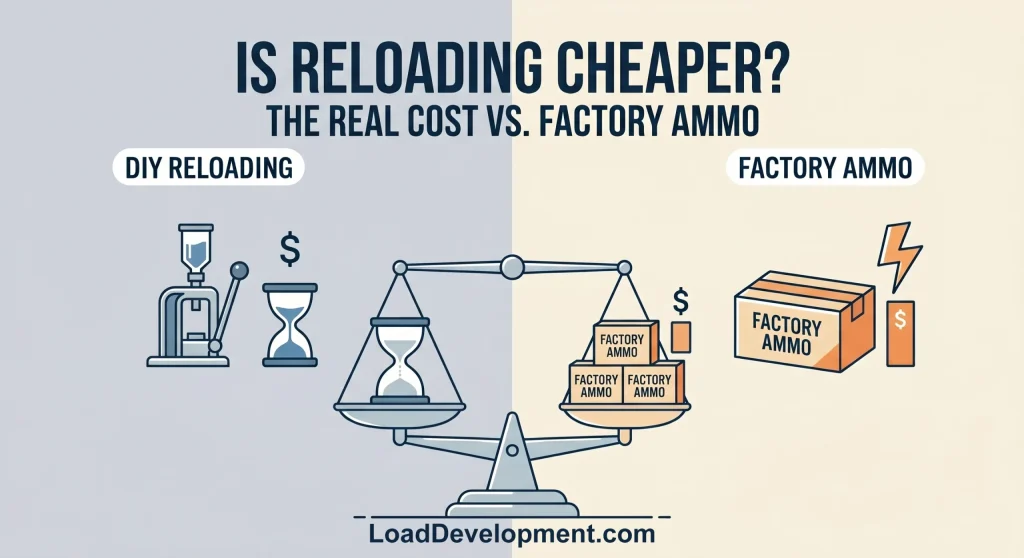
If you ask a veteran shooter if reloading saves money, they will likely laugh and tell you: “You won’t save a dime, but you will shoot twice as much for the exact same price.”
This is the oldest joke in the shooting industry, but it is entirely true. When shooters start handloading, they don’t put their savings into a bank account—they use it to buy more components and shoot more matches.
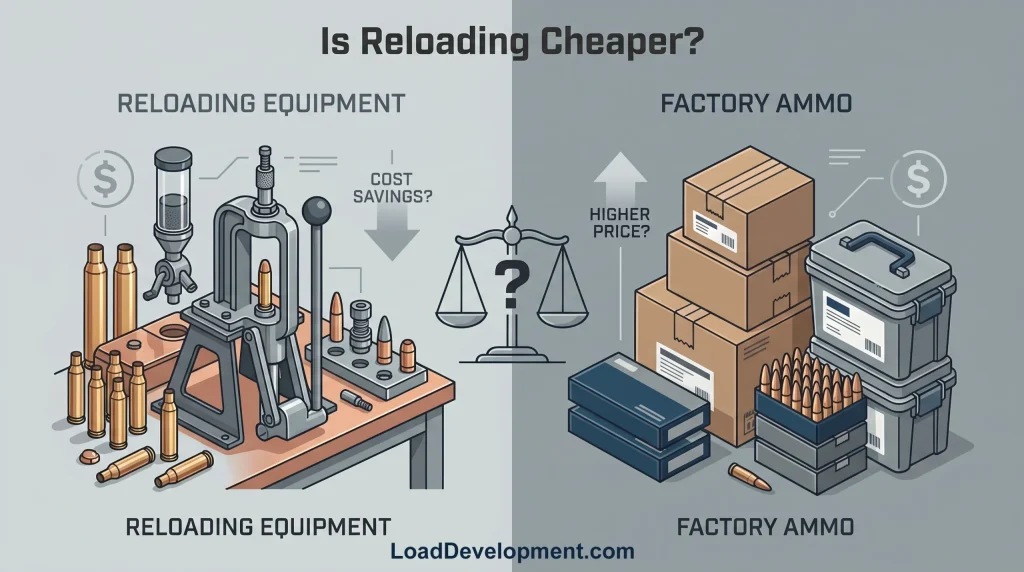
But what is the actual math? If you are shooting precision rifles, how much does a handloaded cartridge cost compared to a box of premium factory match ammo?
Here is the exact, no-nonsense breakdown of reloading costs, the break-even point for your equipment, and why saving money is actually the least important reason to reload.
The Math: Factory Match Ammo vs. Handloading
To get an accurate comparison, we cannot compare premium handloads to cheap, bulk surplus ammo. We have to compare apples to apples: Premium Match-Grade Ammunition.
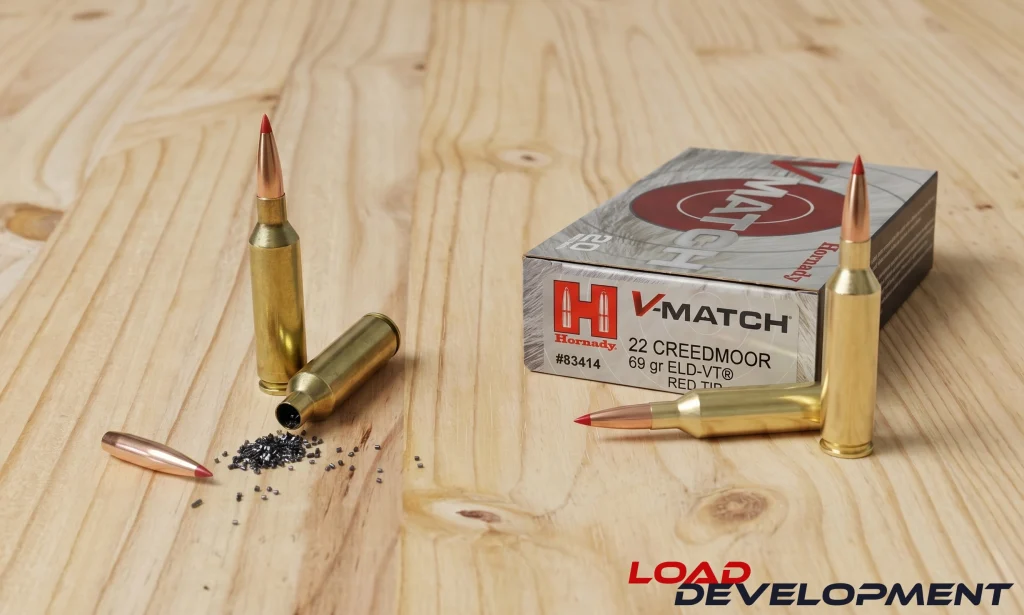
Let’s look at the most popular precision cartridge in the world: the 6.5 Creedmoor. We will compare the cost of buying factory Hornady 140gr ELD Match ammunition versus building the exact same load on your bench.
(Note: Component prices fluctuate, but the ratios remain remarkably consistent).
Cost Per Round Breakdown (6.5 Creedmoor)
| Component | Factory Ammo Cost (Hornady 140gr ELD-M) |
Handload Cost (Using exact same components) |
|---|---|---|
| The Bullet (Projectile) | Included | $0.45 (Hornady 140gr ELD-M) |
| Gunpowder | Included | $0.30 (~41.5gr of H4350) |
| Primer | Included | $0.10 (Large Rifle Match Primer) |
| Brass Casing | Included | $0.15* (Amortized over 5 firings) |
| Total Cost Per Round | $1.75 – $2.00 | $1.00 |
| Total Cost Per Box (20) | $35.00 – $40.00 | $20.00 |
*Note on Brass: When you buy factory ammo, you use the brass once. When you reload, you reuse the brass. If a piece of premium brass costs $0.75, and you reload it 5 times before the primer pockets get loose, the actual cost is only $0.15 per firing.
*Note on Brass: When you buy factory ammo, you use the brass once. When you reload, you reuse the brass. If a piece of premium brass costs $0.75, and you reload it 5 times before the primer pockets get loose, the actual cost is only $0.15 per firing.
The Verdict on Ammo Cost
Yes, reloading is significantly cheaper on a per-round basis. By handloading a premium cartridge like the 6.5 Creedmoor, you are saving roughly $0.75 to $1.00 per round, effectively cutting your ammunition costs in half. If you shoot expensive magnum calibers (like 300 PRC or 338 Lapua), the savings are even more extreme—often saving you over $2.00 per round.
The Hidden Cost: The Equipment ROI (Return on Investment)
While the ammo itself is cheaper, you have to buy the tools to make it.
As detailed in our guide on How to Build a Custom Precision Reloading Bench, a high-quality beginner setup (single-stage press, dies, digital scale, calipers, and priming tool) will cost you roughly $750 to $1,000.
If you are saving $0.75 per round by reloading, your break-even point is exactly 1,000 rounds.
- If you only shoot one box of ammo (20 rounds) a year to sight in your hunting rifle, reloading will never pay for itself. Stick to factory ammo.
- If you shoot PRS matches, NRL Hunter, or go to the range every month, you will easily shoot 1,000 rounds in your first year. At that point, the equipment has paid for itself, and every round you load after that is pure savings.
Why You Actually Reload: Accuracy > Cost
If you talk to competitive shooters, none of them reload to save money. They reload because it is the only way to achieve extreme long-range precision.
When an ammunition factory loads a million rounds of 6.5 Creedmoor, they have to ensure it will safely chamber and fire in every 6.5 Creedmoor rifle ever made—from a loose gas-gun to a tight custom bolt-action. Because of these generic tolerances, factory ammo will always have slight variations in powder charge and seating depth.
When you handload, you aren’t building generic ammo. You are building custom ammunition tailored to the exact microscopic dimensions of your rifle’s chamber.
By reloading, you can:
- Lower your Standard Deviation (SD): By weighing powder charges to the tenth of a grain, you ensure every bullet leaves the muzzle at the exact same velocity, eliminating vertical stringing at 1,000 yards.
- Tune Barrel Harmonics: By adjusting the powder charge in small increments (a ladder test), you can find the exact velocity node where your barrel vibrates the least, drastically shrinking your group sizes.
- Adjust Bullet Jump: You can seat the bullet closer to or further from the rifling lands, optimizing accuracy for your specific barrel.
The Final Verdict: Should You Start Reloading?
If your goal is to shoot half-MOA groups, ring steel past 1,000 yards, or compete in precision rifle matches, reloading is not an option—it is a mandatory requirement. The fact that it cuts your per-round cost in half is simply a bonus.
Ready to get started? Follow our beginner path:
- Get the Gear: Read The Complete Reloading Setup for Beginners to see exactly what press and tools you need to buy.
- Learn the Steps: Read How to Reload Ammunition: A Step-by-Step Guide to learn the mechanical process.
- Master the Craft: Once you have the basics down, the next step is achieving single-digit standard deviations. Join my Advanced Precision Reloading Course to learn the exact load development strategies used by the pros.
Frequently Asked Questions

AJ Deysel is a competitive rifle shooter in the PRS and NRL Hunter series, a lifelong hunter, and a recognized ballistics specialist whose load development expertise has been featured by industry leaders like Hornady. He is the founder and lead editor of LoadDevelopment.com. Read more about AJ or view our Editorial & Testing Guidelines.