If you are choosing between 5.56x45mm NATO and .300 AAC Blackout for a specific rifle, the honest answer is that they are not competing cartridges so much as competing design priorities. The 5.56 is a velocity-driven cartridge that does its best work with a longer barrel, a flat trajectory, and bullets that depend on impact speed to perform. The .300 Blackout is a bore-diameter and bullet-weight solution that was engineered around a 9-inch barrel, a suppressor, and the ability to run both supersonic and subsonic ammunition through the same rifle.
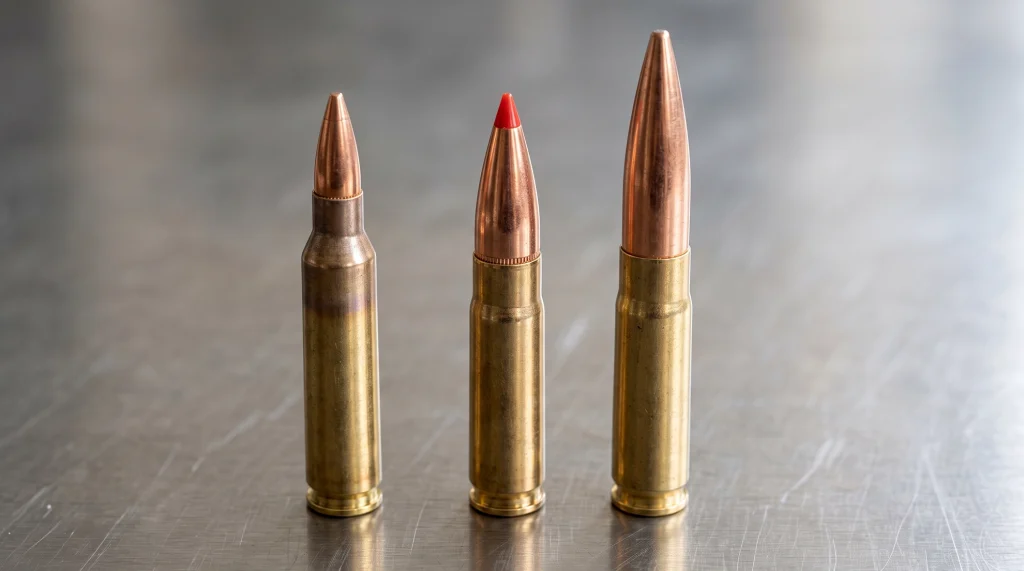
Neither cartridge has a fixed performance ceiling; what you actually get is the product of projectile construction, impact velocity, barrel length, zero, and atmospheric conditions, which is why a 9-inch .300 BLK and a 20-inch 5.56 cannot be compared with one universal chart. A 55gr M193 clone leaving a 20-inch barrel at 3,240 fps behaves nothing like the same bullet leaving a 10.5-inch barrel at roughly 2,850 fps, and the terminal consequences of that difference are larger than most caliber arguments admit.
Throughout this comparison, .300 Blackout is treated as two distinct cartridges: supersonic 110 to 125gr loads and subsonic 200 to 220gr loads. Those two categories have almost nothing in common ballistically, and lumping them together is the single most common error in this debate. The 5.56 side is represented by 55gr, 62gr, and 77gr loads, which likewise diverge substantially past 200 yards.
Expect load-dependent conclusions rather than declarations. Where a claim rests on a specific bullet, a specific impact velocity threshold, or a specific test protocol, that dependency is stated plainly.
The Decision in One Minute
Most shooters can resolve this decision by naming the primary role, the barrel length they intend to run, and whether a suppressor is part of the plan. Volume training and any engagement past 200 yards favor 5.56; compact .30-caliber work inside 200 yards and dedicated suppressed use favor .300 Blackout.
Choose 5.56 NATO for High-Volume Training and Distance
If you shoot a lot, 5.56 wins on economics before ballistics even enters the conversation. Bulk 55gr and 62gr FMJ typically runs a third to half the cost per round of comparable .300 BLK supersonic, and that gap compounds across a training year.
Ballistically, 5.56 holds a flatter trajectory and less time of flight to 300 yards and beyond, particularly with 62gr and 77gr bullets carrying better ballistic coefficients. Recoil impulse is mild, which keeps sight tracking clean during fast follow-up shots.
Choose .300 Blackout Supersonic for Compact .30-Caliber Roles
Supersonic 110 to 125gr .300 BLK is the answer when you want meaningful .30-caliber terminal performance from a 9 to 11.5-inch barrel without the velocity collapse that short-barreled 5.56 suffers.
Inside roughly 200 yards, a 110gr expanding bullet at 2,300 fps delivers reliable expansion and penetration for hogs and similar-sized game. Past 250 yards, drop and wind drift climb quickly and the cartridge stops being competitive.
Choose .300 Blackout Subsonic for Dedicated Suppressed Use
Subsonic 200 to 220gr .300 BLK exists for one reason: eliminating the supersonic crack so a suppressor can actually do its job. Nothing else in the AR-15 platform does this as cleanly with standard STANAG magazines and an unchanged bolt.
Accept the trade. You are working with roughly 1,000 to 1,050 fps, energy in the 480 to 550 ft-lb range, and terminal performance that depends entirely on whether the bullet was designed to expand below the sonic barrier. Most are not.
A Master Theory Framework for Comparing Rifle Cartridges
Cartridge performance is a system output, not a property of the case headstamp. Projectile construction, impact velocity, barrel length, zero range, and atmospheric conditions each shift the result enough to invert conclusions drawn from a single spec sheet.
Why Muzzle Energy Is Only a Starting Point
Muzzle energy is a scalar computed from mass and velocity at the muzzle. It tells you nothing about where that energy goes, how fast it bleeds off, or whether the bullet is built to transfer it.
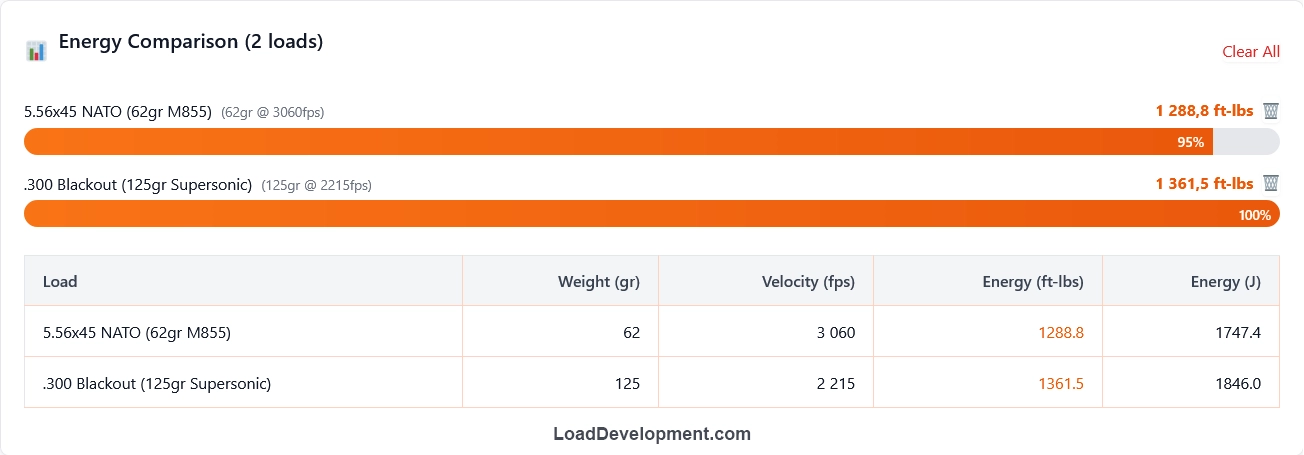
A 220gr subsonic at 1,010 fps produces roughly 498 ft-lbs. A 55gr 5.56 at 3,240 fps produces roughly 1,282 ft-lbs. Those numbers do not predict which wound channel is larger, because energy transfer depends on projectile behavior at impact velocity, not on the number printed at the muzzle.
Separating External Ballistics From Terminal Ballistics
External ballistics governs everything between muzzle and target: velocity decay, drop, wind drift, and time of flight. It is largely predictable from ballistic coefficient, muzzle velocity, and atmosphere.
Terminal ballistics begins at impact and is governed by jacket construction, core bonding, sectional density, and impact velocity. A cartridge can dominate one domain and lose the other. That is precisely what happens here.
The Role of Projectile Construction and Impact Velocity
Most 5.56 fragmentation behavior is velocity-gated. Typical M193-pattern bullets fragment reliably above roughly 2,500 fps of impact velocity and behave much more like a simple FMJ below it.
Expanding bullets have their own thresholds. A .30-caliber hollow point tuned for 2,000 to 2,300 fps will often fail to open at 1,050 fps, and a subsonic-specific design may over-expand or shed petals if driven supersonic. Match the bullet to the velocity window you will actually produce.
How Barrel Length, Zero Range, and Atmosphere Change Results
Barrel length moves muzzle velocity substantially in 5.56, on the order of 25 to 40 fps per inch in the carbine range. It moves .300 BLK far less, which is the entire point of the design.
Zero range shifts apparent drop numbers without changing physics, and density altitude alters drag enough to matter at 300 yards. Run your own numbers with the Trajek and Kinetic Energy calculators on LoadDevelopment.com rather than borrowing a chart built on someone else’s barrel.
External Ballistics: Velocity, Drop, Drift, and Time of Flight
Trajectory differences between these cartridges are large, consistent, and easy to model. What follows are representative figures under stated assumptions; your barrel, ammunition lot, and atmosphere will move them.
Representative Load Assumptions and Test Conditions
All figures below assume a 100-yard zero, sight height of 2.6 inches, standard atmosphere at sea level (59°F, 29.92 inHg), and a 10 mph full-value crosswind. Ballistic coefficients are G1 values typical of the bullet class.
| Load | Barrel | Muzzle Velocity | G1 BC | Muzzle Energy |
|---|---|---|---|---|
| 5.56 55gr FMJ (M193 class) | 16 in | 3,100 fps | 0.243 | 1,173 ft-lbs |
| 5.56 62gr FMJ (M855 class) | 16 in | 2,950 fps | 0.304 | 1,198 ft-lbs |
| 5.56 77gr OTM | 16 in | 2,720 fps | 0.372 | 1,265 ft-lbs |
| 5.56 55gr FMJ | 10.5 in | 2,850 fps | 0.243 | 992 ft-lbs |
| .300 BLK 110gr supersonic | 9 in | 2,350 fps | 0.290 | 1,349 ft-lbs |
| .300 BLK 125gr supersonic | 9 in | 2,175 fps | 0.340 | 1,313 ft-lbs |
| .300 BLK 220gr subsonic | 9 in | 1,010 fps | 0.608 | 498 ft-lbs |
Drop and Retained Energy at 100, 200, and 300 Yards
| Load | 100 yd Drop / Energy | 200 yd Drop / Energy | 300 yd Drop / Energy |
|---|---|---|---|
| 5.56 55gr, 16 in | 0.0 in / 848 ft-lbs | -3.4 in / 597 ft-lbs | -13.1 in / 407 ft-lbs |
| 5.56 62gr, 16 in | 0.0 in / 900 ft-lbs | -3.5 in / 665 ft-lbs | -13.2 in / 481 ft-lbs |
| 5.56 77gr OTM, 16 in | 0.0 in / 1,001 ft-lbs | -4.0 in / 782 ft-lbs | -14.7 in / 604 ft-lbs |
| 5.56 55gr, 10.5 in | 0.0 in / 710 ft-lbs | -4.1 in / 486 ft-lbs | -15.9 in / 324 ft-lbs |
| .300 BLK 110gr, 9 in | 0.0 in / 1,081 ft-lbs | -6.4 in / 856 ft-lbs | -24.0 in / 671 ft-lbs |
| .300 BLK 125gr, 9 in | 0.0 in / 1,088 ft-lbs | -7.4 in / 895 ft-lbs | -27.2 in / 731 ft-lbs |
| .300 BLK 220gr subsonic, 9 in | 0.0 in / 452 ft-lbs | -32.9 in / 412 ft-lbs | -108.6 in / 377 ft-lbs |
Note the inversion: supersonic .300 BLK retains more energy at 300 yards than any of these 5.56 loads while dropping roughly twice as far. Energy retention and trajectory are separate questions.
Wind Drift and Time of Flight at Practical Distances
| Load | 200 yd Drift (10 mph) | 300 yd Drift | 300 yd Time of Flight |
|---|---|---|---|
| 5.56 55gr, 16 in | 6.5 in | 15.6 in | 0.34 s |
| 5.56 62gr, 16 in | 5.5 in | 13.1 in | 0.35 s |
| 5.56 77gr OTM, 16 in | 4.9 in | 11.5 in | 0.37 s |
| .300 BLK 110gr, 9 in | 6.9 in | 16.5 in | 0.43 s |
| .300 BLK 220gr subsonic, 9 in | 7.8 in | 18.4 in | 0.94 s |
Subsonic time of flight at 300 yards is nearly a full second. On anything that moves, that is disqualifying.
Why 5.56 NATO Maintains the Flatter Long-Range Profile
Flat trajectory is a function of velocity first and ballistic coefficient second. The 5.56 starts 700 to 1,100 fps faster than supersonic .300 BLK, and that head start dominates inside 400 yards.
The 220gr subsonic actually carries the highest BC in the table, which is why it holds velocity well in percentage terms. It simply never had enough velocity to produce a usable trajectory beyond 150 to 200 yards.
Terminal Performance: Load Design Beats Caliber Labels
Bore diameter is a poor predictor of wound channel geometry. What matters is whether a given projectile reaches the target above its designed threshold for fragmentation or expansion, and whether it holds together well enough to reach vital structures.
5.56 NATO: Fragmentation, Yaw, and Velocity Thresholds
M193-pattern 55gr FMJ yaws early in tissue and, above roughly 2,500 fps impact velocity, tends to fracture at the cannelure and fragment. That fragmentation is what produces the disproportionate wounding 5.56 is known for.
The threshold is the whole story. From a 16-inch barrel, 55gr M193 stays above 2,500 fps to roughly 150 yards. From a 10.5-inch barrel, that window shrinks to something closer to 75 to 100 yards. Below threshold, expect an icepick-style track from FMJ.
Bonded and open-tip match designs behave differently. A 62gr bonded soft point expands more reliably at lower velocities, and 77gr OTM loads fragment across a wider velocity band, which is one reason they are favored for short barrels.
.300 Blackout Supersonic: Expansion and Penetration With 110–125gr Bullets
A 110gr copper hollow point or 125gr expanding bullet launched at 2,200 to 2,350 fps operates in a comfortable window for controlled expansion out to roughly 200 yards, where impact velocity still exceeds most designs’ 1,800 fps expansion floor.
Sectional density helps here. A 125gr .308 bullet has a sectional density around 0.188 versus roughly 0.157 for a 55gr .224, which generally supports deeper penetration once expansion begins.
The practical result on hogs and deer-sized game is a wider, more consistent permanent cavity than short-barreled 5.56 typically produces inside 150 yards.
.300 Blackout Subsonic: Heavy-Bullet Performance at Near-Sonic Speeds
At 1,000 to 1,050 fps, a 220gr FMJ is essentially a slow, heavy pistol bullet with excellent sectional density. It penetrates deeply and produces a narrow, straight channel with minimal tissue disruption.
Subsonic expanding designs exist and some open reliably in the 900 to 1,100 fps band. Verify your specific load rather than assuming, because most .30-caliber hollow points are engineered for velocities twice that high and will pass through unopened.
Also verify stabilization. Long 220gr bullets generally require a 1:7 or 1:8 twist, and marginal stabilization at subsonic speeds shows up as keyholing on paper.
Barrier Penetration, Ballistic Gel, and Overpenetration Limits
Ballistic gelatin is a calibrated comparative medium, not a tissue simulant with predictive authority over any single incident. Treat gel results as a way to rank load behavior, not as proof of outcomes.
For interior walls, both cartridges penetrate drywall readily. Fragmenting 5.56 at high impact velocity often sheds mass and energy faster through multiple layers than a 220gr subsonic, which tends to continue on a straight path with substantial retained momentum.
Auto glass and light steel favor heavier, bonded .30-caliber projectiles. Neither cartridge should be described as safe against overpenetration; both demand a considered backstop.
Platform, Barrel, and Suppressor Considerations
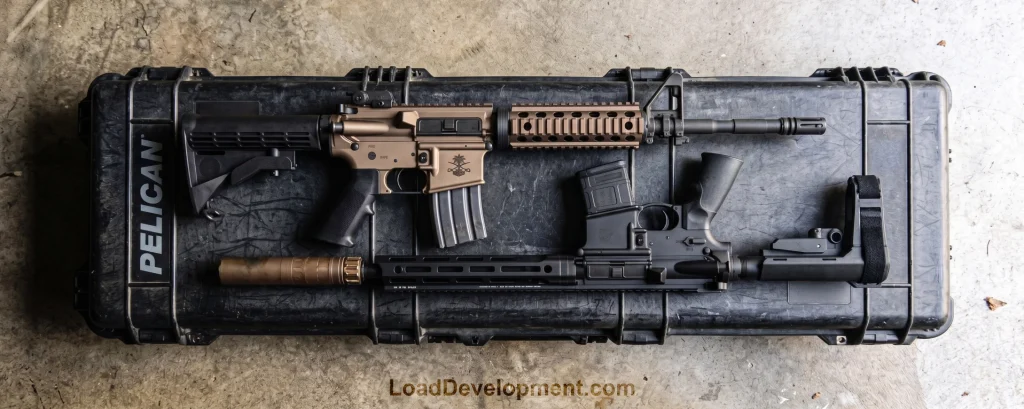
The mechanical case for .300 Blackout rests on a specific design goal: full powder burn in a 9-inch barrel with a suppressor attached. The mechanical case for 5.56 depends on giving it enough barrel to reach its velocity thresholds.
9-Inch .300 Blackout and the Short-Barrel Advantage
The .300 BLK powder charge is small enough and the burn rate fast enough that a 9-inch barrel captures nearly all available velocity. Extending to 16 inches typically gains only 50 to 100 fps with supersonic loads and almost nothing with subsonic.
Pistol-length gas is standard, and a 1:7 or 1:8 twist handles the full bullet weight range. An adjustable gas block is close to mandatory if you intend to run both supersonic and subsonic ammunition suppressed and unsuppressed.
10.5-Inch, 16-Inch, and 20-Inch 5.56 NATO Trade-Offs
A 10.5-inch 5.56 gives up roughly 250 to 350 fps against a 16-inch, which pulls the fragmentation threshold in close and produces significant muzzle blast. It remains a capable CQB tool with the right bullet, especially 62gr bonded or 77gr loads.
Sixteen inches is the practical baseline for most builds. Twenty inches recovers another 100 to 150 fps and extends the fragmentation window meaningfully, at the cost of handling.
Subsonic Ammunition, Sonic Crack, and Suppressor Reality
A suppressor addresses muzzle blast. It cannot address the sonic crack of a bullet traveling above roughly 1,125 fps, which is why suppressed supersonic 5.56 is still loud downrange.
Subsonic .300 BLK removes that crack entirely. Suppressed, a 9-inch .300 BLK with quality subsonic ammunition is genuinely hearing-safe in most configurations, and the difference against suppressed 5.56 is not subtle.
Expect to tune gas or use a suppressor-specific setting. Under-gassed subsonic cycling and over-gassed supersonic suppressed fire are the two most common reliability complaints.
AR-15 Parts Compatibility and the Cross-Loading Hazard
.300 BLK uses the same bolt, bolt carrier, charging handle, lower receiver, and STANAG magazines as 5.56. Only the barrel, and typically the gas system tuning, changes.
That compatibility creates a real danger. A .300 BLK cartridge will chamber in a 5.56 barrel and produce a catastrophic overpressure event on firing.
Segregate your magazines, mark them clearly, and never stage mixed ammunition on the same bench. This is the single most consequential safety consideration in running both chamberings on one lower.
Selecting the Right Load for the Intended Role
Role definition should precede caliber selection. Cost, recoil, expected engagement distance, and whether a suppressor is involved will resolve most builds without further debate.
Training, Competition, and Ammunition Cost
Bulk 5.56 55gr FMJ generally runs a fraction of the cost of .300 BLK supersonic, and subsonic .300 BLK is more expensive still. Across 5,000 rounds a year, that difference funds a suppressor.
Recoil impulse is mild in both, though 5.56 is flatter and quicker back on target. For any high-round-count discipline, 5.56 is the defensible choice.
CQB and Home-Defense Priorities
Inside 25 yards, both cartridges are effective with appropriate bullets. The differentiators are blast, barrier behavior, and whether you are shooting suppressed.
A 10.5-inch 5.56 with 62gr bonded or 77gr OTM offers proven terminal behavior and low overpenetration risk relative to heavy subsonics. A suppressed 9-inch .300 BLK with a verified expanding subsonic offers dramatically lower noise and less flash at the cost of penetration control.
Hog Hunting and Short-Range Field Use
For hogs inside 150 yards, supersonic 110 to 125gr .300 BLK with a controlled-expansion bullet is the stronger option. Sectional density and bullet mass make a real difference on heavy shoulder structure.
Where legal for deer, the same loads perform well to about 200 yards. Beyond that, drop management becomes the limiting factor rather than energy.
Reloading Variables and Validating Your Own Data
.300 BLK is straightforward to load and can be formed from trimmed 5.56 brass, though case-length consistency after forming deserves attention. Small charge weights mean small errors produce large pressure swings, so a reliable scale is not optional.
Model your trajectory and energy with the Trajek and Kinetic Energy calculators on LoadDevelopment.com using your measured muzzle velocity, then confirm with a chronograph and live fire. Calculators refine expectations; they do not replace published load data, safe workup, or verification at distance.
Frequently Asked Questions
The 5.56 launches lighter bullets 700 to 1,100 fps faster, producing a flatter trajectory, less wind drift, and shorter time of flight. Supersonic .300 BLK retains more energy past 200 yards but drops roughly twice as much, and subsonic .300 BLK is effectively limited to about 150 to 200 yards by trajectory alone.
Supersonic 110 to 125gr .300 BLK carries more retained energy and higher sectional density at typical engagement distances, which generally translates to deeper penetration and wider expansion. That advantage disappears with subsonic loads, and it depends entirely on the bullet reaching its expansion threshold at impact.
For hogs and deer-sized game inside 200 yards, supersonic .300 BLK with a controlled-expansion 110 to 125gr bullet is the better choice. The 5.56 remains excellent for varmints and predators, and 62gr bonded or 77gr loads are workable on larger game where legal, but bullet selection matters more than the headstamp.
Yes, and the difference is substantial with subsonic ammunition. Suppressed 5.56 still produces a supersonic crack downrange, while a suppressed 9-inch .300 BLK firing 200 to 220gr subsonics eliminates that crack and is genuinely hearing-safe in most configurations.
Both are mild, but 5.56 produces a sharper, faster impulse while supersonic .300 BLK delivers a slightly heavier push due to greater bullet mass. Subsonic .300 BLK has the lowest felt recoil of the three, which makes it easy to spot impacts and stay on target.
It delivers near-full ballistic potential from a 9-inch barrel, runs subsonic ammunition reliably for suppressed use, and provides .30-caliber bullet mass and sectional density while using the same bolt, magazines, and lower receiver as 5.56. Those advantages come at the cost of trajectory, effective range, and ammunition price.

AJ Deysel is a competitive rifle shooter in the PRS and NRL Hunter series, a lifelong hunter, and a recognized ballistics specialist whose load development expertise has been featured by industry leaders like Hornady. He is the founder and lead editor of LoadDevelopment.com. Read more about AJ or view our Editorial & Testing Guidelines.