Hodgdon powder load data is best used as a tested starting point, not as a recipe you copy blindly at the bench. If you want safe, current information, your first stop should be Hodgdon’s official data tools, followed by careful load development with your exact components.
You will get the best results when you combine official Hodgdon data with careful component matching, small charge-weight changes, and disciplined note-taking.
If you have spent time comparing screenshots, forum posts, older manuals, and powder labels, you already know how easy it is to get mixed signals. At the bench, small differences matter. Case capacity, primer choice, bullet bearing surface, seating depth, and barrel length can all change pressure and performance in ways that are easy to underestimate.
This guide gives you a practical way to use Hodgdon load data correctly. You will see where to find current tested information, how Hodgdon powders are grouped, which powders are commonly favored for precision rifle loads, and how to build safe test loads without guessing.
Key Takeaways
- Use current manufacturer-tested data before you choose a starting charge.
- Burn rate helps narrow powder choices, though it does not make powders interchangeable.
- Small component changes can shift pressure, velocity, and accuracy more than many handloaders expect.
How to Find Current Tested Data
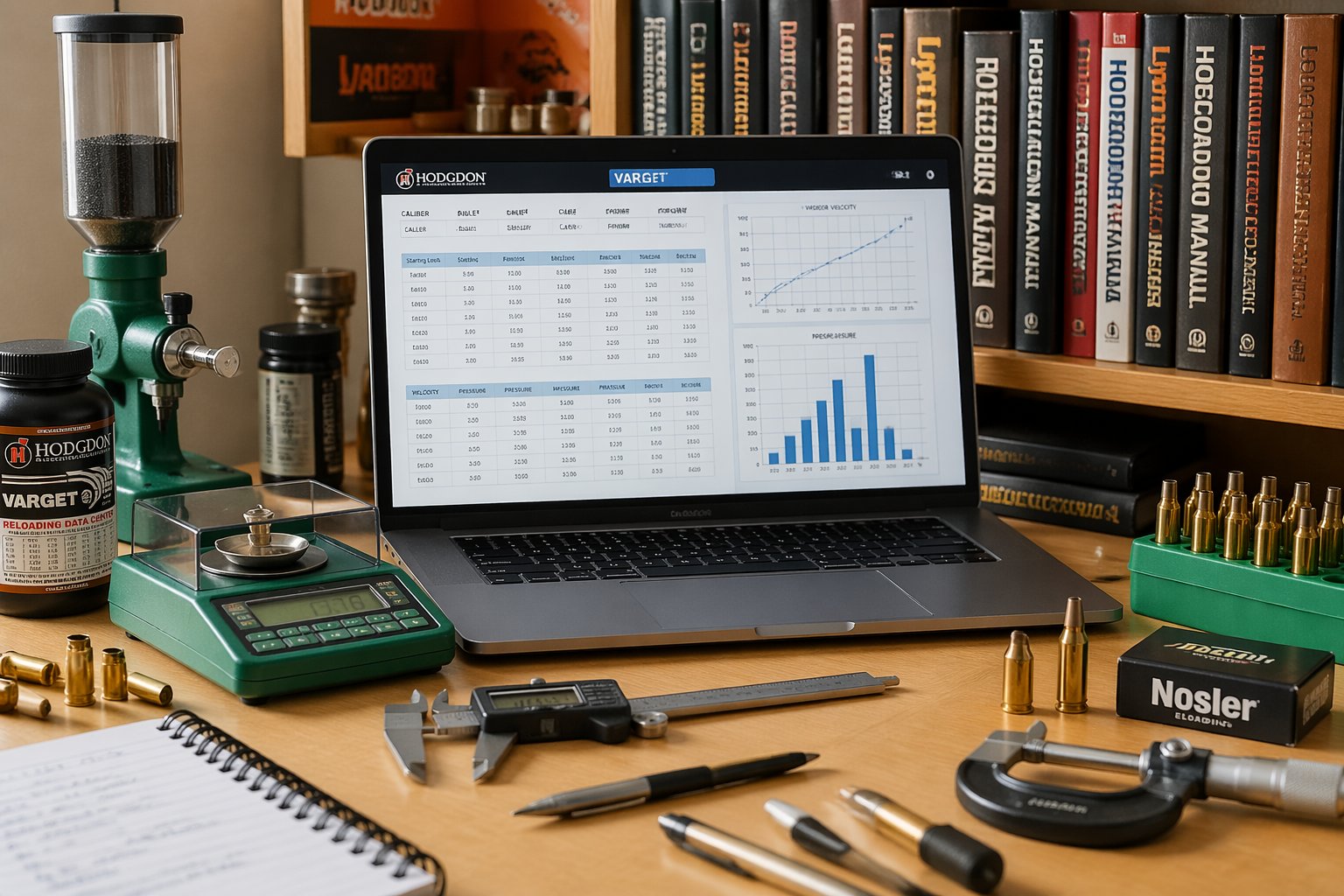
The fastest way to find current Hodgdon load data is through the company’s online tools and current publications. If you are building loads for a new rifle, changing powders, or checking whether older notebook entries are still valid, start with the newest tested data you can access.
Using Hodgdon’s Reloading Data Center
For most reloaders, the best starting point is the official Hodgdon Reloading Data Center. It lets you filter by cartridge or powder, refine categories, and pull current load data for rifle, handgun, and shotshell applications.
At the bench, this matters because online data can reflect updates that an older printed manual will not show. When I cross-check loads, I treat the Data Center as the live reference and my manuals as supporting material.
A good workflow looks like this:
- Search by cartridge first if you know the exact chambering
- Confirm bullet weight and bullet type match closely
- Verify powder name exactly, including similar-sounding variants
- Record starting load, maximum load, overall length, and primer details
- Note the test barrel data if listed
When to Use the Annual Reloading Manual
A current reloading manual still has real value. As noted in coverage of the 2026 Hodgdon Annual Manual, new editions add expanded load data and updated reloading education.
Printed manuals are useful when you want a bench reference that does not depend on a screen. They are also easier to compare across cartridges, especially when you are evaluating several powder options at once.
If you use both, let the newest official listing break any tie.
How Older Data and New Data Differ
Older data can differ from new data for several legitimate reasons. Pressure-testing methods improve, component lots change, bullet designs change, and powder lines evolve over time.
That is why a pet load from 2012 may not align with a current listing. A load that was fine in one rifle with one lot of brass may be warm in another. If your notes and current Hodgdon load data disagree, default to the current tested reloading data and work up again.
Understanding Hodgdon Powder Types
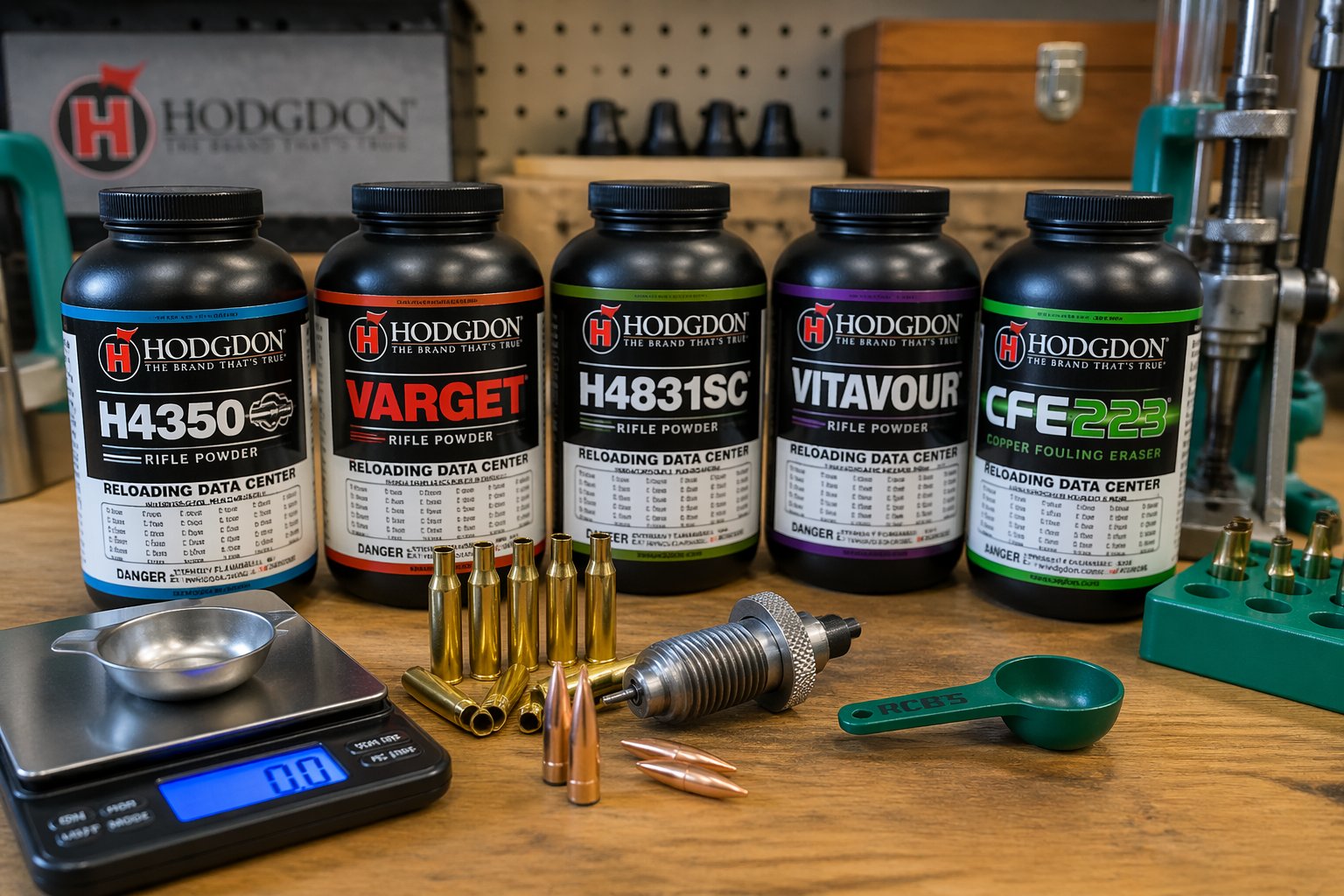
Hodgdon powders cover a wide range of propellants, and the label alone does not tell you everything you need to know. Shape, application, and relative burn rates all affect how a powder meters, ignites, and performs in your load.
Extruded vs. Spherical Propellants
Extruded propellant is usually stick-shaped. It is common in rifle cartridges where consistency and predictable pressure curves matter. Many precision reloaders like extruded powders because they often produce excellent accuracy, even if they do not meter as smoothly through some powder measures.
Spherical propellants, often called ball powders, usually meter more easily. That can be helpful on progressive presses or anytime you are loading larger batches. In practice, I find spherical powders convenient for volume loading, while extruded powders often get the nod when I am chasing a tight vertical spread in a bolt gun.
Pistol powders sit in their own category. Fast pistol powders are designed for short-barrel, lower-capacity applications and should never be treated as interchangeable with rifle propellants.
What Extreme Extruded Powders Are Designed to Do
Hodgdon’s Extreme extruded propellant line is known for stable performance across temperature swings. That is one reason you see powders like Varget and H4350 show up so often in precision rifle conversations.
If you shoot in both winter and summer, this matters. You still need to verify velocity and pressure in your conditions, though temperature-stable does not mean pressure-proof.
Why Burn Rates Matter in Powder Selection
Burn rates help you narrow your list of Hodgdon powders for a cartridge and bullet weight. Faster powders generally suit smaller cases and lighter applications, while slower powders often fit larger cases and heavier bullets.
Use burn rate as a map, not a substitution rule. If you want a quick visual comparison, the Hodgdon 2024 relative burn rate chart is useful for context only.
Top Hodgdon Powders for Precision Rifle Loads
Some Hodgdon powders show up again and again because they have a long record of practical performance. Precision-minded handloaders often settle on these powders because they balance accuracy, consistency, and broad cartridge fit.
Varget for .308 Winchester and .223 Remington
Varget remains one of the most common picks for .308 Winchester and .223 Remington. It has a reputation for stable performance, useful velocity, and very good results with common match bullet weights.
In .308 Winchester, Varget has long been favored with midweight match bullets. In .223 Remington, it often performs well with heavier precision bullets, though exact case fill and seating depth can get tight depending on the bullet and magazine length.
H4350 for 6.5 Creedmoor and .260 Remington
H4350 is one of the first powders many experienced rifle reloaders test in 6.5 Creedmoor and .260 Remington. It often delivers a very workable balance of velocity and low spread with 130- to 147-grain class bullets.
If you are loading for a precision rifle, H4350 is usually worth trying early in the process. It is also one of those powders where lot tracking in your notes is worth the effort.
Retumbo for Magnum Rifle Cartridges
Retumbo is commonly associated with overbore and magnum rifle cartridges where heavy bullets and slower powder columns make sense. It can be a strong fit when you need a slow powder that supports efficient fill and controlled pressure in large-capacity cases.
This is not a powder to improvise with. Stick closely to tested data and watch case fill, compression, and seating depth carefully.
H1000 for Heavy Magnum Bullets
H1000 is another staple in magnum rifle loading, especially with heavy-for-caliber bullets. In cartridges like 7mm Remington Magnum, .300 PRC, and similar cases, it is often one of the first powders checked against official data.
At the bench, H1000 often rewards patience. Small seating changes and minor charge-weight changes can tighten groups noticeably when the bullet and case combination is right.
Hodgdon Benchmark for Small High-Accuracy Cartridges
Hodgdon Benchmark has a strong following in small varmint cartridges and efficient precision rounds. You will see it discussed for the .204 Ruger, .223 Remington, 6mm BR, 22 PPC, and 6mm PPC, especially with light match bullets or smaller-capacity, high-efficiency cases.
For competitive-shooting reloaders, Benchmark is attractive because it can combine good metering with excellent accuracy potential. In small cartridges, that mix is hard to ignore.
Moving Beyond Factory Data: Finding Your Node
Hodgdon’s Reloading Data Center is the safest place to find your starting charge and maximum pressure limits. But factory data is generated in a lab using a universal receiver—not your specific rifle.
Once you have your starting charge from Hodgdon, you need to shoot a velocity ladder with a reliable chronograph to find your rifle’s specific powder node. To calculate the exact internal ballistics, optimize your powder charge, and track your true Standard Deviation (SD), plug your Hodgdon starting data and your chronograph results into LoadForge. LoadForge will help you refine that factory starting point into a precision, single-digit SD load tuned perfectly for your barrel.
Quick-Reference Burn Rate and Use Chart
Burn rates help you place powders in a broad performance neighborhood. They do not tell you safe charge weights, safe substitutions, or guaranteed pressure behavior in your rifle.
| Relative Speed | Typical Use Range | Examples |
|---|---|---|
| Faster | Many pistol powders, some small-capacity rifle applications | HP-38, Titegroup |
| Medium | General rifle and some versatile crossover roles | Benchmark, H4895, Varget |
| Slower | Medium to large rifle cases, heavier bullets | H4350, H4831 |
| Slowest | Magnum rifle cartridges, heavy bullets, large case capacity | H1000, Retumbo |
How to Read a Relative Burn Rate Chart
A burn rate chart ranks propellants from faster to slower. It is best used to compare broad categories, not to swap powders line-for-line.
As noted in a published relative burn rate chart explanation, these charts only place powders in approximate burn rate envelopes. That matches real bench experience. Two powders can sit near each other on a chart and still behave very differently in pressure, density, or ideal charge range.
Popular Hodgdon, IMR, and Winchester Options
Hodgdon Powder Company markets Hodgdon, IMR, and Winchester reloading propellants, so you will often see all three brands when you search official data. Common rifle options include Varget, H4350, H1000, IMR 4064, IMR 4895, and Winchester StaBALL variants, depending on the cartridge.
For handgun use, popular pistol powders may include HP-38, Titegroup, CFE Pistol, and Winchester 231, depending on the load recipes you are evaluating.
If you want a simple comparison tool while planning loads, LoadDevelopment.com’s Burn Rate Chart can help you narrow candidates before you confirm everything against official load data.
When a Similar Burn Rate Is Not a True Substitute
This is where many handloaders get into trouble. Similar burn rates do not mean equal chemistry, equal bulk density, equal temperature behavior, or equal pressure curves.
A powder substitution should only happen when there is tested load data for that exact powder in your cartridge and bullet range. The caution printed with many powder burn rate references is worth treating seriously.
How to Read Load Tables and Build Safe Test Loads
Load tables contain more information than many new handloaders realize. If you read them carefully, they tell you where to begin, what components were used, and where your safety margins can disappear.
Starting Loads, Maximums, and Charge Weights
A starting load is not a suggestion to skip ahead from. It is the tested lower end of that published recipe, and it gives you a controlled place to begin.
A maximum load is not a goal. It is simply the top of the tested listing with the specific components shown. I have seen plenty of rifles shoot their best well below max, especially when the barrel, brass, and bullet combination already fit together well.
A practical work-up for many rifle loads is:
- Start at the published starting charge, or slightly above only if official notes support it
- Increase in small steps, often 0.2 to 0.5 grains depending on cartridge size
- Watch velocity, group shape, and bolt lift together
- Stop immediately if pressure signs appear
Component Matching and Why Exact Details Matter
Load recipes are component-specific. Primer brand, brass manufacturer, bullet construction, and overall length all affect pressure.
A 140-grain bullet is not just a 140-grain bullet. A long monolithic bullet and a short cup-and-core bullet of the same weight can create very different seating depth and case-capacity conditions. This is why you should match the published reloading data as closely as possible.
Pressure Signs and Practical Load Development Steps
Pressure signs are useful, though they are not perfect. Stiff bolt lift, ejector marks, flattened primers, cratered primers, and unusual velocity jumps deserve immediate attention.
You should also use a chronograph if possible. In real load development, a sudden velocity spike often tells you something is changing before the brass makes it obvious. If you want to compare group size more clearly while testing, a simple MOA Calculator, like the one on LoadDevelopment.com, makes your notebook more useful.
Special Considerations for Subsonic Loads
Subsonic loads deserve extra caution. You should never reduce standard rifle data arbitrarily and assume it will remain safe or stable.
Some powders are unsuitable for large reductions, and poor ignition can create dangerous inconsistency. Use only tested subsonic loads when they exist, and verify bullet exit every time during early testing.
Common Questions Reloaders Ask About Hodgdon Data
Most reloaders are not asking for more numbers. They are asking how to trust the numbers, when to stop, and what to do when real-world bench conditions do not match a published table.
Why Manufacturer Data Is Usually Conservative
Manufacturer data is usually conservative because it has to work across many rifles, chambers, brass lots, and environmental conditions. As explained in Hodgdon’s discussion of why test and publish load data, tested data exists to support safe and accurate use of the product.
That conservatism is useful. It gives you room to work up safely in your firearm instead of starting near the edge.
Are Hodgdon, IMR, and Winchester Powders the Same
No. They are marketed under the same corporate umbrella, though they are not all identical powders with different labels.
Some handloaders assume same company means interchangeable products. That is not how you should treat them. Always search the exact powder name in Hodgdon load data before making any change.
What to Do When Your Preferred Powder Is Unavailable
Start by checking official data for alternate powders listed for the same cartridge and bullet weight. Do not chase a substitute based only on rumor, burn-rate proximity, or what happened to work in somebody else’s rifle.
When supply is tight, patience is safer than improvisation. I would rather wait for the right powder or restart with a tested alternative than try to force-fit a near match.
How the Reloading Community Should and Should Not Be Used as a Source
The reloading community is useful for spotting patterns, not for replacing tested data. Forum threads and videos can help you identify powders worth researching, common accuracy nodes, and rifle-specific quirks.
They should not be used as pressure-tested authority. A stranger’s “safe in my rifle” load tells you almost nothing about your chamber, your brass, or your throat length.
Frequently Asked Questions
Where can I find official and up-to-date reloading data for specific cartridges and bullets?
You should start with the official Reloading Data Center from Hodgdon, then verify details against the newest annual manual when needed. Use the exact cartridge, bullet weight, and powder name, and stay as close to the listed components as possible.
How do I interpret the published starting load, maximum load, and overall length for a given recipe?
The starting load is your safe entry point for that tested combination, and the maximum is the top tested charge for the listed components. The published overall length affects case volume and pressure, so changing it can alter performance even when the powder charge stays the same.
What should I change in a load recipe when switching to a different primer, brass, or bullet design?
You should treat any component change as a new load and reduce back toward the published starting range. Brass capacity, primer strength, and bullet shape can all raise or lower pressure in ways that are not obvious from weight alone.
How can I safely work up a load while monitoring pressure signs and maintaining consistent performance?
Increase charge weights in small increments, record velocity with a chronograph, and inspect brass after every step. Consistent case prep, stable seating depth, and careful note-taking matter just as much as watching for flattened primers or stiff bolt lift.
Why might a listed load not match my firearm’s velocity, accuracy, or pressure behavior, and how do I troubleshoot it?
Your chamber, barrel length, throat, brass lot, primer, and even powder lot can change results. Start by checking your component match, measuring seating depth, confirming chronograph setup, and backing down if pressure appears sooner than expected.
What are the safe procedures and limits for reducing or increasing charge weights with common rifle and handgun powders?
You should only reduce or increase charge weights within published data limits for the exact powder and application. Avoid arbitrary reductions for rifle loads, especially when experimenting with subsonic loads, and never exceed listed maximums without pressure-tested data that specifically supports it.

AJ Deysel is a competitive rifle shooter in the PRS and NRL Hunter series, a lifelong hunter, and a recognized ballistics specialist whose load development expertise has been featured by industry leaders like Hornady. He is the founder and lead editor of LoadDevelopment.com. Read more about AJ or view our Editorial & Testing Guidelines.